Frank A. Kafker – författare
Visar alla böcker från författaren Frank A. Kafker. Handla med fri frakt och snabb leverans.
5 produkter
5 produkter
Del 194 - Oxford University Studies in the Enlightenment
Notable encyclopedias of the seventeenth and eighteenth centuries
nine predecessors of the Encyclopédie
Inbunden, Engelska, 1981
1 536 kr
Skickas inom 7-10 vardagar
General encyclopedias illuminate the culture of an era, but they tend to be neglected as a subject of scholarly research. This is especially true for the period from 1674 to 1750. Of the more than thirty encyclopedias published in those years, the contributors to this book examine nine of the most important, paying particular attention to their publishing history, editing, prose style, political and religious views, and contents as books of knowledge. Seven of them – those either in English or French – went into at least five editions. The other two encyclopedias are Johann Heinrich Zedler’s German-language Universal-lexicon, by far the longest European encyclopedia of the period, and Gianfrancesco Pivati’s Nuovo dizionario, the first learned alphabetized Italian encyclopedia to be completed. Also, at least seven of the nine works deserve notice, because they served as models or sources for the Encyclopédie. The epilogue of this study compares the Encyclopédie with the nine predecessors so that the renowned work edited by Diderot and D’Alembert can be more accurately evaluated and appreciated once a previously ignored part of its background is clarified. This book is a companion to Notable encyclopedias of the late eighteenth century: eleven successors of the ‘Encyclopédie’ (SVEC 315, 1994), edited by Frank A. Kafker.
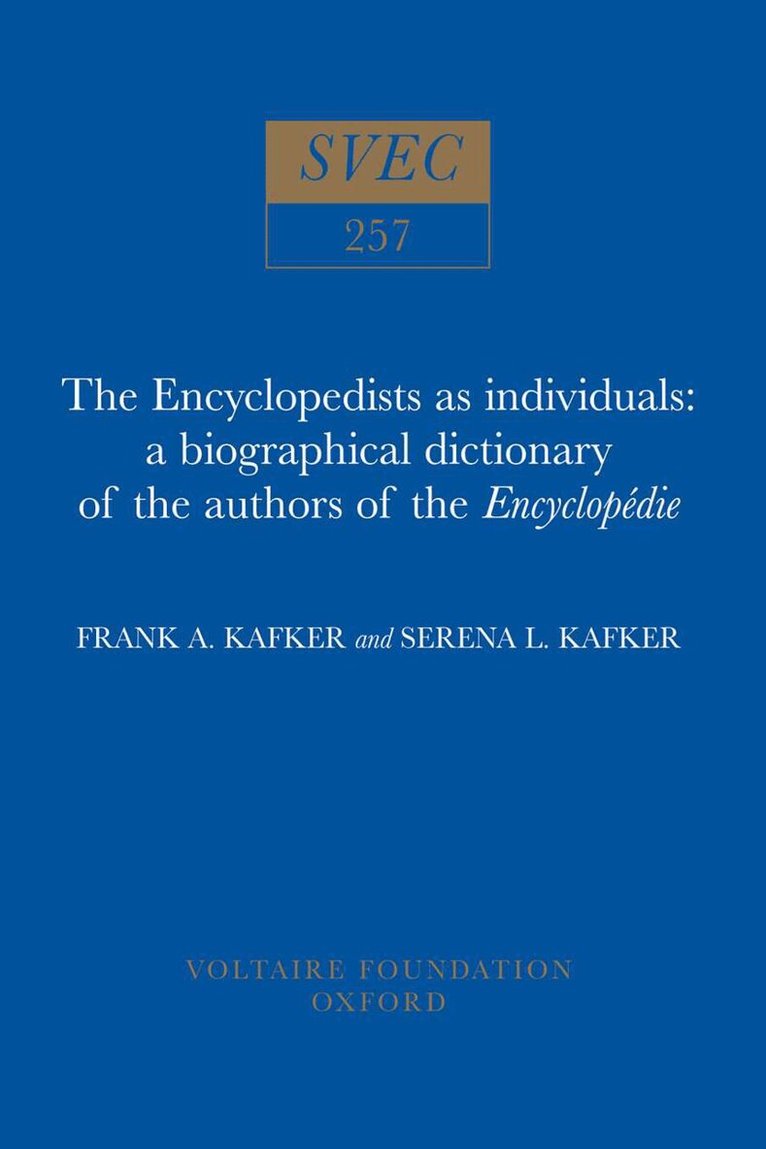
Del 257 - Oxford University Studies in the Enlightenment
Encyclopedists as Individuals
A Biographical Dictionary of the Authors of the 'Encyclopédie'
Inbunden, Engelska, 1988
1 536 kr
Skickas inom 7-10 vardagar
Although the Encyclopédie is one of the landmarks of eighteenth-century thought and one of the most famous encyclopedias of all time, most of its collaborators are scarcely known. This is unfair and misleading: the editors, Diderot and d’Alembert, were able directors and prolific contributors, but they needed the help of many others to complete such an ambitious and trying enterprise.This biological dictionary also seeks to deepen our knowledge of the Encyclopedists. Scholars frequently generalise about the contributors’ social background, politics, religious beliefs, and other matters without being able to speak knowledgeably about many more than a dozen Encyclopedists. But, as we shall see, the Encyclopedists do not lend themselves to stereotypes. They were not a sect of like-minded thinkers, even though contemporaries and later historians believed otherwise. Some of them met at such salons as the baron d’Holbach’s and madame d’Epinay’s or at such learned societies as the Paris Académie royale des sciences or the Académie française; but others did not know each other, and they certainly did not try to co-ordinate policies. Even if they had, they would have failed. These biographical profiles indicate that the Encyclopedists were not united by a common social background, occupation, or ideology.Dissimilarities among the Encyclopedists are not surprising considering how they came to write for the enterprise. At the start, the publishers and their first editor, Jean-Paul de Gua de Malves, recruited people to help them revise and translate Ephraim Chambers’ Cyclopaedia. After Diderot and d’Alembert had assumed the editorship, the work took on a polemical purpose – to reform the Old Regime. But it also remained a general encyclopedia requiring contributors with a knowledge of such non-controversial subjects as the harp, wood engraving, or bridge building. Also, on controversial subjects, the editors accepted contributions that differed from their own opinions. Scholars pursuing research in prosopography, social history, and many facets of the eighteenth century will find something of value in profiles of so many men of letters, clergymen, artisans, physicians, and scientists.
Del 315 - Oxford University Studies in the Enlightenment
Notable encyclopedias of the late eighteenth century
eleven successors of the Encyclopédie
Inbunden, Engelska, 1994
1 536 kr
Skickas inom 7-10 vardagar
General encyclopedias illuminate the culture of an era; yet, except for the first edition of the Encyclopédie, those launched from 1750 to 1800 have received far less attention than the novels, plays, poems, newspapers, and pamphlets of the period. This void in our knowledge is all the more regrettable since the compilation of encyclopedias thrived during the late eighteenth century. In the present work a group of scholars examine eleven notable general encyclopedias of the period, paying particular attention to their publishing history, editing, prose style, political and religious views, and contents as books of knowledge. Each of these works sheds light on a specific time and place as well as the encyclopedia genre. They were published in cities and towns in France, Switzerland, Italy, Scotland, England, the United States, Germany, and Russia, and they reveal much about the intellectual, religious, political, economic, and social life of their respective regions, as well as the extent of the reception and diffusion of the Enlightenment. The new information about these eleven encyclopedias provides the basis for an epilogue that discusses their relationship to Diderot and d’Alembert's renowned Encyclopédie and the extent of that work’s influence on the eighteenth-century encyclopedic tradition. This book is designed as a companion to Notable Encyclopedias of the seventeenth and eighteenth centuries: nine predecessors of the ‘Encyclopédie’, edited by Frank A. Kafker, SVEC 194 (1981).
Del 345 - Oxford University Studies in the Enlightenment
Encyclopedists as a Group
A Collective Biography of the Authors of the 'Encyclopédie'
Inbunden, Engelska, 1996
1 536 kr
Skickas inom 7-10 vardagar
This collective biography examines the similarities and differences among the 140 collaborators identified as having written articles for the seventeen folio volumes of text. It discusses the following topics: the family background, formal education, and occupational choice of the encyclopedists; how and where they were recruited for the Encyclopédie and their compensation; their contributions to the work and wheter they were censored or persecuted or both because of them; their political and religious ideas; their productivity in old age; and, for those who lived past 1789, how they reacted to the French Revolution and the reign of Napoleon.In this book Frank A. kafker challenges a stereotype that has grown up about the Encyclopedits. Many scholars continue a tradition of writing about them as if they were united in a campaign to destroy the Old Regime. But they were, moreover, a varied collection of men of letters, physicians, scientists, craftsmen, scholars, and others, each frequently supporting his own point of view with little central direction. The Encyclopédie became not a party statement but rather a great compendium of knowledge, a mixture of ideas – some progressive and some conservative – filled with contradictions and innovations.
1 792 kr
Skickas inom 7-10 vardagar
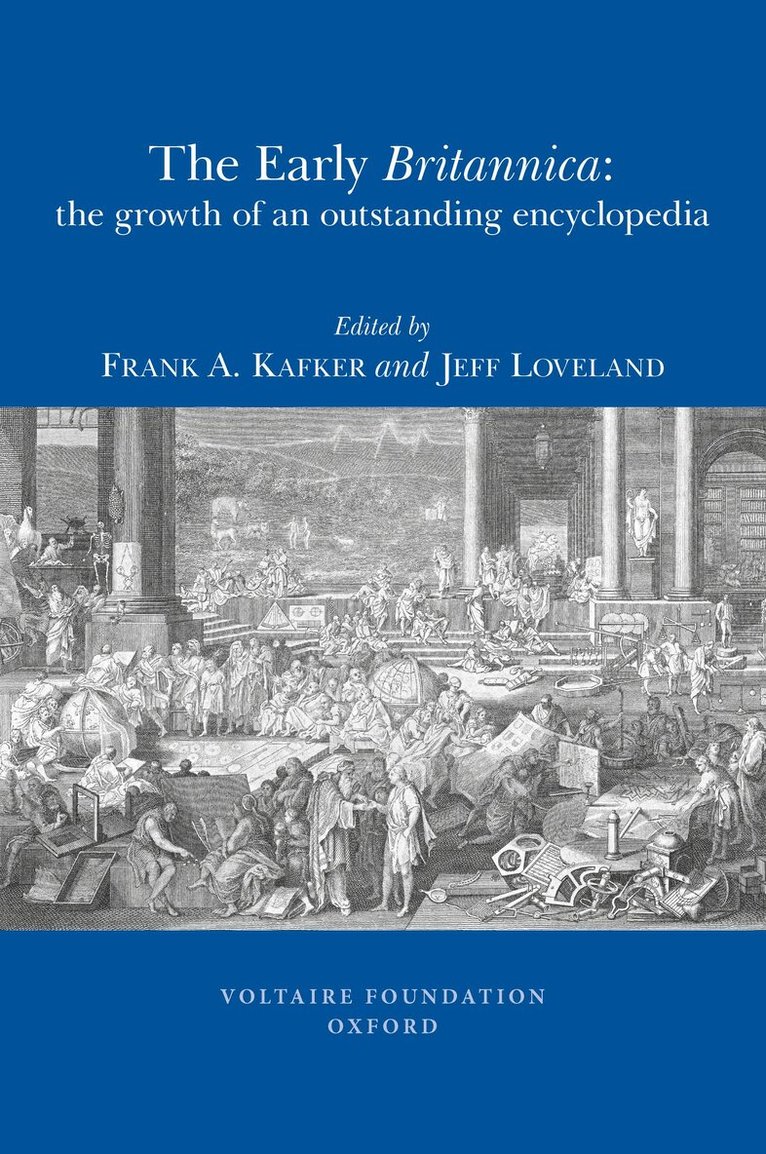
The Encyclopaedia britannica is a familiar cultural icon, but what do we know about the early editions that helped shape it into the longest continuously published encyclopedia still in existence?This first examination of the three eighteenth-century editions traces the Britannica’s extraordinary development into a best seller and an exceptional book of knowledge, especially in biography and in the natural sciences. The combined expertise of the contributors to this volume allows an extensive exploration of each edition, covering its publication history and evolving editorial practices, its commentary on subjects that came in and out of fashion and its contemporary reception. The contributors also examine the cultural and intellectual milieu in which the Britannica flourished, discussing its role in the Scottish Enlightenment and comparing its pressrun, contents, reputation, and influence with those of the much more reform-minded Encyclopédie.