Frank Andre Guridy - Böcker
Visar alla böcker från författaren Frank Andre Guridy. Handla med fri frakt och snabb leverans.
4 produkter
4 produkter
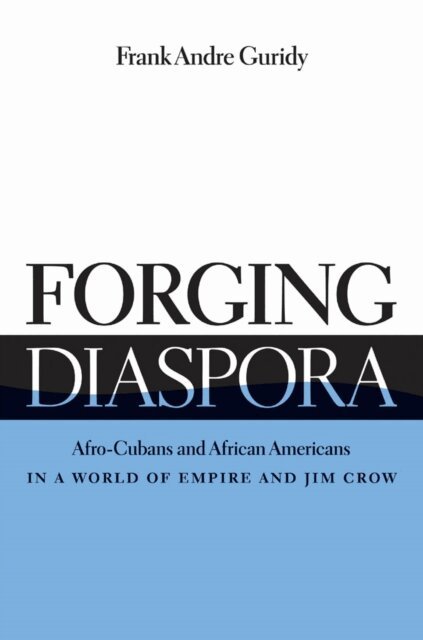
Forging Diaspora
Afro-Cubans and African Americans in a World of Empire and Jim Crow
Häftad, Engelska, 2010
433 kr
Skickas inom 10-15 vardagar
This book attempts to document diaspora among neighbors. Cuba's geographic proximity to the United States and its centrality to U.S. imperial designs following the War of 1898 led to the creation of a unique relationship between Afro-descended populations in the two countries. In ""Forging Diaspora"", Frank Andre Guridy shows that the cross-national relationships nurtured by Afro-Cubans and black Americans helped to shape the political strategies of both groups as they attempted to overcome a shared history of oppression and enslavement. Drawing on archival sources in both countries, Guridy traces four encounters between Afro-Cubans and African Americans. These hidden histories of cultural interaction - of Cuban students attending Booker T. Washington's Tuskegee Institute, the rise of Garveyism, the Havana-Harlem cultural connection during the Harlem Renaissance and Afro-Cubanism movement, and the creation of black travel networks during the Good Neighbor and early Cold War eras - illustrate the significance of cross-national linkages to the ways both Afro-descended populations negotiated the entangled processes of U.S. imperialism and racial discrimination. As a result of these relationships, argues Guridy, Afro-descended people in Cuba and the United States came to identify themselves as part of a transcultural African diaspora.
342 kr
Skickas inom 7-10 vardagar
The story of Texas’s impact on American sports culture during the civil rights and second-wave feminist movements, this book offers a new understanding of sports and society in the state and the nation as a whole.In the 1960s and 1970s, America experienced a sports revolution. New professional sports franchises and leagues were established, new stadiums were built, football and basketball grew in popularity, and the proliferation of television enabled people across the country to support their favorite teams and athletes from the comfort of their homes. At the same time, the civil rights and feminist movements were reshaping the nation, broadening the boundaries of social and political participation. The Sports Revolution tells how these forces came together in the Lone Star State. Tracing events from the end of Jim Crow to the 1980s, Frank Guridy chronicles the unlikely alliances that integrated professional and collegiate sports and launched women’s tennis. He explores the new forms of inclusion and exclusion that emerged during the era, including the role the Dallas Cowboys Cheerleaders played in defining womanhood in the age of second-wave feminism. Guridy explains how the sexual revolution, desegregation, and changing demographics played out both on and off the field as he recounts how the Washington Senators became the Texas Rangers and how Mexican American fans and their support for the Spurs fostered a revival of professional basketball in San Antonio. Guridy argues that the catalysts for these changes were undone by the same forces of commercialization that set them in motion and reveals that, for better and for worse, Texas was at the center of America’s expanding political, economic, and emotional investments in sport.
251 kr
Skickas inom 7-10 vardagar
The story of Texas’s impact on American sports culture during the civil rights and second-wave feminist movements, this book offers a new understanding of sports and society in the state and the nation as a whole.In the 1960s and 1970s, America experienced a sports revolution. New professional sports franchises and leagues were established, new stadiums were built, football and basketball grew in popularity, and the proliferation of television enabled people across the country to support their favorite teams and athletes from the comfort of their homes. At the same time, the civil rights and feminist movements were reshaping the nation, broadening the boundaries of social and political participation. The Sports Revolution tells how these forces came together in the Lone Star State. Tracing events from the end of Jim Crow to the 1980s, Frank Guridy chronicles the unlikely alliances that integrated professional and collegiate sports and launched women’s tennis. He explores the new forms of inclusion and exclusion that emerged during the era, including the role the Dallas Cowboys Cheerleaders played in defining womanhood in the age of second-wave feminism. Guridy explains how the sexual revolution, desegregation, and changing demographics played out both on and off the field as he recounts how the Washington Senators became the Texas Rangers and how Mexican American fans and their support for the Spurs fostered a revival of professional basketball in San Antonio. Guridy argues that the catalysts for these changes were undone by the same forces of commercialization that set them in motion and reveals that, for better and for worse, Texas was at the center of America’s expanding political, economic, and emotional investments in sport.
266 kr
Skickas inom 7-10 vardagar
The sweeping story of the American stadium-from the first wooden ballparks to today's glass and steel mega-arenas-revealing how it has made, and remade, American lifeStadiums are monuments to recreation, sports, and pleasure. Yet from the earliest ballparks to the present, stadiums have also functioned as public squares. Politicians have used them to cultivate loyalty to the status quo, while activists and athletes have used them for anti-fascist rallies, Black Power demonstrations, feminist protests, and much more. In this book, historian Frank Guridy recounts the contested history of play, protest, and politics in American stadiums. From the beginning, stadiums were political, as elites turned games into celebrations of war, banned women from the press box, and enforced racial segregation. By the 1920s, they also became important sites of protest as activists increasingly occupied the stadium floor to challenge racism, sexism, homophobia, fascism, and more. Following the rise of the corporatized stadium in the 1990s, this complex history was largely forgotten. But today's athlete-activists, like Colin Kaepernick and Megan Rapinoe, belong to a powerful tradition in which the stadium is as much an arena of protest as a palace of pleasure. Moving between the field, the press box, and the locker room, this book recovers the hidden history of the stadium and its important role in the struggle for justice in America.