Frank Graziani – författare
Visar alla böcker från författaren Frank Graziani. Handla med fri frakt och snabb leverans.
3 produkter
3 produkter
Del 96 - Lecture Notes in Computational Science and Engineering
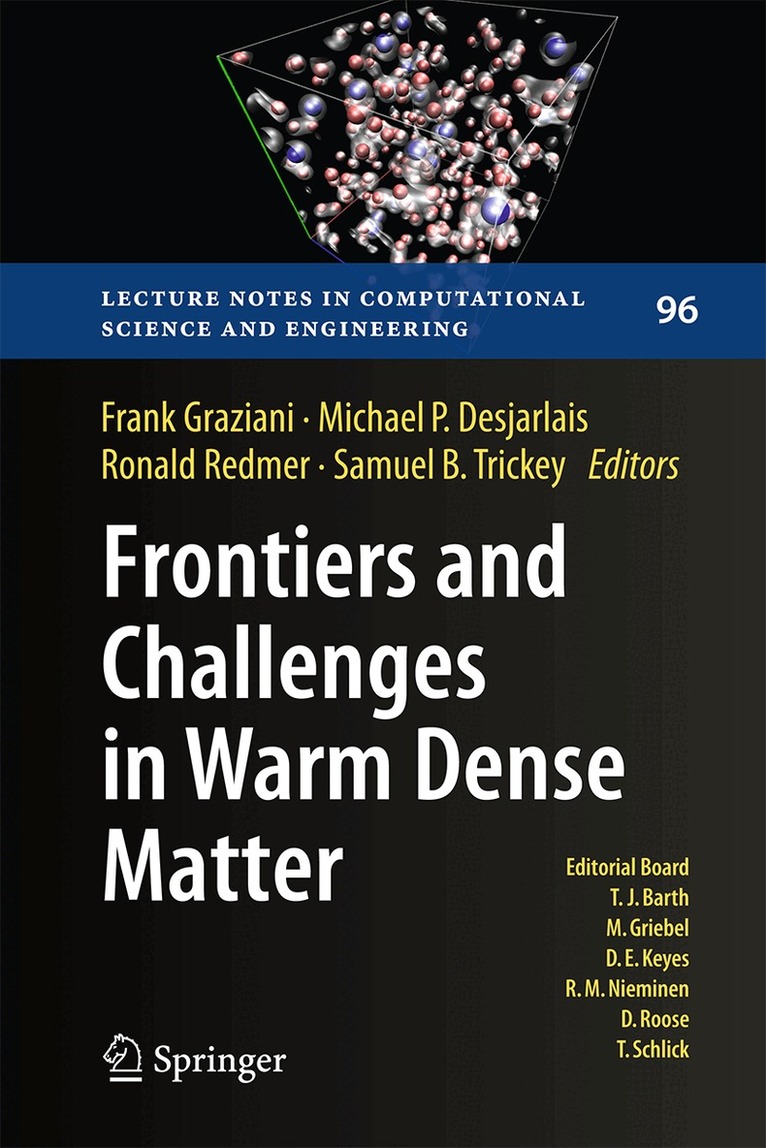
Frontiers and Challenges in Warm Dense Matter
Inbunden, Engelska, 2014
1 589 kr
Skickas inom 10-15 vardagar
Warm Dense Matter (WDM) occupies a loosely defined region of phase space intermediate between solid, liquid, gas, and plasma, and typically shares characteristics of two or more of these phases. WDM is generally associated with the combination of strongly coupled ions and moderately degenerate electrons, and careful attention to quantum physics and electronic structure is essential. The lack of a small perturbation parameter greatly limits approximate attempts at its accurate description. Since WDM resides at the intersection of solid state and high energy density physics, many high energy density physics (HEDP) experiments pass through this difficult region of phase space. Thus, understanding and modeling WDM is key to the success of experiments on diverse facilities. These include the National Ignition Campaign centered on the National Ignition Facility (NIF), pulsed-power driven experiments on the Z machine, ion-beam-driven WDM experiments on the NDCX-II, and fundamental WDM research at the Linear Coherent Light Source (LCLS). Warm Dense Matter is also ubiquitous in planetary science and astrophysics, particularly with respect to unresolved questions concerning the structure and age of the gas giants, the nature of exosolar planets, and the cosmochronology of white dwarf stars. In this book we explore established and promising approaches to the modeling of WDM, foundational issues concerning the correct theoretical description of WDM, and the challenging practical issues of numerically modeling strongly coupled systems with many degrees of freedom.
Del 96 - Lecture Notes in Computational Science and Engineering
Frontiers and Challenges in Warm Dense Matter
Häftad, Engelska, 2016
1 589 kr
Skickas inom 10-15 vardagar
Warm Dense Matter (WDM) occupies a loosely defined region of phase space intermediate between solid, liquid, gas, and plasma, and typically shares characteristics of two or more of these phases. WDM is generally associated with the combination of strongly coupled ions and moderately degenerate electrons, and careful attention to quantum physics and electronic structure is essential. The lack of a small perturbation parameter greatly limits approximate attempts at its accurate description. Since WDM resides at the intersection of solid state and high energy density physics, many high energy density physics (HEDP) experiments pass through this difficult region of phase space. Thus, understanding and modeling WDM is key to the success of experiments on diverse facilities. These include the National Ignition Campaign centered on the National Ignition Facility (NIF), pulsed-power driven experiments on the Z machine, ion-beam-driven WDM experiments on the NDCX-II, and fundamental WDM research at the Linear Coherent Light Source (LCLS). Warm Dense Matter is also ubiquitous in planetary science and astrophysics, particularly with respect to unresolved questions concerning the structure and age of the gas giants, the nature of exosolar planets, and the cosmochronology of white dwarf stars. In this book we explore established and promising approaches to the modeling of WDM, foundational issues concerning the correct theoretical description of WDM, and the challenging practical issues of numerically modeling strongly coupled systems with many degrees of freedom.
Del 62 - Lecture Notes in Computational Science and Engineering
Computational Methods in Transport: Verification and Validation
Häftad, Engelska, 2008
1 062 kr
Skickas inom 10-15 vardagar
In a wide variety of applications, accurate simulation of particle transport is necessary whether those particles be photons, neutrinos, or charged par- cles. For inertial con?nement fusion, where one is dealing with either direct drive through photon or ion beams or indirect drive via thermal photons in a hohlraum, the accurate transport of energy around and into tiny capsules requires high-order transport solutions for photons and electrons. In ast- physics, the life cycle of the stars, their formation, evolution, and death all require transport of photons and neutrinos. In planetary atmospheres, cloud variability and radiative transfer play a key role in understanding climate. These few examples are just a small subset of the applications where an - curate and fast determination of particle transport is required. Computational Methods in Transport Workshop (CMTW) is devoted to providing a forum for interdisciplinary discussions among transport experts from a wide range of science, engineering, and mathematical disciplines. The goal is to advance the ?eld of computational transport by exposing the me- ods used in a particular ?eld to a wider audience, thereby opening channels of communicationbetweenpractitionersinthe ?eld.Theoriginalconceptforthe workshop was born at the SCaLeS (scienti?c case for large scale simulation) meeting held in Washington, DC in June 2003. The discussions at SCaLeS were lively and informative, and it was clear that the opportunity to meet with experts outside of a particular sub?eld created new insights into the problems being discussed.