Frank Hearn - Böcker
Visar alla böcker från författaren Frank Hearn. Handla med fri frakt och snabb leverans.
4 produkter
4 produkter
465 kr
Skickas inom 10-15 vardagar
Drawing upon both classical insights and more recent writings, Hearn provides a compelling account of social breakdown in the United States. The book examines the conditions most responsible for the deterioration of social institutions, notably the family, and of communitarian interdependencies, such as those that support neighborhoods. More specifically, Hearn analyzes the defining forces of liberal modernity--among them, especially, the market economy (favored by the political right) and the democratic welfare state (endorsed by the political left)--whose steady expansion has diminished the social contexts that nurture trust, mutuality, and a robust sense of both personal responsibility and social obligation. The originality of Hearn's book lies in the solutions he proposes, which differ from those rooted in what Hearn calls "the languages of modernity." Hearn advocates modes that would serve instead to renew solidarity and reclaim social virtue, a repertory of strategies that would answer Emile Durkheim's call for the creation of moral individualism. He assesses various approaches to revitalizing the social settings, the social institutions, and communitarian structures within which people become moral individuals capable of care about and taking responsibility for the fates of others. Readers of this book are invited to draw their own conclusions by relying in larger part on themselves as parents, neighbors, community members, and citizen-participants in a civil society in restoration. As the American Journal of Sociology notes, "the book succeeds in its goals, and it deserves to be widely read."Frank Hearn was professor of sociology at the State University of New York, College of Cortland, and the author of Reason and Freedom in Sociological Thought and The Transformation of Industrial Organization.
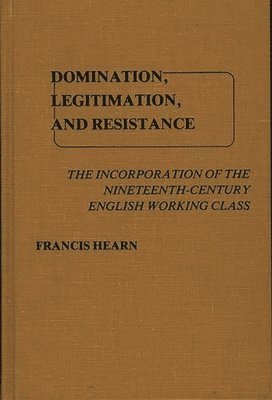
Domination, Legitimation, and Resistance
The Incorporation of the Nineteenth Century English Working Class
Inbunden, Engelska, 1978
1 039 kr
Skickas inom 10-15 vardagar
This work uses the critical theory developed by Herbert Marcuse and Jurgen Habermas to analyze the English working class from 1750 to 1867, in particular its social protest activities.
2 045 kr
Skickas inom 10-15 vardagar
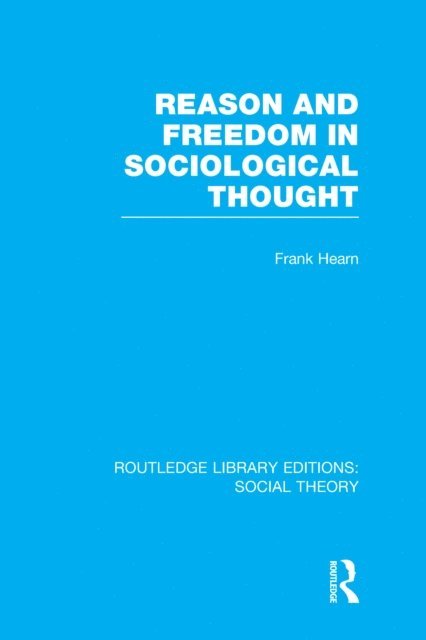
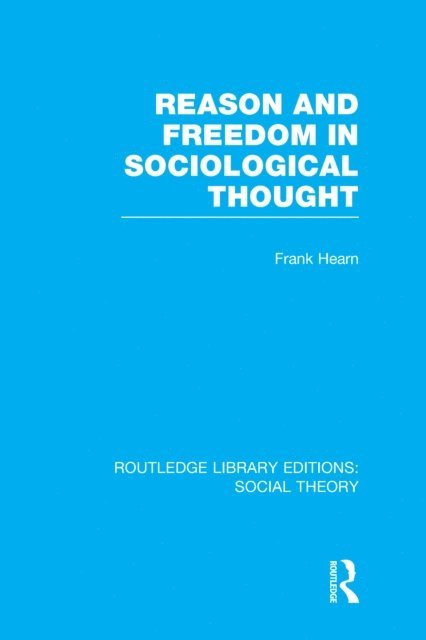
How has reason, believed since the Enlightenment to be the ally of freedom in the search for a better, more humanly satisfying world, been reduced to a technical rationality that has actually impoverished the bases of human freedom? What might be the options and obligations for sociologists who wish to restore reason to its proper status?Working within the tradition of C. Wright Mills and Jurgen Habermas, Frank Hearn sets out to answer these questions. He surveys the treatment of the relation between reason and freedom in both the classical tradition (especially the writings of Saint-Simon, Comte, Durkheim, Marx, Weber, and Freud) and an increasingly significant segment of social thought and criticism (and, for example, in the contrasting visions of Daniel Bell and Christopher Lasch.) He then analyses both the concrete social and historical forms of expression taken by what Mills calls 'rationality without reason' and their impact on individual autonomy and the freedoms associated with democratic politics. Finally, he develops Mills's and Habermas's claims that the cultivation of democratic publics and a critical social theory committed to a vibrant public life are indispensable to the protection and revitalization of the values of reason and freedom and of the practices they entail.This book updates and enriches Mills's influential argument by demonstrating its affinity with critical theory, by showing its contributions to a critical understanding of the classical tradition, and by showing its implications for contemporary social, political, and economic developments.
651 kr
Skickas inom 10-15 vardagar
How has reason, believed since the Enlightenment to be the ally of freedom in the search for a better, more humanly satisfying world, been reduced to a technical rationality that has actually impoverished the bases of human freedom? What might be the options and obligations for sociologists who wish to restore reason to its proper status?Working within the tradition of C. Wright Mills and Jurgen Habermas, Frank Hearn sets out to answer these questions. He surveys the treatment of the relation between reason and freedom in both the classical tradition (especially the writings of Saint-Simon, Comte, Durkheim, Marx, Weber, and Freud) and an increasingly significant segment of social thought and criticism (and, for example, in the contrasting visions of Daniel Bell and Christopher Lasch.) He then analyses both the concrete social and historical forms of expression taken by what Mills calls 'rationality without reason' and their impact on individual autonomy and the freedoms associated with democratic politics. Finally, he develops Mills's and Habermas's claims that the cultivation of democratic publics and a critical social theory committed to a vibrant public life are indispensable to the protection and revitalization of the values of reason and freedom and of the practices they entail.This book updates and enriches Mills's influential argument by demonstrating its affinity with critical theory, by showing its contributions to a critical understanding of the classical tradition, and by showing its implications for contemporary social, political, and economic developments.