Frank W. Brecher - Böcker
Visar alla böcker från författaren Frank W. Brecher. Handla med fri frakt och snabb leverans.
5 produkter
5 produkter
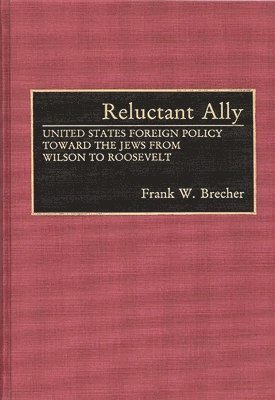
Reluctant Ally
United States Foreign Policy Toward the Jews from Wilson to Roosevelt
Inbunden, Engelska, 1991
1 009 kr
Skickas inom 10-15 vardagar
United States diplomatic policy towards European Jews, Zionists, and Israelis remains vitally important to the stability and international posture of numerous countries. This study traces the evolution of that policy from its roots in isolated responses to post-World War I antisemitism to its coherent statement in the post-World War II era. Topics such as the Jewish minority problem in Europe, the history of U.S.-Zionist relations, and the American response to the Holocaust, often treated separately, are here studied together, and their integral part within U.S. policy emphasized.Told in narrative form, this is the story of the origins of U.S. policy towards European Jews and the Jews' reaction to that policy. Reluctant Ally is a powerful account of how the American outrage at mistreatment of European Jewry joined with the Zionist movement to support the inevitable settling of Palestine. Policy changed rapidly from 1900 to mid-century, and this objective discussion of the various aspects of that development brings many new facts to light and furnishes information that can enhance understanding of current U.S. policy toward Israel as well as the current war in the Middle East.
1 039 kr
Skickas inom 10-15 vardagar
England's capture of Canada in 1760 was the culmination of the French and Indian War and of a century and a half of conflict between Britain and France for control of the North American continent. During that long period, there were several English military efforts to evict the French, but all failed. Therefore, at the war's start, few among the English entertained serious thoughts of totally evicting France from all of Canada. Nor did the French consider such a result a serious possibility. Drawing heavily on primary sources, Brecher tells the dramatic story of why the war's outcome differed so sharply from original expectations. He does so from the vantage point of France, while demonstrating in greater depth than has been available to date the linkages between France's American policy and involvement in the Seven Years' War.Brecher provides an unprecedently full-scale analysis of the political, military, social, and economic conditions of mid-18th-century France and its North American colony, New France. That analysis also examines the direct connection between those internal conditions and the results for France of the war that ended in 1763. In doing so, Brecher assesses France's military strategy and major battles in Europe and America, as well as the diplomatic goals Versailles set for itself in the conduct of the war. Further, he describes why France concurred in leaving not only Canada, but also the vast Louisiana territory, to be divided between England and France's belated wartime ally, Bourbon Spain. Finally, Brecher explains the longer-term implications of the war for North American development and for the future of France. This is an important study for students and scholars of French and colonial American history and for the broad reading public, as well as those interested in the more recent Quebec problem.
1 039 kr
Skickas inom 10-15 vardagar
Brecher explores the controversial diplomacy by which the United States separately brought to a de facto close its War of Independence against the British, leaving its one ally, France, in the lurch. He focuses on the two dominant, ostensibly allied peace negotiators, John Jay and Vergennes.Veteran diplomat and diplomatic history author Frank Brecher follows the chronology of the American War of Independence, alternating between accounts of the conflict as experienced diplomatically and, in less detail, militarily by the Americans and the French, respectively. In doing so, after summarizing in his preface a highly informed and articulate contemporary analysis of the origins of the Revolution from the perspective of the more conservative elements of the American leadership, of whom John Jay was very much a part, Brecher focuses on the particular experiences of Jay and Vergennes, both in their personal lives and in their politial careers. He describes and compares their respective—and quite different—preparations for their historical activities as peace negotiators, and describes the major developments of the conflict itself as they themselves participated in, and analyzed, them.While Vergennes, the French Foreign Minister, for the first time in his career, remained physically stationary in Versailles, Jay, for the first time in his life as well as career, left the New York region to live in Philadelphia, then Madrid, and finally Paris, before returning as Secretary for Foreign Affairs in 1784, after four and a half eventful and personally dramatic years abroad. The lessons each of these two diplomats learned as a result of the crucible through which they had to pass before their very personal—and historically important—encounter in France toward war's end very much affected the negotiating strategies they adopted and the ultimatley paradoxical mixture of both triumph and disappoinment with which they helped bring to a succesful conclusion the military phase of an alliance embarked upon by their two nations some five long years earlier. Brecher presents a provocative view of early American diplomacy that will be of interest to scholars and students alike.
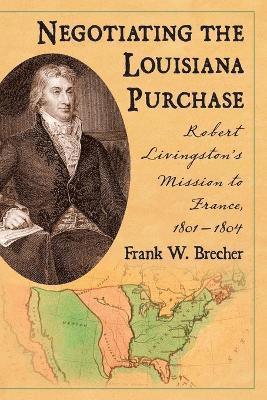
Negotiating the Louisiana Purchase
Robert Livingston's Mission to France, 1801-1804
Häftad, Engelska, 2006
366 kr
Skickas inom 5-8 vardagar
The transaction that changed the course of U.S. history and gave America an undisputed outlet to the Pacific Ocean did not come without a certain amount of trepidation and negotiation. The second half of the 18th century found the newly formed nation with Spain as its primary neighbor. In 1763, after a disastrous war with Britain, France had ceded all of its North American mainland territory to Spain. Through Pinckney's Treaty of 1795, the Spanish guaranteed U.S. access to the Gulf of Mexico via the Mississippi River, providing a trade outlet for the westernmost states. The 1801 discovery of a secret treaty between France and Spain and the resultant possibility of Spain's retrocession of Louisiana to the French sent panic throughout American ranks, pushing the government to quick action to stop this change of neighbors and the possible hostile consequences.This work details the political maneuverings that took place between the United States and France during their negotiations over the Louisiana territory from 1801 to 1804. Through primary sources such as letters and memoranda, the book closely examines the role Robert Livingston, U.S. minister to France, and other politicians played in bringing the issue to a successful conclusion for the United States. Topics discussed include the economic and military ramifications that would have resulted from a French return to North America, the threat of domestic dissension and the ways in which a French Louisiana would have affected the international political landscape. Appendices provide summaries of Livingston's Louisiana memorandum and two Talleyrand-Napoleon memoranda as well as an analysis of Marbois's book on Louisiana.
478 kr
Skickas inom 5-8 vardagar
Events since the end of the Cold War have dashed hopes that the demise of the Soviet Union would ease the Arab-Israeli conflict and help bring about a more stable Middle East--the basic goal of American foreign policy toward that region. Far from that, the past two decades have seen an intensification of regional instability and have added further religious fuel to that conflict. Moreover, we have witnessed major new interventions by such non-Arab states in the region as Iran and Turkey.The consequence of all this for the U.S. is that its long-term policy of seeking credible balance in its relations with the contesting countries is being tested as never before, and at the center of the problem is the need to find a peaceful solution to the imbroglio involving Israel and the Palestinians--an essential ingredient in any overall attainment of America's regional aspirations. There is now a renewed focus on such categories of intra-Palestinian issues as were experienced in 1948 at the inception of the State of Israel, e.g., borders, return of refugees, status of Jerusalem, policy at the U.N., etc. It is the purpose of this book to give a fresh reading to these root issues in the Arab-Israeli conflict, mainly in the light of the most recently available primary sources from the U.S., U.K., Israel and the U.N.