Frauke Sachse - Böcker
Visar alla böcker från författaren Frauke Sachse. Handla med fri frakt och snabb leverans.
3 produkter
3 produkter
355 kr
Skickas inom 5-8 vardagar
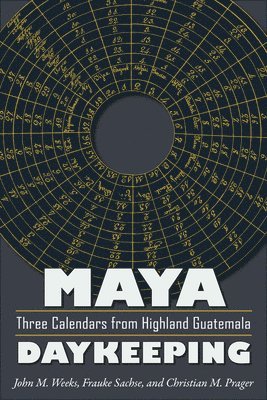
In Maya Daykeeping, three divinatory calendars from highland Guatemala - examples of a Mayan literary tradition that includes the Popul Vuh, Annals of the Cakchiquels, and the Titles of the Lords of Totonicapan - dating to 1685, 1722, and 1855, are transcribed in K'iche or Kaqchikel side-by-side with English translations. Calendars such as these continue to be the basis for prognostication, determining everything from the time for planting and harvest to foreshadowing illness and death. Good, bad, and mixed fates can all be found in these examples of the solar calendar and the 260-day divinatory calendar.The use of such calendars is mentioned in historical and ethnographic works, but very few examples are known to exist. Each of the three calendars transcribed and translated by John M. Weeks, Frauke Sachse, and Christian M. Prager - and housed at the University of Pennsylvania Museum of Archaeology and Anthropology - is unique in structure and content. Moreover, except for an unpublished study of the 1722 calendar by Rudolf Schuller and Oliver La Farge (1934), these little-known works appear to have escaped the attention of most scholars. Introductory essays contextualize each document in time and space, and a series of appendixes present previously unpublished calendrical notes assembled in the early twentieth century.Providing considerable information on the divinatory use of calendars in colonial highland Maya society previously unavailable without a visit to the University of Pennsylvania's archives, Maya Daykeeping is an invaluable primary resource for Maya scholars. Mesoamerican Worlds Series
1 240 kr
Tillfälligt slut
This volume offers an integrated and comparative approach to the Popol Vuh, analyzing its myths to elucidate the ancient Maya past while using multiple lines of evidence to shed light on the text. Combining interpretations of the myths with analyses of archaeological, iconographic, epigraphic, ethnohistoric, ethnographic, and literary resources, the work demonstrates how Popol Vuh mythologies contribute to the analysis and interpretation of the ancient Maya past. The chapters are grouped into four sections. The first section interprets the Highland Maya worldview through examination of the text, analyzing interdependence between deities and human beings as well as the textual and cosmological coherence of the Popol Vuh as a source. The second section analyzes the Precolumbian Maya archaeological record as it relates to the myths of the Popol Vuh, providing new interpretations of the use of space, architecture, burials, artifacts, and human remains found in Classic Maya caves. The third explores ancient Maya iconographic motifs, including those found in Classic Maya ceramic art; the nature of predatory birds; and the Hero Twins’ deeds in the Popol Vuh. The final chapters address mythological continuities and change, reexamining past methodological approaches using the Popol Vuh as a resource for the interpretation of Classic Maya iconography and ancient Maya religion and mythology, connecting the myths of the Popol Vuh to iconography from Preclassic Izapa, and demonstrating how narratives from the Popol Vuh can illuminate mythologies from other parts of Mesoamerica. The Myths of the Popol Vuh in Cosmology, Art, and Ritual is the first volume to bring together multiple perspectives and original interpretations of the Popol Vuh myths. It will be of interest not only to Mesoamericanists but also to art historians, archaeologists, ethnohistorians, iconographers, linguists, anthropologists, and scholars working in ritual studies, the history of religion, historic and Precolumbian literature and historic linguistics. Contributors: Jaime J. Awe, Karen Bassie-Sweet, Oswaldo Chinchilla Mazariegos, Michael D. Coe, Iyaxel Cojtí Ren, Héctor Escobedo, Thomas H. Guderjan, Julia Guernsey, Christophe Helmke, Nicholas A. Hopkins, Barbara MacLeod, Jesper Nielsen, Colin Snider, Karl A. Taube
507 kr
Skickas inom 5-8 vardagar
This volume offers an integrated and comparative approach to the Popol Vuh, analyzing its myths to elucidate the ancient Maya past while using multiple lines of evidence to shed light on the text. Combining interpretations of the myths with analyses of archaeological, iconographic, epigraphic, ethnohistoric, ethnographic, and literary resources, the work demonstrates how Popol Vuh mythologies contribute to the analysis and interpretation of the ancient Maya past. The chapters are grouped into four sections. The first section interprets the Highland Maya worldview through examination of the text, analyzing interdependence between deities and human beings as well as the textual and cosmological coherence of the Popol Vuh as a source. The second section analyzes the Precolumbian Maya archaeological record as it relates to the myths of the Popol Vuh, providing new interpretations of the use of space, architecture, burials, artifacts, and human remains found in Classic Maya caves. The third explores ancient Maya iconographic motifs, including those found in Classic Maya ceramic art; the nature of predatory birds; and the Hero Twins’ deeds in the Popol Vuh. The final chapters address mythological continuities and change, reexamining past methodological approaches using the Popol Vuh as a resource for the interpretation of Classic Maya iconography and ancient Maya religion and mythology, connecting the myths of the Popol Vuh to iconography from Preclassic Izapa, and demonstrating how narratives from the Popol Vuh can illuminate mythologies from other parts of Mesoamerica. The Myths of the Popol Vuh in Cosmology, Art, and Ritual is the first volume to bring together multiple perspectives and original interpretations of the Popol Vuh myths. It will be of interest not only to Mesoamericanists but also to art historians, archaeologists, ethnohistorians, iconographers, linguists, anthropologists, and scholars working in ritual studies, the history of religion, historic and Precolumbian literature and historic linguistics. Contributors: Jaime J. Awe, Karen Bassie-Sweet, Oswaldo Chinchilla Mazariegos, Michael D. Coe, Iyaxel Cojtí Ren, Héctor Escobedo, Thomas H. Guderjan, Julia Guernsey, Christophe Helmke, Nicholas A. Hopkins, Barbara MacLeod, Jesper Nielsen, Colin Snider, Karl A. Taube