Fred Harrison - Böcker
Visar alla böcker från författaren Fred Harrison. Handla med fri frakt och snabb leverans.
10 produkter
10 produkter
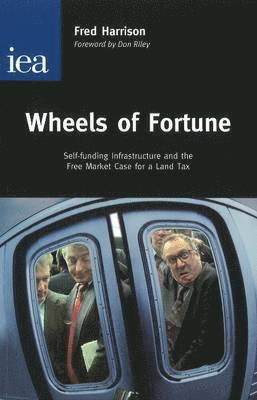
Wheels of Fortune
Self-Funding Infrastructure and the Free Market Case for a Land Tax
Häftad, Engelska, 2006
237 kr
Skickas inom 5-8 vardagar
It is often assumed that government intervention is required to bring to fruition large scale infrastructure projects because the large initial capital outlays such projects require must be funded from the public purse. In "Wheels of Fortune", Fred Harrison shows that large scale infrastructure projects can be made self-funding. Infrastructure projects almost always bring about a large increase in the value of adjoining land. For example, it is estimated that the London Underground Jubilee Line extension increased adjoining land values by close to GBP3 billion. When such infrastructure projects are funded by government, they therefore involve a substantial transfer of wealth from a large number of taxpayers to a small number of property owners. Harrison argues that a fairer and more efficient means to fund infrastructure projects is to capture and use the increases in land values that they bring.
334 kr
Tillfälligt slut
344 kr
Skickas inom 3-6 vardagar
When the first edition appeared in 2005, the consensus among forecasters was that the boom in house prices would cool to an annual 2 or 3% rise over the following years. As predicted by the author, however, prices continued to rise by more than 10% well into 2007. Basing his argument on a study of property markets over the last 200 years, Harrison warns of the danger to banks, business and jobs of ignoring a remarkably regular 18-year cycle. Recent events have proved the accuracy of his prediction. He accuses Gordon Brown of giving people a false sense of security by his oft repeated claim, last made in his 2007 Budget speech, that 'we will never return to the old boom and bust'. Alan Greenspan in the US encouraged a similar belief which led to the risky sub-prime mortgage spree. The reason for the instability, Harrison explains, is not the housing market itself but the land market on which all buildings stand. Land is in fixed supply - as Mark Twain noted: 'They're not making any more of it'.Therefore, as the demand for land for new homes and offices rises with population growth and economic expansion, market forces, which normally increase supply to reduce prices, have the reverse effect: prices rise. This encourages speculation, with banks lending more against escalating asset values and reinforcing the upward spiral. Under existing government policies, the only way land prices can be brought back to affordable levels is a slump, undermining the banking system and causing widespread unemployment and repossessions. This is what happened with the collapse of US sub-prime mortgages. The author argues that monetary policy and bank regulation only have a marginal impact on land speculation. The only way of neutralising the boom bust cycle and creating conditions of economic stability is a fundamental reform of the tax system.
375 kr
Skickas inom 3-6 vardagar
The major industrial nations enter the 1990s in the midst of land booms offering riches for a few but unemployment for many.Banks in TEXAS were bankrupted by massive speculation in real estate. Even embassies had to abandon their offices because they could not afford the rents in TOKYO.In BRITAIN, the spoils from housing - the direct result of the way the land market operates - enriched owner-occupiers but crippled the flow of workers into regions where entrepreneurs wanted to invest and lead the economy back to full-employment.Fred Harrison's thesis is that land speculation is the major cause of depressions. He shows how the land market functions as a junction box which regulates the power flowing between Labour and Capital. And how land speculation periodically throws the switches on the productive power of men and machines, causing economic stagnation.This theory was acknowledged by philosophers such as Adam Smith and Karl Marx, and social reformers ranging from Winston Churchill to Leo Tolstoy, but it has been forgotten by today's economists and policy-makers. The hypothesis is tested against the historical facts and the recent booms and slumps, and is found to offer a powerful explanation for postwar trends in unemployment and the distribution of income.The Power in the Land challenges the pessimistic belief, nurtured by the depressions of the last two decades, that unemployment is now a permanent feature of late 20th century society. The author elaborates policies, based on a radical reform of the tax system, which would banish involuntary unemployment and generate continuous economic growth.Author Details:Fred Harrison is Executive Director for the Land Research Trust. He studied economics at Oxford, first at Ruskin College and then at University College, where he read Philosophy, Politics and Economics. His MSc is from the University of London.Reviews:“This is a brilliantly-written and extremely readable book … not unduly difficult for those with no more than an elementary grasp of economic concepts.” Journal of General Management “Harrison’s book is a formidable challenge to the apologists for the status quo which raises, and goes a long way toward answering, the questions that gnaw at the intellects and consciences of all thinking men and women.” The American Journal of Economics and Sociology“In his book, The Power in the Land, first published in 1983, Harrison, correctly forecast property prices would peak in 1989 as well as the recession that followed it.” The Full Interview with Ed Magnus is available here: www.thisismoney.co.uk (Financial Website of the Year and part of the Daily Mail Group)
103 kr
Skickas inom 5-8 vardagar
174 kr
Skickas inom 5-8 vardagar
174 kr
Skickas inom 5-8 vardagar
299 kr
Skickas
224 kr
Skickas
456 kr
Kommande
What if the poverty, inequality,and instability in modern life are not historical accidents, but thepredictable results of a single act of fraud committed five thousand years agothat has never been fixed? This is the argument made by economist and forecasterFred Harrison. By the time you finish reading, it's hard to disagree.The fraud is elegant in itssimplicity. When people live and work together, they create a surplus — a netincome that belongs to no individual, arising from the community, shared land,and nature. Economists call it rent. For most of human prehistory, communitiesshared this surplus for the common good. Then, with the rise of agriculture andsettled civilisations, chiefs and priests realised they could take rent forthemselves. They did, leading to everything that followed: slavery, empires,the cyclical collapse of societies, and the deep poverty that coexists withgreat wealth — all stemming from that original betrayal.This is not a book about ancienthistory; it's about today. Harrison shows that the fraud still exists in thefinancial systems of every modern state. Governments tax wages and businesses —activities that create wealth — while allowing the value of land and naturalresources to remain in private hands. The result is an economy permanentlytilted against working people, a property market that inflates in regulareighteen-year boom-and-bust cycles (Harrison predicted the 2008 crash years inadvance and identifies 2028 as the next), and severe spatial inequality wherethe gap in healthy life expectancy between the wealthiest and poorest areas ofBritain stretches to eighteen years — determined not by individual choices, butby where the rent flows.The human cost is staggering. InScotland, communities whose land was taken over centuries now face the highestdrug death rate in Europe. In places like Blackpool, life is noticeably shorterand harder than in wealthy London boroughs. Harrison estimates 125,000 peoplein Britain die from preventable causes every year as a direct consequence offiscal choices that could change. These are not distant statistics; theyrepresent neighbours, parents, and children.What makes this book sounsettling is its parallel story of how the fraud became invisible. Harrisonexplains how economists and policymakers who had identified the problem weresidelined or absorbed into a professional culture that removed rent from itsdiscussions — producing a discipline able to debate inequality at great length,yet never quite pinpointing its cause.But history is speeding up. Fiveurgent crises are now converging: political deadlock, ecological collapse, massdisplacement, rising authoritarianism, and the newest and most alarming —artificial intelligence trained on a civilisation's worth of data, all shapedby a culture of cheating. An AI that adopts humanity's current values may seeno reason to keep humanity around.Harrison's solution, One WorldRent, is as ambitious as the diagnosis. He proposes replacing taxes on wageswith charges on the rental value of land and natural resources. Sharing rentsacross borders makes cooperation more profitable than conflict. Pooling globalrents could fund the transition to a sustainable climate. The boom-bust cyclewould vanish. Working people would be freed from fiscal punishment. Theinequalities quietly harming people in post-industrial towns could finallybegin to shrink.Rigorous, compassionate, andfuelled by a controlled fury at what has been allowed to persist for so long,Cheating — The Human Project and Its Betrayal is one of the most ambitiousworks of political economy in a generation — a clear explanation of why theworld is as it is, and a strong case that it doesn't have to remain this way.The Human Project faced betrayalonce. The question this book poses is whether we will allow it to be betrayedagain.