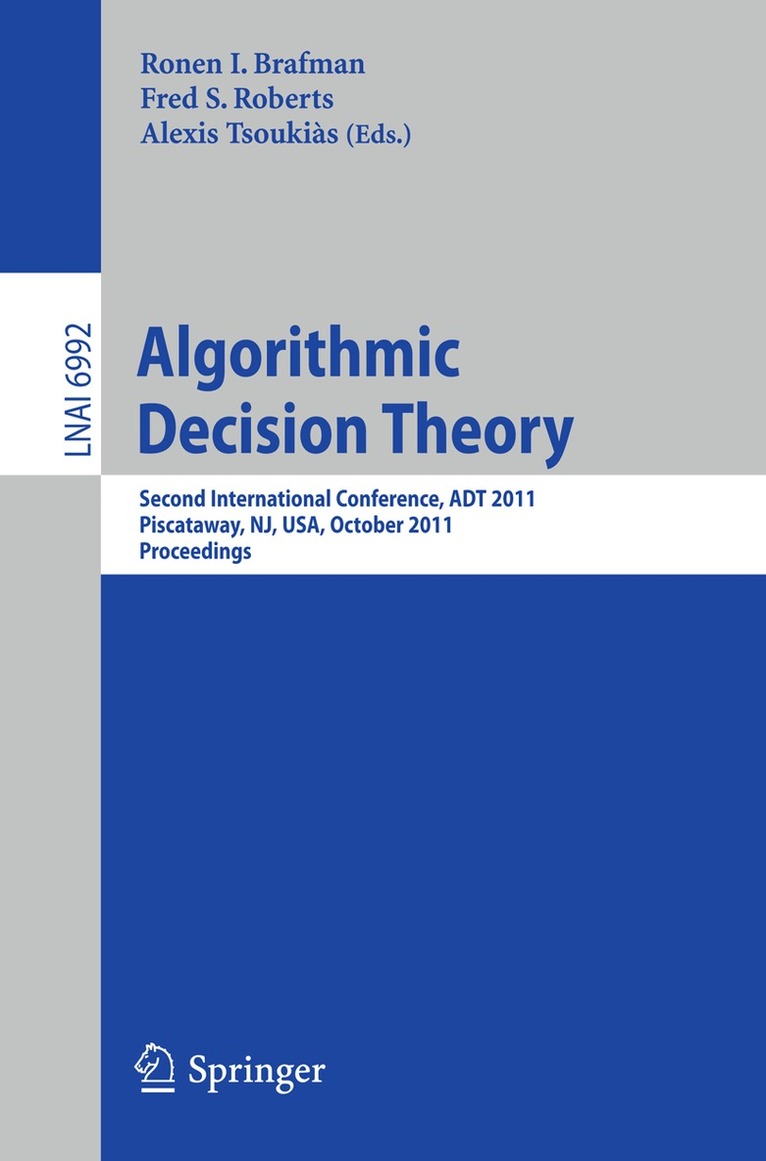
Fred S. Roberts – författare
Measurement Theory: Volume 7
With Applications to Decisionmaking, Utility, and the Social Sciences
1 032 kr
Skickas inom 7-10 vardagar
2 176 kr
Skickas inom 10-15 vardagar
766 kr
Skickas inom 11-20 vardagar
801 kr
Skickas inom 5-8 vardagar
1 826 kr
Skickas inom 10-15 vardagar
2 109 kr
Läs direkt efter köp
2 109 kr
Läs direkt efter köp
809 kr
Skickas inom 10-15 vardagar
930 kr
Läs direkt efter köp
930 kr
Läs direkt efter köp
354 kr
Skickas inom 3-6 vardagar
Mathematics of Planet Earth
Protecting Our Planet, Learning from the Past, Safeguarding for the Future
1 738 kr
Skickas inom 10-15 vardagar
2 149 kr
Läs direkt efter köp
Since its inception in 2013, Mathematics of Planet Earth (MPE) focuses on mathematical issues arising in the study of our planet. Interested in the impact of human activities on the Earth’s system, this multidisciplinary field considers the planet not only as a physical system, but also as a system supporting life, a system organized by humans, and a system at risk.
The articles collected in this volume demonstrate the breadth of techniques and tools from mathematics, statistics, and operations research used in MPE. Topics include climate modeling, the spread of infectious diseases, stability of ecosystems, ecosystem services, biodiversity, infrastructure restoration after an extreme event, urban environments, food security, and food safety. Demonstrating the mathematical sciences in action, this book presents real-world challenges for the mathematical sciences, highlighting applications to issues of current concern to society. Arranged into three topical sections (Geo- and Physical Sciences; Life Sciences, Ecology and Evolution; Socio-economics and Infrastructure), thirteen chapters address questions such as how to measure biodiversity, what mathematics can say about the sixth mass extinction, how to optimize the long-term human use of natural capital, and the impact of data on infrastructure management. The book also treats the subject of infectious diseases with new examples and presents an introduction to the mathematics of food systems and food security.
Each chapter functions as an introduction that can be studied independently, offering source material for graduate student seminars and self-study. The range of featured research topics provides mathematical scientists with starting points for the study of our planet and the impact of human activities. At the same time, it offers application scientists a plethora of modern mathematical tools and techniques to address the various topics in practice. Including hundreds of references to the vast literature associated with each topic, this book serves as an inspiration for further research.
Mathematics of Planet Earth
Protecting Our Planet, Learning from the Past, Safeguarding for the Future
1 738 kr
Skickas inom 10-15 vardagar
Resilience in the Digital Age
676 kr
Skickas inom 10-15 vardagar
865 kr
Läs direkt efter köp
The growth of a global digital economy has enabled rapid communication, instantaneous movement of funds, and availability of vast amounts of information. With this come challenges such as the vulnerability of digitalized sociotechnological systems (STSs) to destructive events (earthquakes, disease events, terrorist attacks). Similar issues arise for disruptions to complex linked natural and social systems (from changing climates, evolving urban environments, etc.). This book explores new approaches to the resilience of sociotechnological and natural-social systems in a digital world of big data, extraordinary computing capacity, and rapidly developing methods of Artificial Intelligence.
Most of the book’s papers were presented at the Workshop on Big Data and Systems Analysis held at the International Institute for Applied Systems Analysis in Laxenburg, Austria in February, 2020. Their authors are associated with the Task Group “Advanced mathematical tools for data-driven applied systems analysis” created and sponsored by CODATA in November, 2018.
The world-wide COVID-19 pandemic illustrates the vulnerability of our healthcare systems, supply chains, and social infrastructure, and confronts our notions of what makes a system resilient. We have found that use of AI tools can lead to problems when unexpected events occur. On the other hand, the vast amounts of data available from sensors, satellite images, social media, etc. can also be used to make modern systems more resilient.
Papers in the book explore disruptions of complex networks and algorithms that minimize departure from a previous state after a disruption; introduce a multigrammatical framework for the technological and resource bases of today’s large-scale industrial systems and the transformations resulting from disruptive events; and explain how robotics can enhance pre-emptive measures or post-disaster responses to increase resiliency. Other papers explore current directions in data processing and handling and principles of FAIRness in data; how the availability of large amounts of data can aid in the development of resilient STSs and challenges to overcome in doing so. The book also addresses interactions between humans and built environments, focusing on how AI can inform today’s smart and connected buildings and make them resilient, and how AI tools can increase resilience to misinformation and its dissemination.
1 727 kr
Skickas inom 10-15 vardagar
2 130 kr
Läs direkt efter köp
1 727 kr
Skickas inom 10-15 vardagar
561 kr
Skickas inom 10-15 vardagar
687 kr
Läs direkt efter köp