William V. Gehrlein - Böcker
Visar alla böcker från författaren William V. Gehrlein. Handla med fri frakt och snabb leverans.
8 produkter
8 produkter
1 170 kr
Skickas inom 10-15 vardagar
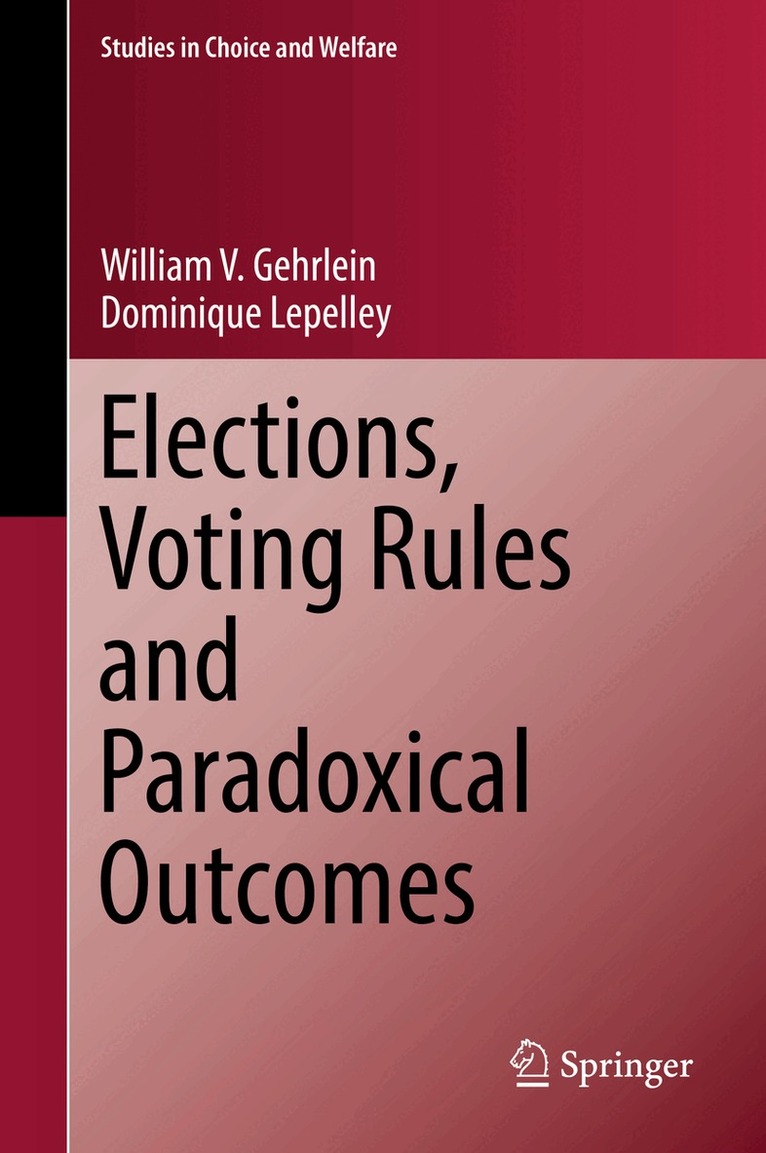
This monograph studies voting procedures based on the probability that paradoxical outcomes like the famous Condorcet Paradox might exist. It is well known that hypothetical examples of many different paradoxical election outcomes can be developed, but this analysis examines factors that are related to the process by which voters form their preferences on candidates that will significantly reduce the likelihood that such voting paradoxes will ever actually be observed. It is found that extreme forms of voting paradoxes should be uncommon events with a small number of candidates. Another consideration is the propensity of common voting rules to elect the Condorcet Winner, which is widely accepted as the best choice as the winner, when it exists. All common voting rules are found to have identifiable scenarios for which they perform well on the basis of this criterion. But, Borda Rule is found to consistently work well at electing the Condorcet Winner, while the other voting rules have scenarios where they work poorly or have a very small likelihood of electing a different candidate than Borda Rule. The conclusions of previous theoretical work are presented in an expository format and they are validated with empirically-based evidence. Practical implications of earlier studies are also developed.
1 170 kr
Skickas inom 10-15 vardagar
This monograph studies voting procedures based on the probability that paradoxical outcomes like the famous Condorcet Paradox might exist.
1 064 kr
Skickas inom 10-15 vardagar
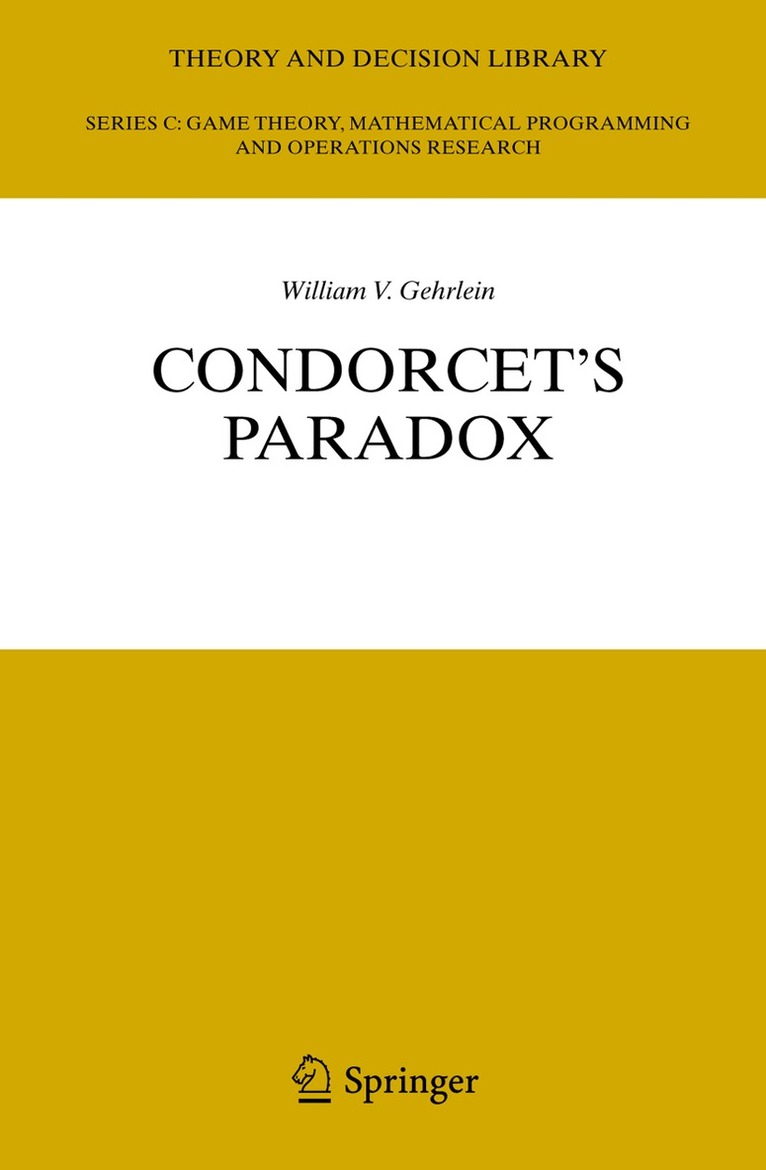
Condorcet’s Paradox has been formally studied by an amazing number of people in many different contexts for more than two centuries. Peter Fishburn introduced the basic notion of the Paradox to me in 1971 during a course in Social Choice Theory at Pennsylvania State University. My immediate response to seeing the simple example that he presented was that this phenomenon certainly could not be very likely to ever be observed in reality. Peter quickly suggested that I should work on developing some representations for the probability that the Paradox might occur, and very soon thereafter that pursuit began. It is only after 35 years of effort, with a lot of help from Peter, that I now feel that a good answer can be given to the challenge that was presented in that classroom in 1971. Many people have suggested to me over the years that a book like this should be completed, since the source material is spread over such a wide variety of disciplines of a- demic journals and books that it is very difficult for people to know what has been done, and has not been done, in this area of determining representations for the probability that Condorcet’s Paradox would ever be observed in reality.
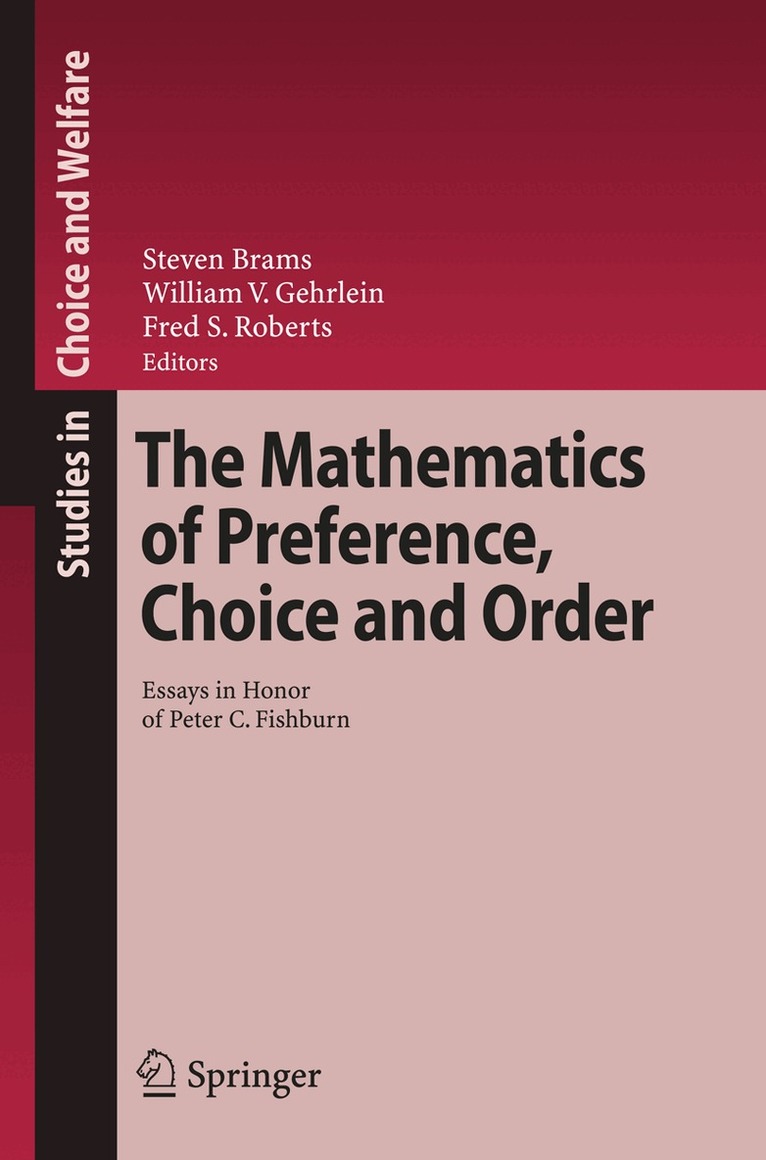
Mathematics of Preference, Choice and Order
Essays in Honor of Peter C. Fishburn
Inbunden, Engelska, 2008
1 682 kr
Skickas inom 10-15 vardagar
Peter Fishburn has had a splendidly productive career that led to path-breaking c- tributions in a remarkable variety of areas of research. His contributions have been published in a vast literature, ranging through journals of social choice and welfare, decision theory, operations research, economic theory, political science, mathema- cal psychology, and discrete mathematics. This work was done both on an individual basis and with a very long list of coauthors. The contributions that Fishburn made can roughly be divided into three major topical areas, and contributions to each of these areas are identi?ed by sections of this monograph. Section 1 deals with topics that are included in the general areas of utility, preference, individual choice, subjective probability, and measurement t- ory. Section 2 covers social choice theory, voting models, and social welfare. S- tion 3 deals with more purely mathematical topics that are related to combinatorics, graph theory, and ordered sets. The common theme of Fishburn’s contributions to all of these areas is his ability to bring rigorous mathematical analysis to bear on a wide range of dif?cult problems.
Voting Paradoxes and Group Coherence
The Condorcet Efficiency of Voting Rules
Inbunden, Engelska, 2010
1 381 kr
Skickas inom 10-15 vardagar
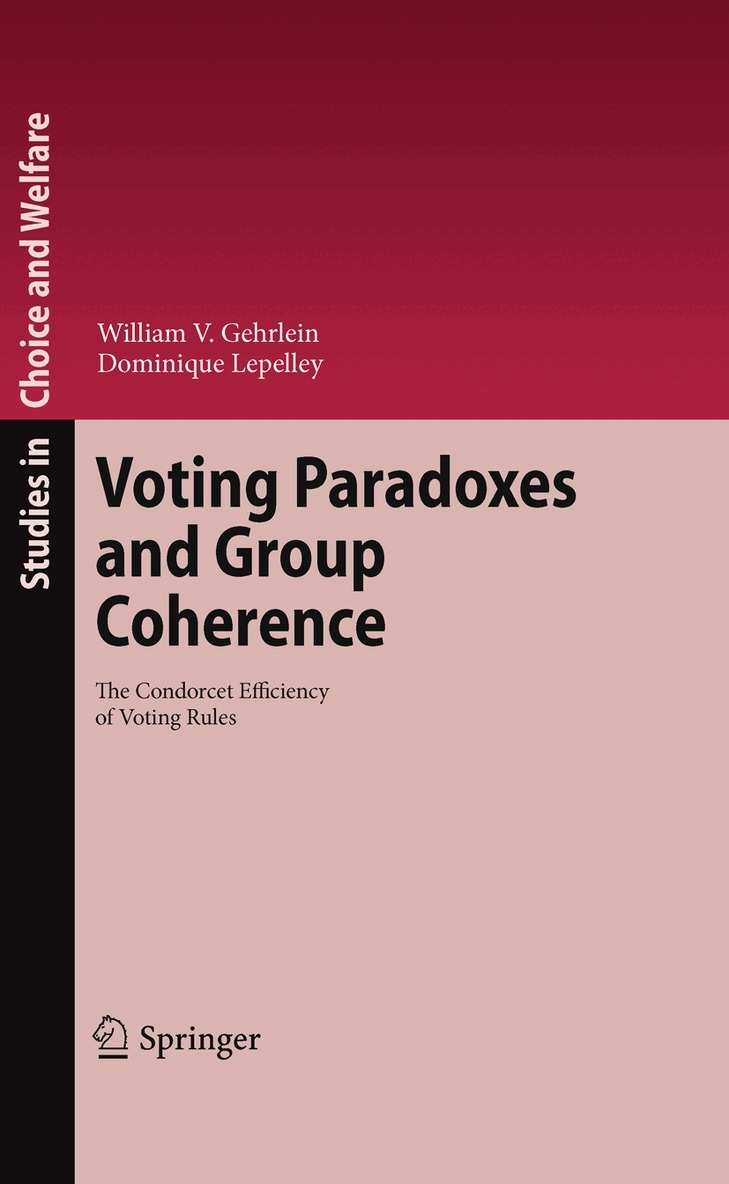
The likelihood of observing Condorcet's Paradox is known to be very low for elections with a small number of candidates if voters’ preferences on candidates reflect any significant degree of a number of different measures of mutual coherence. This reinforces the intuitive notion that strange election outcomes should become less likely as voters’ preferences become more mutually coherent. Similar analysis is used here to indicate that this notion is valid for most, but not all, other voting paradoxes. This study also focuses on the Condorcet Criterion, which states that the pairwise majority rule winner should be chosen as the election winner, if one exists. Representations for the Condorcet Efficiency of the most common voting rules are obtained here as a function of various measures of the degree of mutual coherence of voters’ preferences. An analysis of the Condorcet Efficiency representations that are obtained yields strong support for using Borda Rule.
1 064 kr
Skickas inom 10-15 vardagar
Condorcet’s Paradox has been formally studied by an amazing number of people in many different contexts for more than two centuries. Peter Fishburn introduced the basic notion of the Paradox to me in 1971 during a course in Social Choice Theory at Pennsylvania State University. My immediate response to seeing the simple example that he presented was that this phenomenon certainly could not be very likely to ever be observed in reality. Peter quickly suggested that I should work on developing some representations for the probability that the Paradox might occur, and very soon thereafter that pursuit began. It is only after 35 years of effort, with a lot of help from Peter, that I now feel that a good answer can be given to the challenge that was presented in that classroom in 1971. Many people have suggested to me over the years that a book like this should be completed, since the source material is spread over such a wide variety of disciplines of a- demic journals and books that it is very difficult for people to know what has been done, and has not been done, in this area of determining representations for the probability that Condorcet’s Paradox would ever be observed in reality.
Mathematics of Preference, Choice and Order
Essays in Honor of Peter C. Fishburn
Häftad, Engelska, 2010
1 682 kr
Skickas inom 10-15 vardagar
Peter Fishburn has had a splendidly productive career that led to path-breaking c- tributions in a remarkable variety of areas of research. His contributions have been published in a vast literature, ranging through journals of social choice and welfare, decision theory, operations research, economic theory, political science, mathema- cal psychology, and discrete mathematics. This work was done both on an individual basis and with a very long list of coauthors. The contributions that Fishburn made can roughly be divided into three major topical areas, and contributions to each of these areas are identi?ed by sections of this monograph. Section 1 deals with topics that are included in the general areas of utility, preference, individual choice, subjective probability, and measurement t- ory. Section 2 covers social choice theory, voting models, and social welfare. S- tion 3 deals with more purely mathematical topics that are related to combinatorics, graph theory, and ordered sets. The common theme of Fishburn’s contributions to all of these areas is his ability to bring rigorous mathematical analysis to bear on a wide range of dif?cult problems.
1 381 kr
Skickas inom 10-15 vardagar
The likelihood of observing Condorcet's Paradox is known to be very low for elections with a small number of candidates if voters’ preferences on candidates reflect any significant degree of a number of different measures of mutual coherence. This reinforces the intuitive notion that strange election outcomes should become less likely as voters’ preferences become more mutually coherent. Similar analysis is used here to indicate that this notion is valid for most, but not all, other voting paradoxes. This study also focuses on the Condorcet Criterion, which states that the pairwise majority rule winner should be chosen as the election winner, if one exists. Representations for the Condorcet Efficiency of the most common voting rules are obtained here as a function of various measures of the degree of mutual coherence of voters’ preferences. An analysis of the Condorcet Efficiency representations that are obtained yields strong support for using Borda Rule.