Frederic Kellogg - Böcker
Visar alla böcker från författaren Frederic Kellogg. Handla med fri frakt och snabb leverans.
3 produkter
3 produkter
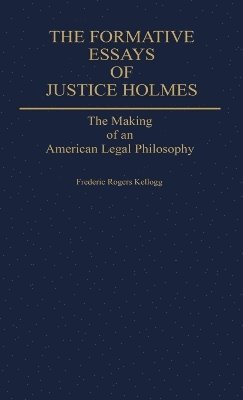
Formative Essays of Justice Holmes
The Making of an American Legal Philosophy
Inbunden, Engelska, 1984
675 kr
Skickas inom 10-15 vardagar
Although The Common Law, the seminal work by Oliver Wendell Holmes, Jr., clearly represents the culmination of an intellectual journey, the development of Holmes' thought has not been easily deciphered. Frederic Rogers Kellogg traces Holmes' intellectual path, and asks: why did Holmes write The Common Law? what did he mean by his message that the law has evolved away from moral and toward external standards of liability? how did he arrive at this conclusion? The answers, Dr. Kellogg maintains, are to be found in a series of nine essays that originally appeared in The American Law Review. They show that Holmes was obsessed with elemental questions of pure legal theory and link him closely to the philosophic method of his friend Charles Sanders Peirce. Taken together with Holmes' later work, and viewed in light of American philosophy, these essays establish Holmes as the founder of a distinct approach to jurisprudence and reveal the implications of that approach for Holmes' later contributions to constitutional law.
1 142 kr
Skickas inom 10-15 vardagar
Pragmatism, Logic and Law offers a view of legal pragmatism consistent with pragmatism writ large, tracing it from origins in late 19th century America to the present, covering various issues, legal cases, personalities, and relevant intellectual movements within and outside law. It addresses pragmatism’s relation to legal liberalism, legal positivism, natural law, critical legal studies (CLS), and post-Rorty “neopragmatism.” It views legal pragmatism as an exemplar of pragmatism’s general contribution to logical theory, which bears two connections to the western philosophical tradition: first, it extends Francis Bacon’s empiricism into contemporary aspects of scientific and legal experience, and second, it is an explicitly social reconstruction of logical induction. Both notions were articulated by John Dewey, and both emphasize the social or corporate element of human inquiry. Empiricism is informed by social as well as individual experience (which includes the problems of conflict and consensus). Rather than following the Aristotelian model of induction as immediate inference from particulars to generals, a model that assumes a consensual objective viewpoint, pragmatism explores the actual, and extended, process of corporate inference from particular experience to generalization, in law as in science. This includes the necessary process of resolving disagreement and finding similarity among relevant particulars.
488 kr
Skickas inom 10-15 vardagar
Pragmatism, Logic and Law offers a view of legal pragmatism consistent with pragmatism writ large, tracing it from origins in late 19th century America to the present, covering various issues, legal cases, personalities, and relevant intellectual movements within and outside law. It addresses pragmatism’s relation to legal liberalism, legal positivism, natural law, critical legal studies (CLS), and post-Rorty “neopragmatism.” It views legal pragmatism as an exemplar of pragmatism’s general contribution to logical theory, which bears two connections to the western philosophical tradition: first, it extends Francis Bacon’s empiricism into contemporary aspects of scientific and legal experience, and second, it is an explicitly social reconstruction of logical induction. Both notions were articulated by John Dewey, and both emphasize the social or corporate element of human inquiry. Empiricism is informed by social as well as individual experience (which includes the problems of conflict and consensus). Rather than following the Aristotelian model of induction as immediate inference from particulars to generals, a model that assumes a consensual objective viewpoint, pragmatism explores the actual, and extended, process of corporate inference from particular experience to generalization, in law as in science. This includes the necessary process of resolving disagreement and finding similarity among relevant particulars.