Frédéric Ogée - Böcker
Visar alla böcker från författaren Frédéric Ogée. Handla med fri frakt och snabb leverans.
3 produkter
3 produkter
Del 357 - Oxford University Studies in the Enlightenment
Dumb Show
Image and Society in the Works of William Hogarth
Inbunden, Engelska, 1997
1 586 kr
Skickas inom 7-10 vardagar
During the first half of the eighteenth century in England the ‘forces of progress’ became increasingly conservative as their grip on power was confirmed. Hogarth’s position as the promoter of an authentically English art was therefore ambiguous, considering his origins, the intellectual milieu in which he moved, and the necessity he was under of defending his endeavours against attacks from all sides. The essays in this volume examine this ambiguity, and draw a composite picture of an exceptionally gifted artist, whose social and artistic involvement engaged him in a permanent search for the ‘line of beauty’, which he found only in a progressive weaving between centre and margins. In pictorial terms, this ambivalence may well account for the ‘dramatic’ proliferation which is one of the most remarkable characteristics of Hogarth’s art. His ‘stage’, where his men and women, his ‘players’, were to ‘exhibit a dumb show’, was a busy crossroads of ideas and influences. The richness and ambivalence of his pictures result from his boldest artistic originality: his adoption of a polycentric stage, on which the ‘dumb show’ exhibited by his ‘players’ offers concomitant areas of meaning. Moreover, they invite the beholder to a serpentine act of deciphering and verbalisation which the essays in this volume both describe and materialise. Each from a different perspective – social, artistic, formal, philosophical – explores the characteristics and raison d’etre of that polycentrism in Hogarth’s art. Linked thematically to each other, the essays combine to assess the true nature of Hogarth’s variety and show the critical consequences of its essential ambivalent sinuosity.
1 771 kr
Skickas inom 7-10 vardagar
The shift in the interpretation of eighteenth-century European culture over the last century provokes the questions: what meaning can be ascribed to that notion at the beginning of the twenty-first century? and how should we see Diderot’s response to it?This collection of essays re-examines Diderot’s uniquely rich relationship with the intellectual life of European nations, and his crucial role in focusing, connecting and spreading its many strands. While sharing certain Eurocentric prejudices, he held a more liberated view of a common humanity and the universal nature of human aspirations. These essays explore his interest in those hybrid, borderline zones, where systems, hierarchies, and national or disciplinary boundaries come under productive stress. What emerges is the irreducibility of his writing, which resists incorporation into any officially sanctioned canon. The Diderot being created by today’s scholars is truly protean, not so much French, or even European, as global, a cultural icon for the modern age.
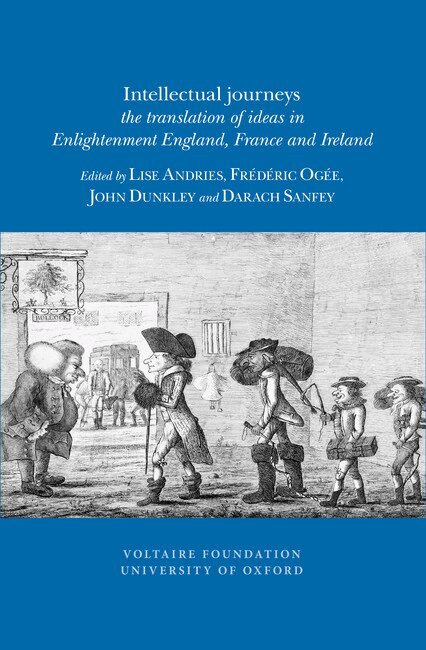
Intellectual Journeys
The Translation of Ideas in Enlightenment England, France and Ireland
Häftad, Engelska, 2013
1 540 kr
Skickas inom 7-10 vardagar
The exchange of ideas between nations during the Enlightenment was greatly facilitated by cultural ventures, commercial enterprise and scientific collaboration. But how were they exchanged? What were the effects of these exchanges on the idea or artefact being transferred?Focussing on contact between England, France and Ireland, a team of specialists explores the translation, appropriation and circulation of cultural products and scientific ideas during the Enlightenment. Through analysis of literary and artistic works, periodicals and official writings contributors uncover:the key role played by literary translators and how they adapted, naturalized and sometimes distorted plays and novels to conform to new cultural norms;the effects of eighteenth-century anglomania, and how this was manifested in French art;how the vagaries of international politics and conflict affected both the cultural products themselves and the modes of dissemination;how religious censorship engendered new Irish Catholic and French Huguenot diasporas, with their particular intellectual pursuits and networks of exchange;the significance of newspapers and periodicals in disseminating new knowledge and often radical philosophical ideas.By exploring both broad areas of cultural activity and precise examples of cultural transfer, contributors to Intellectual journeys reveal the range and complexity of intellectual exchange and its role in the formation of a truly transnational Enlightenment.