Frederick F. Schmitt - Böcker
Visar alla böcker från författaren Frederick F. Schmitt. Handla med fri frakt och snabb leverans.
7 produkter
7 produkter
1 461 kr
Skickas inom 5-8 vardagar
Frederick F. Schmitt offers a systematic interpretation of David Hume's epistemology, as it is presented in the indispensable A Treatise of Human Nature. Hume's text alternately manifests scepticism, empiricism, and naturalism in epistemology. Interpretations of his epistemology have tended to emphasise one of these apparently conflicting positions over the others. But Schmitt argues that the positions can be reconciled by tracing them to a single underlying epistemology of knowledge and probability quietly at work in the text, an epistemology according to which truth is the chief cognitive merit of a belief, and knowledge and probable belief are species of reliable belief. Hume adopts Locke's dichotomy between knowledge and probability and reassigns causal inference from its traditional place in knowledge to the domain of probability--his most significant departure from earlier accounts of cognition. This shift of causal inference to an associative and imaginative operation raises doubts about the merit of causal inference, suggesting the counterintuitive consequence that causal inference is wholly inferior to knowledge-producing demonstration. To defend his associationist psychology of causal inference from this suggestion, Hume must favourably compare causal inference with demonstration in a manner compatible with associationism. He does this by finding an epistemic status shared by demonstrative knowledge and causally inferred beliefs--the status of justified belief. On the interpretation developed here, he identifies knowledge with infallible belief and justified belief with reliable belief, i.e., belief produced by truth-conducive belief-forming operations. Since infallibility implies reliable belief, knowledge implies justified belief. He then argues that causally inferred beliefs are reliable, so share this status with knowledge. Indeed Hume assumes that causally inferred beliefs enjoy this status in his very argument for associationism. On the reliability interpretation, Hume's accounts of knowledge and justified belief are part of a broader veritistic epistemology making true belief the chief epistemic value and goal of science. The veritistic interpretation advanced here contrasts with interpretations on which the chief epistemic value of belief is its empirical adequacy, stability, or fulfilment of a natural function, as well as with the suggestion that the chief value of belief is its utility for common life. Veritistic interpretations are offered of the natural function of belief, the rules of causal inference, scepticism about body and matter, and the criteria of justification. As Schmitt shows, there is much attention to Hume's sources in Locke and to the complexities of his epistemic vocabulary.
2 088 kr
Skickas inom 10-15 vardagar
Knowledge, from Plato onwards, has been considered in relation to justified belief. Current debate has centred around the nature of the justification and whether justified belief can be considered an internal or extenal matter. Epistemological internalists argue that the subject must be able to reflect upon a belief to complete the process of justification. The externalists, on the other hand, claim that it is only necessary to consider whether the belief is reliably formed, and argue that the ability to know by reflection is not required for a justified belief.In the historical section of this book the three most important epistemologists, Plato, Descartes and Hume, as well as the ancient epistemologies of the stoics, Academics and Pyrhonians, are considered. In reconsidering the history of epistemology the author is led to argue against hte view that internalism is historically dominant. His critique of internalism is then developed into a sustained argument against many of its forms, and he goes onto defend an externalist, reliabilist epistemology.
766 kr
Skickas inom 10-15 vardagar
Knowledge, from Plato onwards, has been considered in relation to justified belief. Current debate has centred around the nature of the justification and whether justified belief can be considered an internal or extenal matter. Epistemological internalists argue that the subject must be able to reflect upon a belief to complete the process of justification. The externalists, on the other hand, claim that it is only necessary to consider whether the belief is reliably formed, and argue that the ability to know by reflection is not required for a justified belief.In the historical section of this book the three most important epistemologists, Plato, Descartes and Hume, as well as the ancient epistemologies of the stoics, Academics and Pyrhonians, are considered. In reconsidering the history of epistemology the author is led to argue against hte view that internalism is historically dominant. His critique of internalism is then developed into a sustained argument against many of its forms, and he goes onto defend an externalist, reliabilist epistemology.
1 502 kr
Skickas inom 7-10 vardagar
The classic and contemporary readings in this collection represent the four most influential theories of truth – correspondence, pragmatist, coherence, and deflationary theories. A collection of classic and contemporary philosophical reflections on the nature of truth.Opens with an introduction to theories of truth, designed for readers with little or no prior knowledge of the subject.Divided into four sections on the most important theories of truth - correspondence, pragmatist, coherence, and deflationary theories.Brings together articles in the recent debate over the correspondence theory and deflationism that are not otherwise available in one place.Includes contributions by C.S. Peirce, William James, Bertrand Russell, Alfred Tarski, Hartry Field, Dorothy Grover, Anil Gupta and others.Concludes with an extensive bibliography of recent articles on truth.
467 kr
Skickas inom 7-10 vardagar
The classic and contemporary readings in this collection represent the four most influential theories of truth – correspondence, pragmatist, coherence, and deflationary theories. A collection of classic and contemporary philosophical reflections on the nature of truth.Opens with an introduction to theories of truth, designed for readers with little or no prior knowledge of the subject.Divided into four sections on the most important theories of truth - correspondence, pragmatist, coherence, and deflationary theories.Brings together articles in the recent debate over the correspondence theory and deflationism that are not otherwise available in one place.Includes contributions by C.S. Peirce, William James, Bertrand Russell, Alfred Tarski, Hartry Field, Dorothy Grover, Anil Gupta and others.Concludes with an extensive bibliography of recent articles on truth.
742 kr
Skickas inom 10-15 vardagar
Human life is conducted within a network of social relations, social groups, and societies. Grasping the implications of that fact starts with understanding social metaphysics. Social metaphysics provides a foundation for social theory, as well as for social epistemology, philosophy of language, philosophy of mind, action theory, ethics, and political philosophy. This volume will interest anyone concerned with mind, action, or the foundations of social theory.Socializing Metaphysics supplies diverse answers, from a broad array of voices, to the basic questions of social metaphysics. What is it for human beings to stand in social relations or form social groups? Do these relations and groups bring about something above and beyond the individuals involved? Is there any sense to the notion of a human being apart from social relations? How can an individual achieve autonomy within a society? In what sense are human kinds like race and gender socially constructed? The answers are found within.
808 kr
Skickas inom 10-15 vardagar
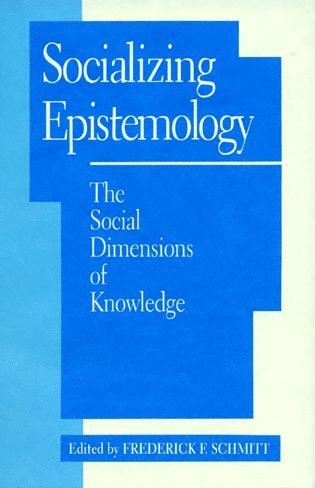
In this wide-ranging collection of never before published essays, distinguished scholars in the fields of philosophy and economics examine such questions as whether testimony is a basic source of knowledge, the degree to which notions of a good argument are determined by speakers and their audiences, the role of individual biases in the development of science, and the social aspects of group belief and group justification. The collection ends with the first comprehensive bibliography of social epistemology.