Fritzsch Harald - Böcker
Visar alla böcker från författaren Fritzsch Harald. Handla med fri frakt och snabb leverans.
7 produkter
7 produkter
Del 40 - World Scientific Series In 20th Century Physics
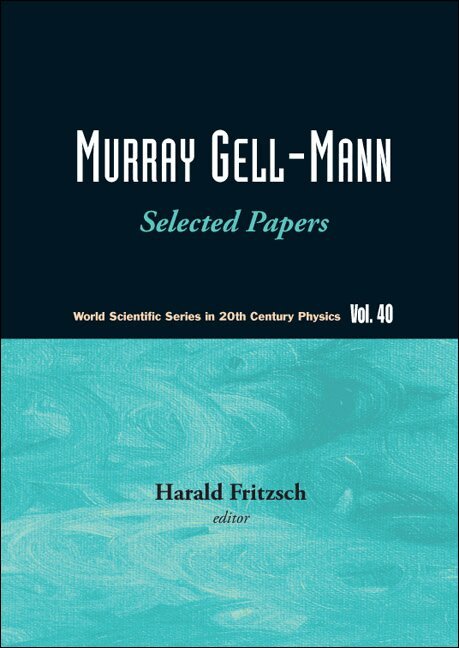
Murray Gell-mann - Selected Papers
Inbunden, Engelska, 2010
2 261 kr
Skickas inom 5-8 vardagar
Murray Gell-Mann is one of the leading physicists of the world. He was awarded the Nobel Prize in Physics in 1969 for his work on the classification and symmetries of elementary particles, including the approximate SU(3) symmetry of hadrons. His list of publications is impressive; a number of his papers have become landmarks in physics. In 1953, Gell-Mann introduced the strangeness quantum number, conserved by the strong and electromagnetic interactions but not by the weak interaction. In 1954 he and F E Low proposed what was later called the renormalization group. In 1958 he and R P Feynman wrote an important article on the V-A theory of the weak interaction. In 1961 and 1962 he described his ideas about the SU(3) symmetry of hadrons and its violation, leading to the prediction of the Ω- particle. In 1964 he proposed the quark picture of hadrons. In 1971 he and H Fritzsch proposed the exactly conserved “color” quantum number and in 1972 they discussed what they later called quantum chromodynamics (QCD), the gauge theory of color. These major publications and many others are collected in this volume, providing physicists with easy access to much of Gell-Mann's work. Some of the articles are concerned with his recollections of the history of elementary particle physics in the third quarter of the twentieth century.
2 168 kr
Skickas inom 5-8 vardagar
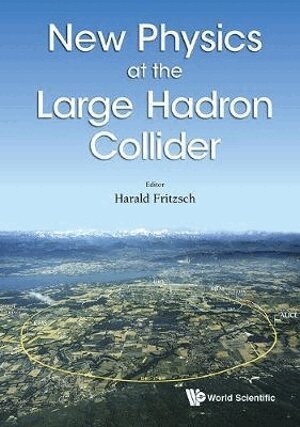
The Standard Theory of Particle Physics describes successfully the observed strong and electroweak interactions, but it is not a final theory of physics, since many aspects are not understood: (1) How can gravity be introduced in the Standard Theory? (2) How can we understand the observed masses of the leptons and quarks as well as the flavor mixing angles? (3) Why are the masses of the neutrinos much smaller than the masses of the charged leptons? (4) Is the new boson, discovered at CERN, the Higgs boson of the Standard Theory or an excited weak boson? (5) Are there new symmetries at very high energy, e.g. a broken supersymmetry? (6) Are the leptons and quarks point-like or composite particles? (7) Are the leptons and quarks at very small distances one-dimensional objects, e.g. superstrings? This proceedings volume comprises papers written by the invited speakers discussing the many important issues of the new physics to be discovered at the Large Hadron Collider.
Cosmology, Gravitational Waves And Particles - Proceedings Of The Conference
Inbunden, Engelska, 2018
1 679 kr
Skickas inom 3-6 vardagar
In February 2016, physicists announced the breakthrough discovery of the gravitational waves, which were predicted by Albert Einstein in his century-old theory of General Relativity. These gravitational waves were emitted as a result of the collision of two massive black holes that happened about 1.3 billion years ago. They were discovered at the Laser Interferometer Gravitational-Wave Observatory (LIGO) in the United States and thus marked a new milestone for physics. However, it remains unclear to physicists how the gravitational interaction can be included in the Standard Theory of particle physics which describes the electroweak and the strong interactions in our universe.In this volume are the lectures, given by the speakers at the conference on cosmology and particle physics. The discussed topics range from gravitational waves to cosmology, dark matter, dark energy and particle physics beyond the Standard Theory.
Del 40 - World Scientific Series In 20th Century Physics
Murray Gell-mann - Selected Papers
Häftad, Engelska, 2010
634 kr
Skickas inom 5-8 vardagar
Murray Gell-Mann is one of the leading physicists of the world. He was awarded the Nobel Prize in Physics in 1969 for his work on the classification and symmetries of elementary particles, including the approximate SU(3) symmetry of hadrons. His list of publications is impressive; a number of his papers have become landmarks in physics. In 1953, Gell-Mann introduced the strangeness quantum number, conserved by the strong and electromagnetic interactions but not by the weak interaction. In 1954 he and F E Low proposed what was later called the renormalization group. In 1958 he and R P Feynman wrote an important article on the V-A theory of the weak interaction. In 1961 and 1962 he described his ideas about the SU(3) symmetry of hadrons and its violation, leading to the prediction of the Ω- particle. In 1964 he proposed the quark picture of hadrons. In 1971 he and H Fritzsch proposed the exactly conserved “color” quantum number and in 1972 they discussed what they later called quantum chromodynamics (QCD), the gauge theory of color. These major publications and many others are collected in this volume, providing physicists with easy access to much of Gell-Mann's work. Some of the articles are concerned with his recollections of the history of elementary particle physics in the third quarter of the twentieth century.
2 528 kr
Skickas inom 3-6 vardagar
"Harald Fritzsch and Murray Gell-Mann, the two fathers of quantum chromodynamics, look back at the events that led to the discovery, and eventually acceptance, of quarks as constituent particles ... it is always worthwhile to reminisce about those times when theoretical physicists were truly eclectic, these stories are the testimony of a very active era, in which theoretical and experimental discoveries rapidly chased one another ... Of central importance now is the understanding of the composition of our universe, the dark matter and dark energy, the hierarchy of masses and forces, and a consistent quantum framework of unification of all forces of nature, including gravity. The closing contributions of the book put this venture in the context of today's high-energy physics programme, and make a connection to the most popular ideas in high-energy physics today, including supersymmetry, unification and string theory."CERN CourierToday it is known that the atomic nuclei are composed of smaller constituents, the quarks. A quark is always bound with two other quarks, forming a baryon or with an antiquark, forming a meson. The quark model was first postulated in 1964 by Murray Gell-Mann — who coined the name “quark” from James Joyce's novel Finnegans Wake — and by George Zweig, who then worked at CERN. In the present theory of strong interactions — Quantum Chromodynamics proposed by H Fritzsch and Gell-Mann in 1972 — the forces that bind the quarks together are due to the exchange of eight gluons.On the 50th anniversary of the quark model, this invaluable volume looks back at the developments and achievements in the elementary particle physics that eventuated from that beautiful model. Written by an international team of distinguished physicists, each of whom have made major developments in the field, the volume provides an essential overview of the present state to the academics and researchers.
634 kr
Skickas inom 5-8 vardagar
"Harald Fritzsch and Murray Gell-Mann, the two fathers of quantum chromodynamics, look back at the events that led to the discovery, and eventually acceptance, of quarks as constituent particles ... it is always worthwhile to reminisce about those times when theoretical physicists were truly eclectic, these stories are the testimony of a very active era, in which theoretical and experimental discoveries rapidly chased one another ... Of central importance now is the understanding of the composition of our universe, the dark matter and dark energy, the hierarchy of masses and forces, and a consistent quantum framework of unification of all forces of nature, including gravity. The closing contributions of the book put this venture in the context of today's high-energy physics programme, and make a connection to the most popular ideas in high-energy physics today, including supersymmetry, unification and string theory."CERN CourierToday it is known that the atomic nuclei are composed of smaller constituents, the quarks. A quark is always bound with two other quarks, forming a baryon or with an antiquark, forming a meson. The quark model was first postulated in 1964 by Murray Gell-Mann — who coined the name “quark” from James Joyce's novel Finnegans Wake — and by George Zweig, who then worked at CERN. In the present theory of strong interactions — Quantum Chromodynamics proposed by H Fritzsch and Gell-Mann in 1972 — the forces that bind the quarks together are due to the exchange of eight gluons.On the 50th anniversary of the quark model, this invaluable volume looks back at the developments and achievements in the elementary particle physics that eventuated from that beautiful model. Written by an international team of distinguished physicists, each of whom have made major developments in the field, the volume provides an essential overview of the present state to the academics and researchers.
Del 25 - Advanced Series on Directions in High Energy Physics
Massive Neutrinos: Flavor Mixing Of Leptons And Neutrino Oscillations
Inbunden, Engelska, 2015
1 541 kr
Skickas inom 3-6 vardagar
Since the discovery of neutrino oscillations neutrino physics has become an interesting field of research in physics. They imply that neutrino must have a small mass and that the neutrinos, coupled to the charged leptons, are mixtures of the mass eigenstates, analogous to the flavor mixing of the quarks. The mixing angles for the quarks are small, but for the leptons two of the mixing angles are large. The masses of the three neutrinos must be very small, less than 1 eV, but from the oscillation experiments we only know the mass differences — the absolute masses are still unknown. Also we do not know, if the masses of the neutrinos are Dirac masses, as the masses of the charged leptons and of the quarks, or whether they are Majorana masses.In this volume, an overview of the present state of research in neutrino physics is given by well-known experimentalists and theorists. The contents — originated from talks and discussions at a recent conference addressing some of the most pressing open questions in neutrino physics — range from the oscillation experiments to CP-violation for leptons, to texture zero mass matrices and to the role of neutrinos in astrophysics and cosmology.