G. Van Der Geer – författare
Visar alla böcker från författaren G. Van Der Geer. Handla med fri frakt och snabb leverans.
4 produkter
4 produkter
Del 129 - Progress in Mathematics
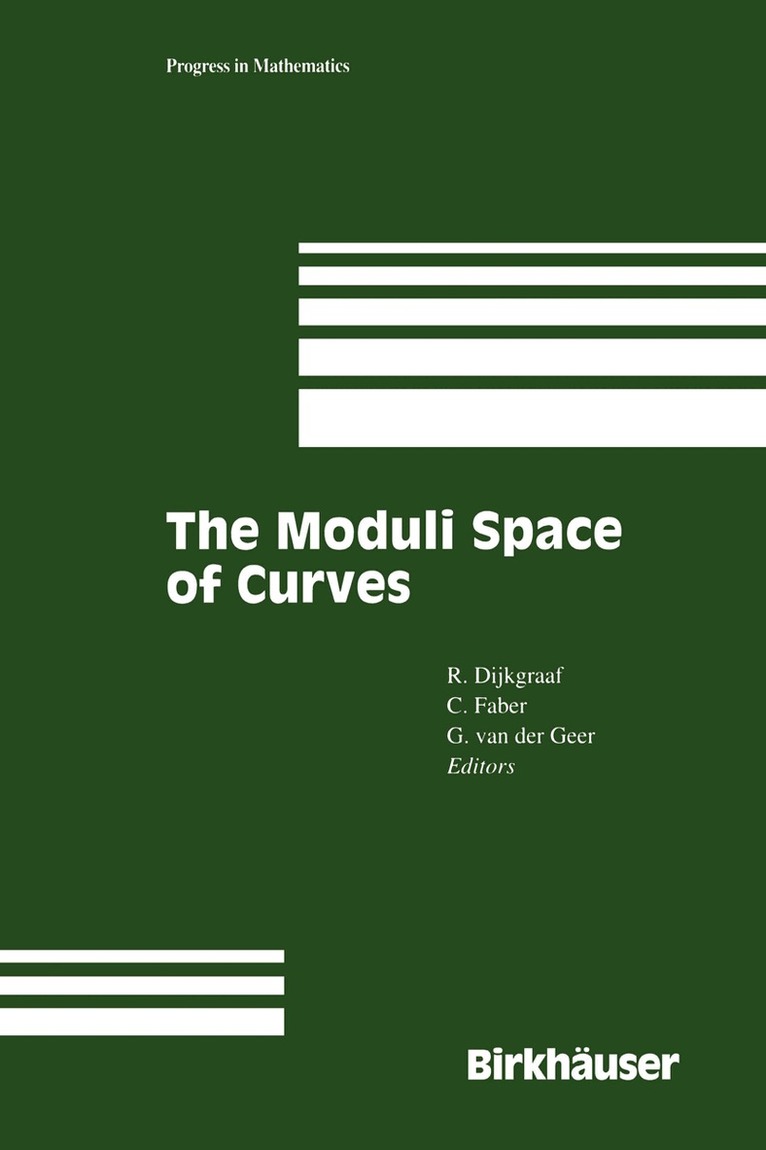
Moduli Space of Curves
Inbunden, Engelska, 1995
2 366 kr
Skickas inom 10-15 vardagar
This generalization of geometry is bound to have wide spread repercussions for mathematics as well as physics. The unearthing of it will entail a new golden age in the interaction of mathematics and physics. E. Witten (1986) The idea that the moduli space Mg of curves of fixed genus 9 - that is, the algebraic variety that parametrizes all curves of genus 9 - is an intriguing object in its own right seems to have come slowly. Although the para meters or moduli of curves surface in Riemann's famous memoir on abelian functions (from 1857) and in work of Hurwitz and later were considered by the geometers of the Italian school, for a long time they attracted attention only in the special case 9 = 1, where they were studied in the framework of the theory of modular functions. The work of Grothendieck, who in the early sixties pointed the way towards the right approach, and the subsequent construction (in 1965) of the moduli space Mg by Mumford were the first foundational work, to be followed by the construction of a compactification Mg by Deligne and Mumford in 1969. The theorem of Harris and Mumford saying that for 9 sufficiently large the space Mg is of general type was the first big insight in its structure.
E-bok
PDF, Engelska, 2012421 kr
Läs direkt efter köp
Häftad, Engelska, 2011
328 kr
Skickas inom 10-15 vardagar
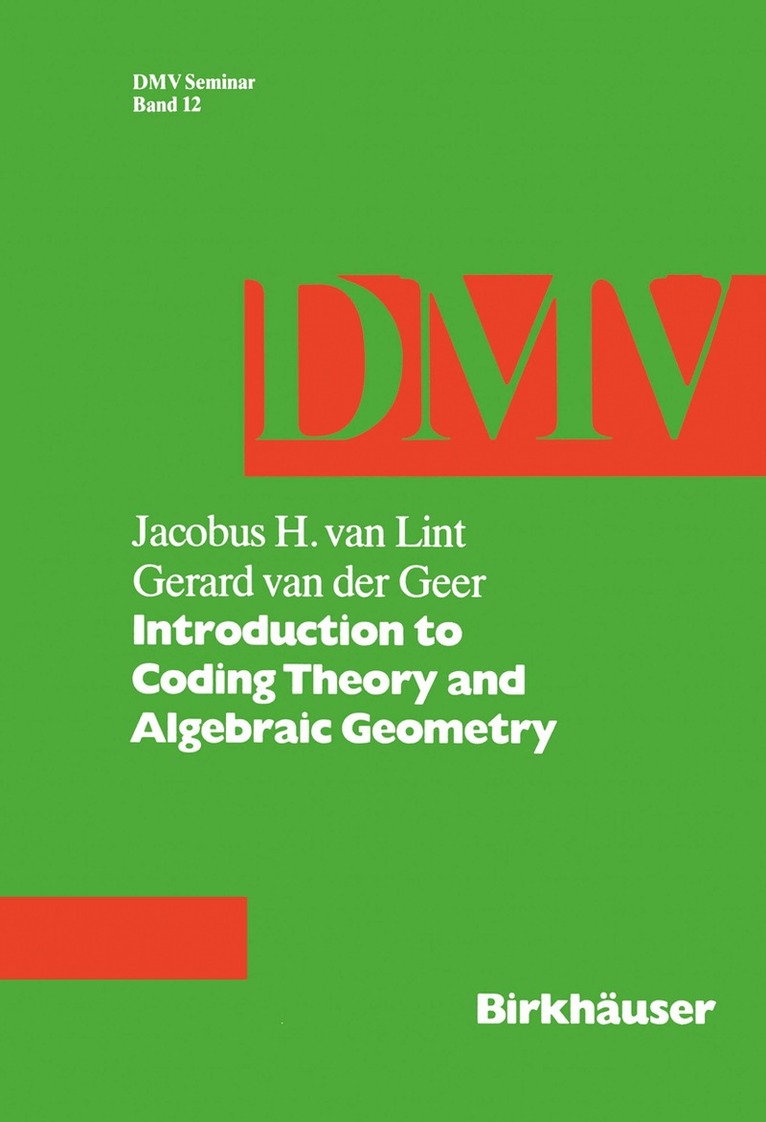
These notes are based on lectures given in the semmar on "Coding Theory and Algebraic Geometry" held at Schloss Mickeln, Diisseldorf, November 16-21, 1987. In 1982 Tsfasman, Vladut and Zink, using algebraic geometry and ideas of Goppa, constructed a seqeunce of codes that exceed the Gilbert-Varshamov bound. The result was considered sensational. Furthermore, it was surprising to see these unrelated areas of mathematics collaborating. The aim of this course is to give an introduction to coding theory and to sketch the ideas of algebraic geometry that led to the new result. Finally, a number of applications of these methods of algebraic geometry to coding theory are given. Since this is a new area, there are presently no references where one can find a more extensive treatment of all the material. However, both for algebraic geometry and for coding theory excellent textbooks are available. The combination ofthe two subjects can only be found in a number ofsurvey papers. A book by C. Moreno with a complete treatment of this area is in preparation. We hope that these notes will stimulate further research and collaboration of algebraic geometers and coding theorists. G. van der Geer, J.H.van Lint Introduction to CodingTheory and Algebraic Geometry PartI -- CodingTheory Jacobus H. vanLint 11 1. Finite fields In this chapter we collect (without proof) the facts from the theory of finite fields that we shall need in this course.
Häftad, Engelska, 1988
328 kr
Skickas inom 10-15 vardagar
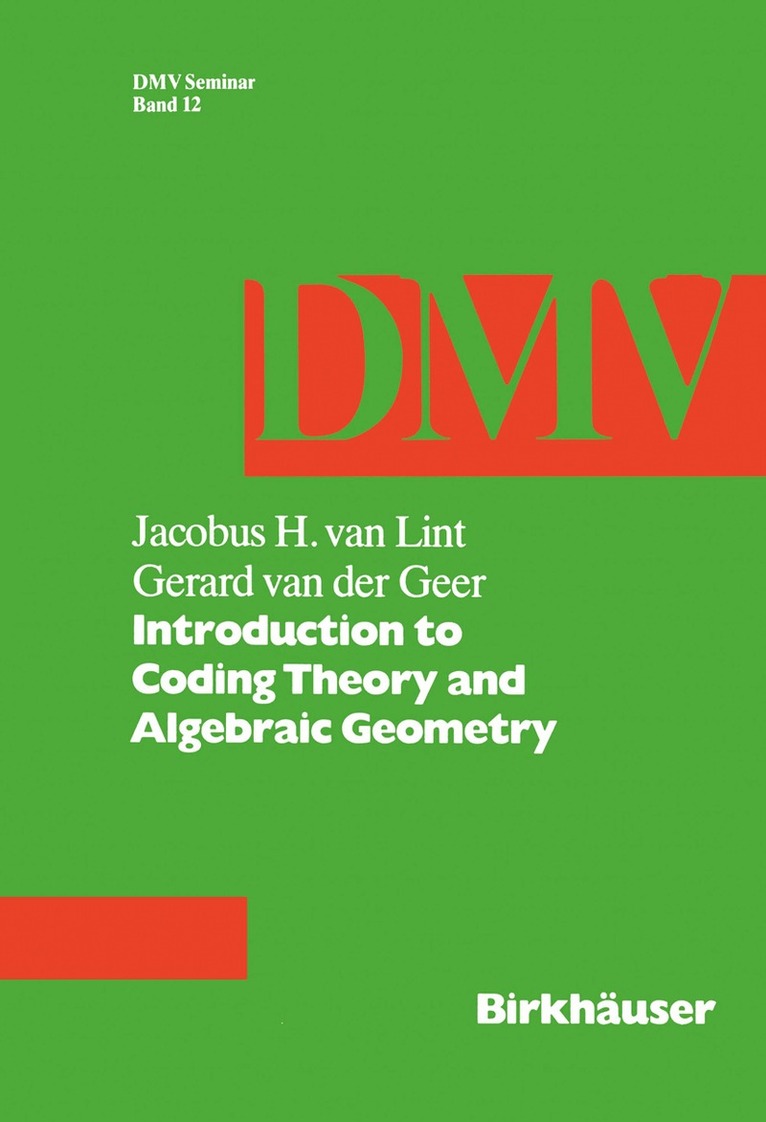
These notes are based on lectures given in the semmar on "Coding Theory and Algebraic Geometry" held at Schloss Mickeln, Diisseldorf, November 16-21, 1987. In 1982 Tsfasman, Vladut and Zink, using algebraic geometry and ideas of Goppa, constructed a seqeunce of codes that exceed the Gilbert-Varshamov bound. The result was considered sensational. Furthermore, it was surprising to see these unrelated areas of mathematics collaborating. The aim of this course is to give an introduction to coding theory and to sketch the ideas of algebraic geometry that led to the new result. Finally, a number of applications of these methods of algebraic geometry to coding theory are given. Since this is a new area, there are presently no references where one can find a more extensive treatment of all the material. However, both for algebraic geometry and for coding theory excellent textbooks are available. The combination ofthe two subjects can only be found in a number ofsurvey papers. A book by C. Moreno with a complete treatment of this area is in preparation. We hope that these notes will stimulate further research and collaboration of algebraic geometers and coding theorists. G. van der Geer, J.H.van Lint Introduction to CodingTheory and Algebraic Geometry PartI -- CodingTheory Jacobus H. vanLint 11 1. Finite fields In this chapter we collect (without proof) the facts from the theory of finite fields that we shall need in this course.