Ganesh Gopalakrishnan - Böcker
Visar alla böcker från författaren Ganesh Gopalakrishnan. Handla med fri frakt och snabb leverans.
7 produkter
7 produkter
633 kr
Skickas inom 10-15 vardagar
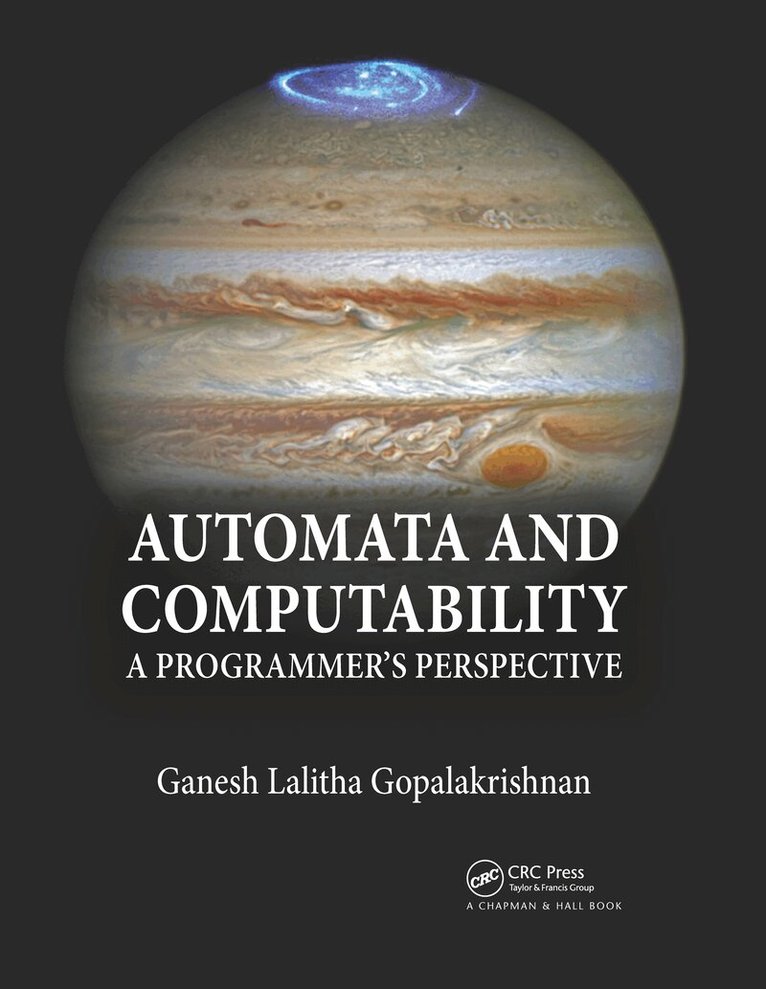
Automata and Computability is a class-tested textbook which provides a comprehensive and accessible introduction to the theory of automata and computation. The author uses illustrations, engaging examples, and historical remarks to make the material interesting and relevant for students. It incorporates modern/handy ideas, such as derivative-based parsing and a Lambda reducer showing the universality of Lambda calculus. The book also shows how to sculpt automata by making the regular language conversion pipeline available through a simple command interface. A Jupyter notebook will accompany the book to feature code, YouTube videos, and other supplements to assist instructors and studentsFeaturesUses illustrations, engaging examples, and historical remarks to make the material accessible Incorporates modern/handy ideas, such as derivative-based parsing and a Lambda reducer showing the universality of Lambda calculusShows how to "sculpt" automata by making the regular language conversion pipeline available through simple command interfaceUses a mini functional programming (FP) notation consisting of lambdas, maps, filters, and set comprehension (supported in Python) to convey math through PL constructs that are succinct and resemble mathProvides all concepts are encoded in a compact Functional Programming code that will tesselate with Latex markup and Jupyter widgets in a document that will accompany the books. Students can run code effortlessly.All the code can be accessed here.
983 kr
Skickas inom 10-15 vardagar
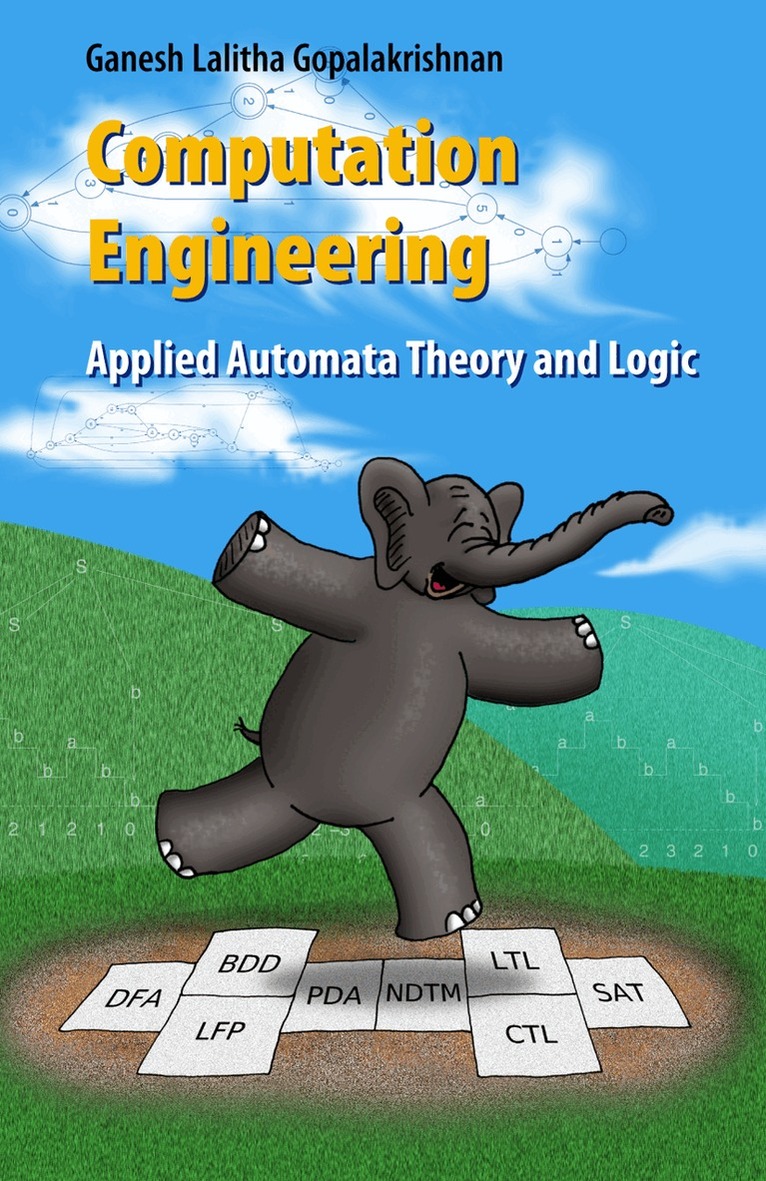
It takes more e?ort to verify that digital system designs are correct than it does to design them, and as systems get more complex the proportion of cost spent on veri?cation is increasing (one estimate is that veri?cation complexity rises as the square of design complexity). Although this veri?cation crisis was predicted decades ago, it is only recently that powerful methods based on mathematical logic and automata theory have come to the designers’ rescue. The ?rst such method was equivalence checking, which automates Boolean algebra calculations.Nextcamemodelchecking,whichcanautomatically verify that designs have – or don’t have – behaviours of interest speci?ed in temporal logic. Both these methods are available today in tools sold by all the major design automation vendors. It is an amazing fact that ideas like Boolean algebra and modal logic, originating frommathematicians andphilosophersbeforemodern computers were invented, have come to underlie computer aided tools for creating hardware designs. The recent success of ’formal’ approaches to hardware veri?cation has lead to the creation of a new methodology: assertion based design, in which formal properties are incorporated into designs and are then validated by a combination of dynamic simulation and static model checking. Two industrial strength property languages based on tem- ral logic are undergoing IEEE standardisation. It is not only hardwaredesignand veri?cation that is changing: new mathematical approaches to software veri?cation are starting to be - ployed. Microsoft provides windows driver developers with veri?cation tools based on symbolic methods.
1 273 kr
Skickas inom 10-15 vardagar
Automata and Computability is a class-tested textbook which provides a comprehensive and accessible introduction to the theory of automata and computation. The author uses illustrations, engaging examples, and historical remarks to make the material interesting and relevant for students. It incorporates modern/handy ideas, such as derivative-based parsing and a Lambda reducer showing the universality of Lambda calculus. The book also shows how to sculpt automata by making the regular language conversion pipeline available through a simple command interface. A Jupyter notebook will accompany the book to feature code, YouTube videos, and other supplements to assist instructors and studentsFeaturesUses illustrations, engaging examples, and historical remarks to make the material accessible Incorporates modern/handy ideas, such as derivative-based parsing and a Lambda reducer showing the universality of Lambda calculusShows how to "sculpt" automata by making the regular language conversion pipeline available through simple command interfaceUses a mini functional programming (FP) notation consisting of lambdas, maps, filters, and set comprehension (supported in Python) to convey math through PL constructs that are succinct and resemble mathProvides all concepts are encoded in a compact Functional Programming code that will tesselate with Latex markup and Jupyter widgets in a document that will accompany the books. Students can run code effortlessly href="https://github.com/ganeshutah/Jove.git/"here.
983 kr
Skickas inom 10-15 vardagar
It takes more e?ort to verify that digital system designs are correct than it does to design them, and as systems get more complex the proportion of cost spent on veri?cation is increasing (one estimate is that veri?cation complexity rises as the square of design complexity). Although this veri?cation crisis was predicted decades ago, it is only recently that powerful methods based on mathematical logic and automata theory have come to the designers’ rescue. The ?rst such method was equivalence checking, which automates Boolean algebra calculations.Nextcamemodelchecking,whichcanautomatically verify that designs have – or don’t have – behaviours of interest speci?ed in temporal logic. Both these methods are available today in tools sold by all the major design automation vendors. It is an amazing fact that ideas like Boolean algebra and modal logic, originating frommathematicians andphilosophersbeforemodern computers were invented, have come to underlie computer aided tools for creating hardware designs. The recent success of ’formal’ approaches to hardware veri?cation has lead to the creation of a new methodology: assertion based design, in which formal properties are incorporated into designs and are then validated by a combination of dynamic simulation and static model checking. Two industrial strength property languages based on tem- ral logic are undergoing IEEE standardisation. It is not only hardwaredesignand veri?cation that is changing: new mathematical approaches to software veri?cation are starting to be - ployed. Microsoft provides windows driver developers with veri?cation tools based on symbolic methods.
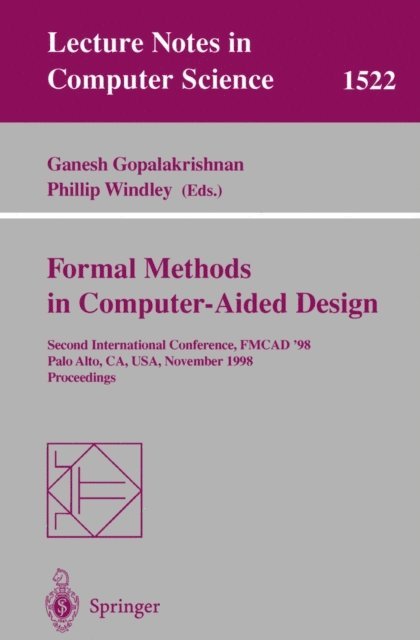
Formal Methods in Computer-Aided Design
Second International Conference, FMCAD '98, Palo Alto, CA, USA, November 4-6, 1998, Proceedings
Häftad, Engelska, 1998
554 kr
Skickas inom 10-15 vardagar
This volumecontains the proceedingsof the Second InternationalConferenceon Formal Methods in Computer-Aided Design (FMCAD'98), organized November 4-6, in Palo Alto, California, USA. The rst event of this series was organized byMandayamSrivasand Albert Camilleriin 1996 inPaloAlto. FMCAD,which evolved from the series Theorem Provers in Circuit Design (TPCD), strives to beapremierforumfordisseminatingresearchinFormalVeri cation(FV) me- ods for digital circuits and systems, including processors, custom VLSI circuits, microcode,andreactivesoftware.Inadditiontosigni cantcase-studiesandve- cationapproaches,FMCADalsoendeavorstorepresentadvancesinthedriving technologies for veri cation, including binary decision diagrams, model che- ing,symbolicreasoning(theorem proving),symbolicsimulation,andabstraction methods. Theconferenceincludedfourinvitedlectures.Theinvitedlecturesweregiven by Kenneth McMillan (Cadence Berkeley Labs) on Minimalist proof assistants: interactions of technology and methodology in formal system level veric ation , by Carl-Johan Seger on Formal methods in CAD from an industrial perspective, by Randal E.Bryant and Bwolen Yang on A performance study of BDD-based model checking, and by Amir Pnueli on Veric ation of data-insensitive circuits: an in-order-retirement case study. Of the 55 regular paper submissionsreceived, 27 were selected by the technical program committee for presentation at the conference. All four tools papers received were also selected. We gratefully acknowledge the services of the technical program comm- tee of FMCAD'98, which consisted of Adnan Aziz (Univ. of Texas at Austin, USA),AlanHu(Univ.ofBritishColumbia,Canada),Albert Camilleri(Hewlett- Packard,USA), CarlPixley(Motorola,USA), CarlosDelgadoKloos (Univ. C- los III de Madrid,Spain), Ching-TsunChou (Intel, USA), EduardCerny (Univ.
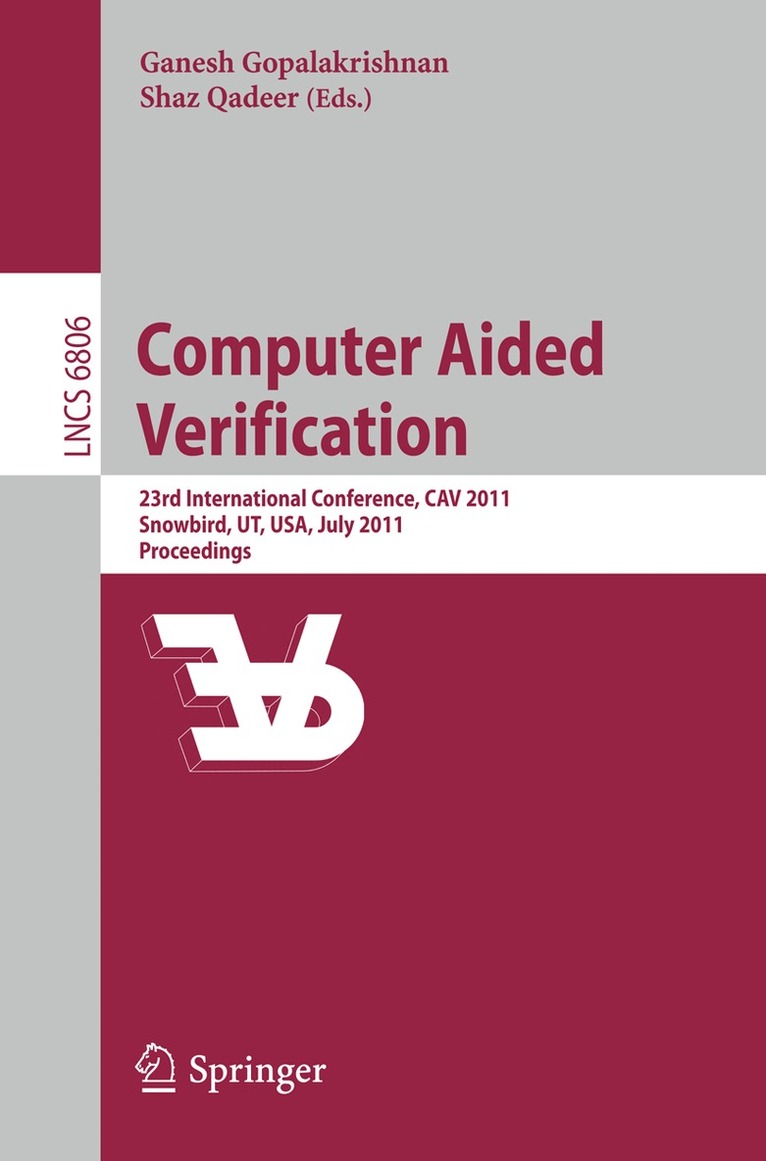
Computer Aided Verification
23rd International Conference, CAV 2011, Snowbird, UT, USA, July 14-20, 2011, Proceedings
Häftad, Engelska, 2011
554 kr
Skickas inom 10-15 vardagar
This book constitutes the refereed proceedings of the 23rd International Conference on Computer Aided Verification, CAV 2011, held in Snowbird, UT, USA, in July 2011.The 35 revised full papers presented together with 20 tool papers were carefully reviewed and selected from 161 submissions. The papers are organized in topical sections on the following workshops: 4th International Workshop on Numerical Software Verification (NSV 2011), 10th International Workshop on Parallel and Distributed Methods in Verifications (PDMC 2011), 4th International Workshop on Exploiting Concurrency Efficiently and Correctly (EC2 2011), Frontiers in Analog Circuit Synthesis and Verification (FAC 2011), International Workshop on Satisfiability Modulo Theories, including SMTCOMP (SMT 2011), 18th International SPIN Workshop on Model Checking of Software (SPIN 2011), Formal Methods for Robotics and Automation (FM-R 2011), and Practical Synthesis for Concurrent Systems (PSY 2011).
430 kr
Skickas inom 5-8 vardagar