Gary M. Ciuba – författare
Visar alla böcker från författaren Gary M. Ciuba. Handla med fri frakt och snabb leverans.
4 produkter
4 produkter
Desire, Violence, and Divinity in Modern Southern Fiction
Katherine Anne Porter, Flannery O'Connor, Cormac McCarthy, Walker Percy
Häftad, Engelska, 2011
364 kr
Skickas inom 10-15 vardagar
In this groundbreaking study, Gary M. Ciuba examines how four of the South's most probing writers of twentieth-century fiction - Katherine Anne Porter, Flannery O'Connor, Cormac McCarthy, and Walker Percy - expose the roots of violence in southern culture. Ciuba draws on the paradigm of mimetic violence developed by cultural and literary critic René Girard, who maintains that individual human nature is shaped by the desire to imitate a model. Mimetic desire may lead in turn to rivalry, cruelty, and ultimately community-sanctioned - and sometimes ritually sanctified - victimization of those deemed outcasts. Ciuba offers an impressively broad intellectual discussion that gives universal cultural meaning to the southern experience of desire, violence, and divinity with which these four authors wrestled and out of which they wrote.In a comprehensive analysis of Porter's semiautobiographical Miranda stories, Ciuba focuses on the prescribed role of women that Miranda imitates and ultimately escapes. O'Connor's The Violent Bear It Away reveals three characters whose scandalous animosity caused by religious rivalry leads to the unbearable stumbling block of violence. McCarthy's protagonist in Child of God, Lester Ballard, appears as the culmination of a long tradition of the sacred violence of southern religion, twisted into his own bloody faith. And Percy's The Thanatos Syndrome brings Ciuba's discussion back to the victim, in Tom Moore's renunciation of a society in which scapegoating threatens to become the foundation of a new social regime. From nostalgia for the old order to visions of a utopian tomorrow, these authors have imagined the interrelationship of desire, antagonism, and religion throughout southern history. Ciuba's insights offer new ways of reading Porter, O'Connor, McCarthy, and Percy as well as their contemporaries who inhabited the same culture of violence - violence desired, dreaded, denied, and deified.
575 kr
Skickas inom 5-8 vardagar
In Walker Percy: Books of Revelations, Gary M. Ciuba examines how Percy’s apocalyptic vision inspires the structure, themes, and strategies of his fiction. This book explores the unity of the southern novelist’s fiction by focusing on its religious and artistic design—one of the first studies to approach Percy’s work from this perspective.Ciuba considers Percy’s six published novels—The Moviegoer, The Last Gentleman, Love in the Ruins, Lancelot, The Second Coming, and The Thanatos Syndrome—and also offers the first extended critical analysis of his unpublished work “The Gramercy Winner.” Although the novels are often seen as increasingly satiric jeremiads about the possible doom of America, Ciuba argues that Percy’s fiction is principally shaped by a demythologized and partially realized form of eschatology. This apocalyptic vision has less to do with the end of the external world than with the demise of the protagonists’ internal worldviews. According to Ciuba, Percy does more than offer direly comic warnings about the end of the world; he shows how the world actually ends and then may begin again in the everyday lives and extraordinary loves of his astonished seers.
1 372 kr
Kommande
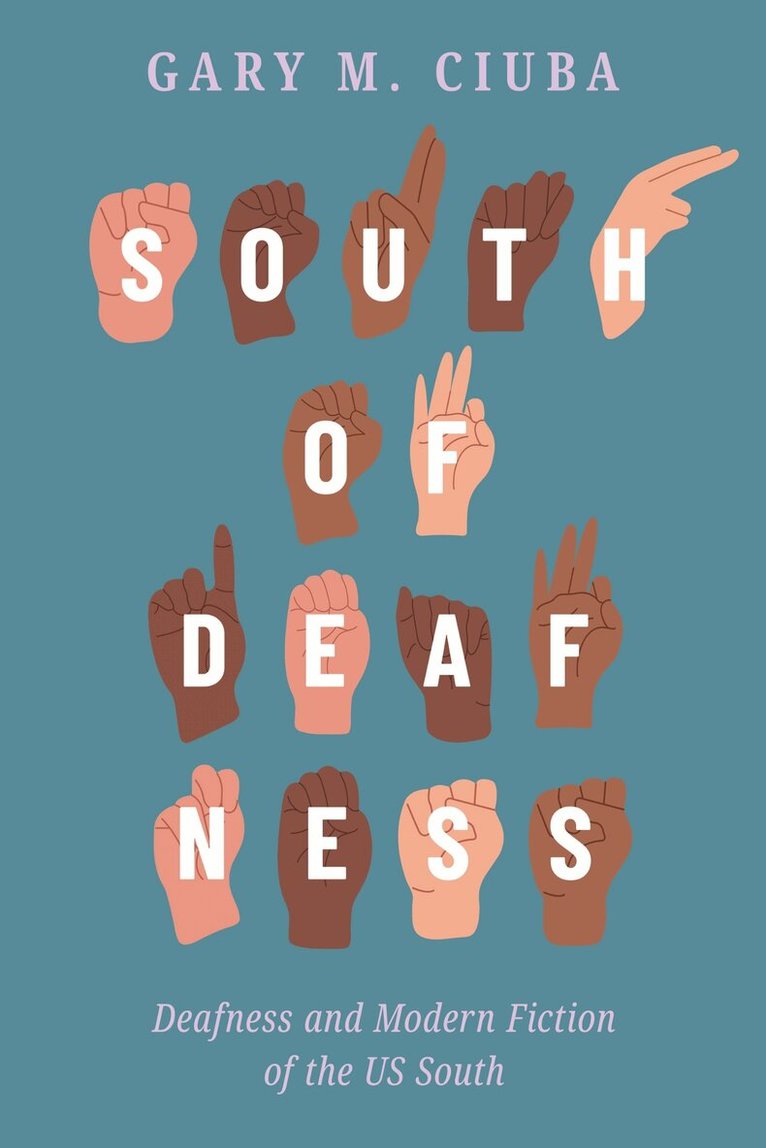
Although the US South is often described as having a culture of the voice, South of Deafness: Deafness and Modern Fiction of the US South draws on deafness studies to imagine an alternate South composed of those who do not fit into its oral and aural boundaries. This book explores deafness in modern Southern fiction, which has both shaped and been shaped by the way our dominant culture "hears" deaf people. Too often the critical tendency in reading fictional portrayals of deafness has been to label it as some form of loss. The result is that the deaf person commonly gets viewed as a trope for alienation, inaccessibility, and incompleteness. Informed by a linguistic and cultural approach to deafness, South of Deafness seeks to reclaim the values associated with deafness. Not only does South of Deafness examine how deafness has been marked, problematized, magnified, and often expelled from texts, but it explores how deafness has been refigured not only in the work of Ellen Glasgow and William Faulkner but also in more recent short stories. Gary M. Ciuba devotes individual chapters to in-depth analyses of deafness in the fiction of Carson McCullers, Eudora Welty, Flannery O’Connor, and Walker Percy. A concluding chapter examines how three deaf writers from the twentieth-century South—Howard Terry, Donald Harington, and Douglas Bullard—have expanded our awareness of deafness in their fiction.
339 kr
Kommande
Although the US South is often described as having a culture of the voice, South of Deafness: Deafness and Modern Fiction of the US South draws on deafness studies to imagine an alternate South composed of those who do not fit into its oral and aural boundaries. This book explores deafness in modern Southern fiction, which has both shaped and been shaped by the way our dominant culture "hears" deaf people. Too often the critical tendency in reading fictional portrayals of deafness has been to label it as some form of loss. The result is that the deaf person commonly gets viewed as a trope for alienation, inaccessibility, and incompleteness. Informed by a linguistic and cultural approach to deafness, South of Deafness seeks to reclaim the values associated with deafness. Not only does South of Deafness examine how deafness has been marked, problematized, magnified, and often expelled from texts, but it explores how deafness has been refigured not only in the work of Ellen Glasgow and William Faulkner but also in more recent short stories. Gary M. Ciuba devotes individual chapters to in-depth analyses of deafness in the fiction of Carson McCullers, Eudora Welty, Flannery O’Connor, and Walker Percy. A concluding chapter examines how three deaf writers from the twentieth-century South—Howard Terry, Donald Harington, and Douglas Bullard—have expanded our awareness of deafness in their fiction.