George A. Akerlof - Böcker
Visar alla böcker från författaren George A. Akerlof. Handla med fri frakt och snabb leverans.
9 produkter
9 produkter
1 025 kr
Skickas inom 5-8 vardagar
For twenty years since the publication of his seminal paper 'The Market for "Lemons"', George A. Akerlof's work has changed the way we see economics, and the economics of information in particular. In abandoning the perfect-competition benchmarks of classical economics, the pragmatic modern economics championed by Akerlof has provided deep insights into markets, identity, discrimination, motivation, and work, and into behavioural economics in general.This collection of Akerlof's most important papers provide both an introduction to Akerlof's work and a grounding in modern economics. Divided into two broad areas, micro- and macroeconomics, they cover the economics of information; the theory of unemployment; macroeconomic equilibria; the demand for money; psychology and economics; and the nature of discrimination and other social issues. The collection closes with Akerlof's 2001 Nobel Lecture, in which he argues that it is imperative that macroeconomics be considered inherently behavioural.Akerlof's substantial introduction to this volume tells the story of these papers, connecting them and showing how his later work has built upon his early contributions, in many cases improving their arguments, their subtlety, and their usefulness today.
564 kr
Skickas inom 5-8 vardagar
617 kr
Skickas inom 7-10 vardagar
These essays explore what happens when a skilful economist makes unconventional assumptions. Economic theory has traditionally relied upon a tacit and 'classical' set of assumptions that have gradually acquired a life of their own in defining how economists write and how they justify economic models. Similarly, these assumptions have acquired an autonomous character: they guide the way economists think about the world. In consequence, consideration of alternative assumptions has become taboo. These essays are substantively and stylistically novel because they break these taboos and bring new assumptions into economic theory. The papers apply this adventurous approach to a wide range of issues - from insurance markets and trade in underdeveloped countries to unemployment and discrimination. Some of the essays derive the implications for economic markets of costly asymmetric information. Others explore the findings of other social sciences such as anthropology, psychology and sociology.
577 kr
Skickas inom 7-10 vardagar
One of the more troubling aspects of the ferment in macroeconomics that followed the demise of the Keynesian dominance in the late 1960s has been the inability of many of the new ideas to account for unemployment remains unexplained because equilibrium in most economic models occurs with supply equal to demand: if this equality holds in the labor market, there is no involuntary unemployment. Efficiency Wage Models of the Labor Market explores the reasons why there are labor market equilibria with employers preferring to pay wages in excess of the market-clearing wage and thereby explains involuntary unemployment. This volume brings together a number of the important articles on efficiency wage theory. The collection is preceded by a strong, integrative introduction, written by the editors, in which the hypothesis is set out and the variations, as described in subsequent chapters, are discussed.
Animal Spirits
How Human Psychology Drives the Economy, and Why It Matters for Global Capitalism
Inbunden, Engelska, 2009
213 kr
Skickas inom 7-10 vardagar
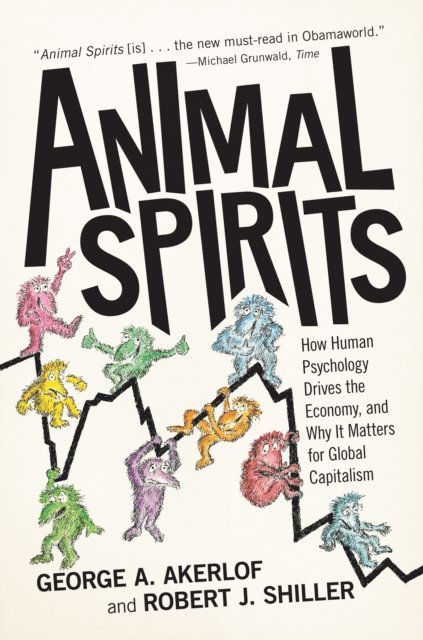
The global financial crisis has made it painfully clear that powerful psychological forces are imperiling the wealth of nations today. From blind faith in ever-rising housing prices to plummeting confidence in capital markets, "animal spirits" are driving financial events worldwide. In this book, acclaimed economists George Akerlof and Robert Shiller challenge the economic wisdom that got us into this mess, and put forward a bold new vision that will transform economics and restore prosperity. Akerlof and Shiller reassert the necessity of an active government role in economic policymaking by recovering the idea of animal spirits, a term John Maynard Keynes used to describe the gloom and despondence that led to the Great Depression and the changing psychology that accompanied recovery. Like Keynes, Akerlof and Shiller know that managing these animal spirits requires the steady hand of government--simply allowing markets to work won't do it.In rebuilding the case for a more robust, behaviorally informed Keynesianism, they detail the most pervasive effects of animal spirits in contemporary economic life--such as confidence, fear, bad faith, corruption, a concern for fairness, and the stories we tell ourselves about our economic fortunes--and show how Reaganomics, Thatcherism, and the rational expectations revolution failed to account for them. Animal Spirits offers a road map for reversing the financial misfortunes besetting us today. Read it and learn how leaders can channel animal spirits--the powerful forces of human psychology that are afoot in the world economy today.
Animal Spirits
How Human Psychology Drives the Economy, and Why It Matters for Global Capitalism
Häftad, Engelska, 2010
172 kr
Skickas inom 7-10 vardagar
The global financial crisis has made it painfully clear that powerful psychological forces are imperiling the wealth of nations today. From blind faith in ever-rising housing prices to plummeting confidence in capital markets, "animal spirits" are driving financial events worldwide. In this book, acclaimed economists George Akerlof and Robert Shiller challenge the economic wisdom that got us into this mess, and put forward a bold new vision that will transform economics and restore prosperity. Akerlof and Shiller reassert the necessity of an active government role in economic policymaking by recovering the idea of animal spirits, a term John Maynard Keynes used to describe the gloom and despondence that led to the Great Depression and the changing psychology that accompanied recovery. Like Keynes, Akerlof and Shiller know that managing these animal spirits requires the steady hand of government--simply allowing markets to work won't do it.In rebuilding the case for a more robust, behaviorally informed Keynesianism, they detail the most pervasive effects of animal spirits in contemporary economic life--such as confidence, fear, bad faith, corruption, a concern for fairness, and the stories we tell ourselves about our economic fortunes--and show how Reaganomics, Thatcherism, and the rational expectations revolution failed to account for them. Animal Spirits offers a road map for reversing the financial misfortunes besetting us today. Read it and learn how leaders can channel animal spirits--the powerful forces of human psychology that are afoot in the world economy today. In a new preface, they describe why our economic troubles may linger for some time--unless we are prepared to take further, decisive action.
196 kr
Skickas inom 7-10 vardagar
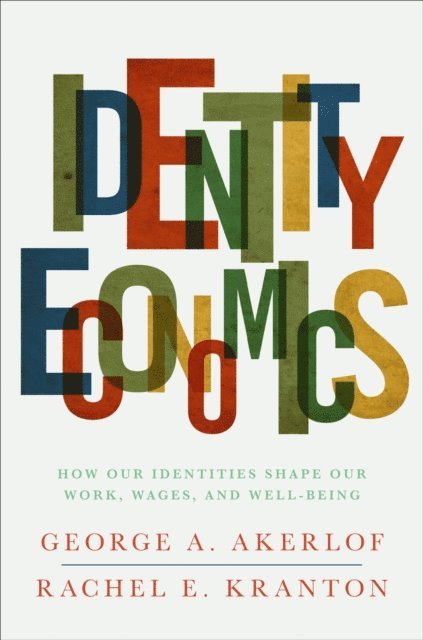
Identity Economics provides an important and compelling new way to understand human behavior, revealing how our identities--and not just economic incentives--influence our decisions. In 1995, economist Rachel Kranton wrote future Nobel Prize-winner George Akerlof a letter insisting that his most recent paper was wrong. Identity, she argued, was the missing element that would help to explain why people--facing the same economic circumstances--would make different choices. This was the beginning of a fourteen-year collaboration--and of Identity Economics. The authors explain how our conception of who we are and who we want to be may shape our economic lives more than any other factor, affecting how hard we work, and how we learn, spend, and save. Identity economics is a new way to understand people's decisions--at work, at school, and at home. With it, we can better appreciate why incentives like stock options work or don't; why some schools succeed and others don't; why some cities and towns don't invest in their futures--and much, much more. Identity Economics bridges a critical gap in the social sciences. It brings identity and norms to economics.People's notions of what is proper, and what is forbidden, and for whom, are fundamental to how hard they work, and how they learn, spend, and save. Thus people's identity--their conception of who they are, and of who they choose to be--may be the most important factor affecting their economic lives. And the limits placed by society on people's identity can also be crucial determinants of their economic well-being.
237 kr
Skickas inom 7-10 vardagar
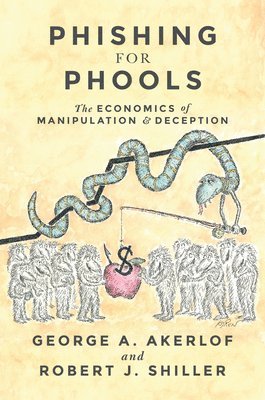
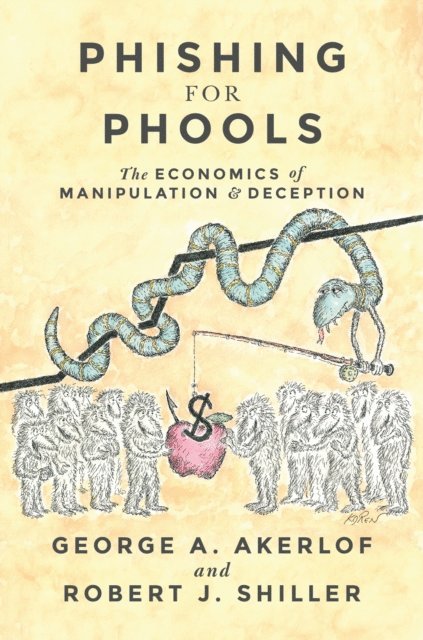
Ever since Adam Smith, the central teaching of economics has been that free markets provide us with material well-being, as if by an invisible hand. In Phishing for Phools, Nobel Prize-winning economists George Akerlof and Robert Shiller deliver a fundamental challenge to this insight, arguing that markets harm as well as help us. As long as there is profit to be made, sellers will systematically exploit our psychological weaknesses and our ignorance through manipulation and deception. Rather than being essentially benign and always creating the greater good, markets are inherently filled with tricks and traps and will "phish" us as "phools." Phishing for Phools therefore strikes a radically new direction in economics, based on the intuitive idea that markets both give and take away. Akerlof and Shiller bring this idea to life through dozens of stories that show how phishing affects everyone, in almost every walk of life. We spend our money up to the limit, and then worry about how to pay the next month's bills. The financial system soars, then crashes. We are attracted, more than we know, by advertising. Our political system is distorted by money.We pay too much for gym memberships, cars, houses, and credit cards. Drug companies ingeniously market pharmaceuticals that do us little good, and sometimes are downright dangerous. Phishing for Phools explores the central role of manipulation and deception in fascinating detail in each of these areas and many more. It thereby explains a paradox: why, at a time when we are better off than ever before in history, all too many of us are leading lives of quiet desperation. At the same time, the book tells stories of individuals who have stood against economic trickery--and how it can be reduced through greater knowledge, reform, and regulation.
172 kr
Skickas inom 7-10 vardagar
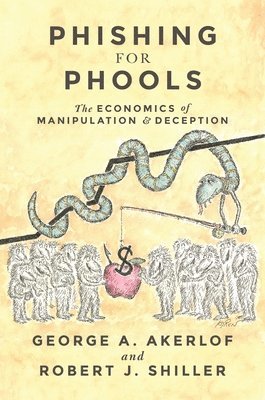
Ever since Adam Smith, the central teaching of economics has been that free markets provide us with material well-being, as if by an invisible hand. In Phishing for Phools, Nobel Prize-winning economists George Akerlof and Robert Shiller deliver a fundamental challenge to this insight, arguing that markets harm as well as help us. As long as there is profit to be made, sellers will systematically exploit our psychological weaknesses and our ignorance through manipulation and deception. Rather than being essentially benign and always creating the greater good, markets are inherently filled with tricks and traps and will "phish" us as "phools." Phishing for Phools therefore strikes a radically new direction in economics, based on the intuitive idea that markets both give and take away. Akerlof and Shiller bring this idea to life through dozens of stories that show how phishing affects everyone, in almost every walk of life. We spend our money up to the limit, and then worry about how to pay the next month's bills. The financial system soars, then crashes. We are attracted, more than we know, by advertising. Our political system is distorted by money.We pay too much for gym memberships, cars, houses, and credit cards. Drug companies ingeniously market pharmaceuticals that do us little good, and sometimes are downright dangerous. Phishing for Phools explores the central role of manipulation and deception in fascinating detail in each of these areas and many more. It thereby explains a paradox: why, at a time when we are better off than ever before in history, all too many of us are leading lives of quiet desperation. At the same time, the book tells stories of individuals who have stood against economic trickery--and how it can be reduced through greater knowledge, reform, and regulation.