George K. Thiruvathukal - Böcker
Visar alla böcker från författaren George K. Thiruvathukal. Handla med fri frakt och snabb leverans.
10 produkter
10 produkter
271 kr
Tillfälligt slut
431 kr
Skickas inom 5-8 vardagar
676 kr
Skickas inom 10-15 vardagar
Software Engineering for Science provides an in-depth collection of peer-reviewed chapters that describe experiences with applying software engineering practices to the development of scientific software. It provides a better understanding of how software engineering is and should be practiced, and which software engineering practices are effective for scientific software.The book starts with a detailed overview of the Scientific Software Lifecycle, and a general overview of the scientific software development process. It highlights key issues commonly arising during scientific software development, as well as solutions to these problems. The second part of the book provides examples of the use of testing in scientific software development, including key issues and challenges. The chapters then describe solutions and case studies aimed at applying testing to scientific software development efforts.The final part of the book provides examples of applying software engineering techniques to scientific software, including not only computational modeling, but also software for data management and analysis. The authors describe their experiences and lessons learned from developing complex scientific software in different domains.About the EditorsJeffrey Carver is an Associate Professor in the Department of Computer Science at the University of Alabama. He is one of the primary organizers of the workshop series on Software Engineering for Science (http://www.SE4Science.org/workshops). Neil P. Chue Hong is Director of the Software Sustainability Institute at the University of Edinburgh. His research interests include barriers and incentives in research software ecosystems and the role of software as a research object.George K. Thiruvathukal is Professor of Computer Science at Loyola University Chicago and Visiting Faculty at Argonne National Laboratory. His current research is focused on software metrics in open source mathematical and scientific software.
1 163 kr
Skickas inom 10-15 vardagar
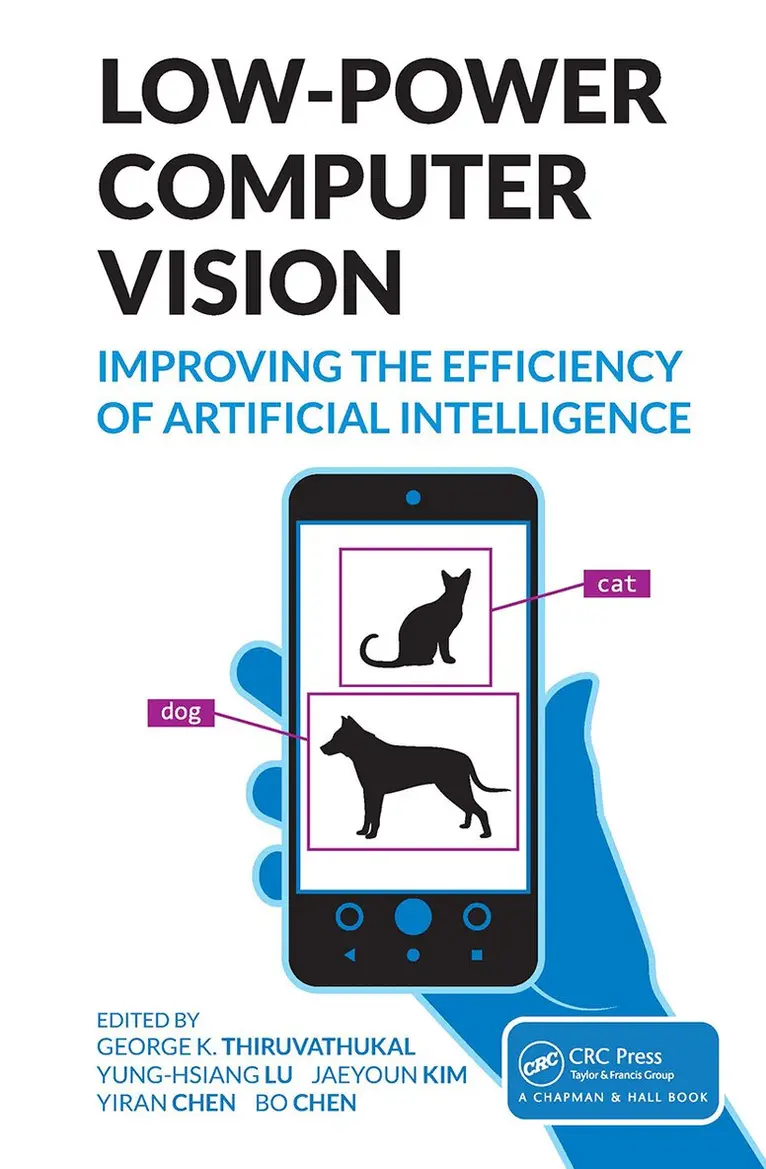
Energy efficiency is critical for running computer vision on battery-powered systems, such as mobile phones or UAVs (unmanned aerial vehicles, or drones). This book collects the methods that have won the annual IEEE Low-Power Computer Vision Challenges since 2015. The winners share their solutions and provide insight on how to improve the efficiency of machine learning systems.
676 kr
Skickas inom 10-15 vardagar
Energy efficiency is critical for running computer vision on battery-powered systems, such as mobile phones or UAVs (unmanned aerial vehicles, or drones). This book collects the methods that have won the annual IEEE Low-Power Computer Vision Challenges since 2015. The winners share their solutions and provide insight on how to improve the efficiency of machine learning systems.
697 kr
Skickas inom 10-15 vardagar
Revised for a new second edition, Intermediate C Programming provides a stepping-stone for intermediate-level students to go from writing short programs to writing real programs well. It shows students how to identify and eliminate bugs, write clean code, share code with others, and use standard Linux-based tools, such as ddd and valgrind.This second edition provides expanded coverage of these topics with new material focused on software engineering, including version control and unit testing. The text enhances their programming skills by explaining programming concepts and comparing common mistakes with correct programs. It also discusses how to use debuggers and the strategies for debugging as well as studies the connection between programming and discrete mathematics.Including additional student and instructor resources available online, this book is particularly appealing as a classroom resource.
1 765 kr
Skickas inom 10-15 vardagar
Revised for a new second edition, Intermediate C Programming provides a stepping-stone for intermediate-level students to go from writing short programs to writing real programs well. It shows students how to identify and eliminate bugs, write clean code, share code with others, and use standard Linux-based tools, such as ddd and valgrind.This second edition provides expanded coverage of these topics with new material focused on software engineering, including version control and unit testing. The text enhances their programming skills by explaining programming concepts and comparing common mistakes with correct programs. It also discusses how to use debuggers and the strategies for debugging as well as studies the connection between programming and discrete mathematics.Including additional student and instructor resources available online, this book is particularly appealing as a classroom resource.
1 383 kr
Kommande
Recursion: Mathematics and Python is designed to help readers develop a clear and systematic understanding of recursion as both a mathematical concept and a programming technique. Rather than presenting recursion as a collection of isolated examples, the book emphasizes recursive thinking: how complex problems can be expressed, analyzed, and solved by breaking them into simpler instances of similar structures.The book adopts a consistent pedagogical approach throughout. Each topic begins with a mathematical or conceptual formulation that highlights the recursive structure of the problem. Readers are guided to identify parameters, base cases, and recursive relationships before translating these ideas into Python programs. Examples are chosen to identify recurring patterns across domains, including integer partitions, Tower of Hanoi, parentheses counting, binary search, quick sort, Sudoku solving, maze traversal, tree structures, and data compression. Code examples are written for clarity. Readers can follow execution flow and understand how recursive calls interact with computer memory. This book also explains how to reduce the recursion time by identifying and removing redundant computation.This book is intended for undergraduate students in computer science and computer engineering who already have basic Python programming experience and some prior exposure to recursion. It is well suited for courses in programming, discrete mathematics, data structures, or algorithms. This book can also help instructors seek a resource that tightly integrates mathematical reasoning with executable code.
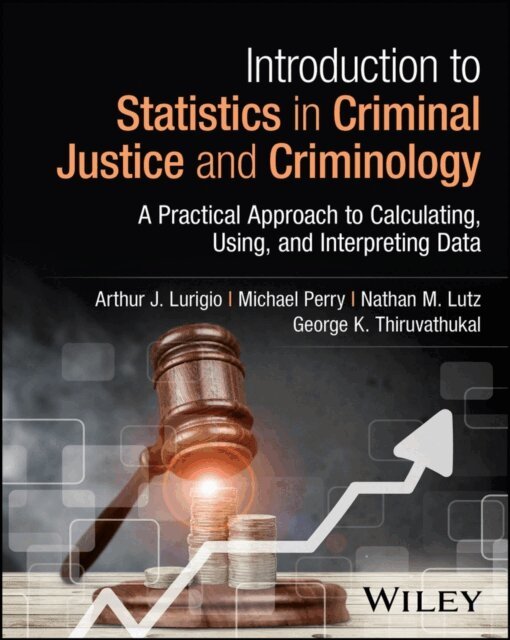
Introduction to Statistics in Criminal Justice and Criminology
A Practical Approach to Calculating, Using, and Interpreting Data
Häftad, Engelska, 2026
955 kr
Kommande
An Accessible, Scenario-Driven Foundation for Statistics in Criminal Justice A solid understanding of statistics is essential for interpreting research, evaluating evidence, and making informed decisions across the social sciences. Introduction to Statistics in Criminal Justice and Criminology offers a clear and structured path to the tools and reasoning that shape empirical inquiry in the field. Emphasizing the practical purposes of statistical thinking, this student-friendly textbook explains how data is organized, described, compared, and analyzed to answer meaningful questions. Each chapter opens with a relatable scenario that frames key concepts, guiding students as they move from foundational topics—such as descriptive statistics and normal distributions—to applications including hypothesis testing, chi-square analysis, regression, ANOVA, and survival analysis. Step-by-step examples, end-of-chapter problems, and intuitive visual displays help students engage more deeply with empirical scholarship and apply a range of data-driven methods. By presenting statistics as both a practical toolkit and an essential mode of reasoning, this comprehensive guide: Balances conceptual understanding with applied calculation to support success in higher-level courseworkProvides a consistent framework that connects chapter content to decision-making and research designUses clear explanations to demystify core statistical ideas and frequently misunderstood conceptsStrengthens computational literacy through a user-friendly software tool aligned with the chapter materialOffers chapter summaries, structured practice opportunities, and extendable problem setsDraws on the authors' extensive experience in criminal justice, psychology, mathematics, statistics, and computer scienceLeverages the expertise of an interdisciplinary team spanning psychology, computer science, data science, and statistics.Requiring no advanced mathematical training, Introduction to Statistics in Criminal Justice and Criminology: A Practical Approach to Calculating, Using, and Interpreting Data is ideal for undergraduate and postgraduate courses such as Statistics in Criminal Justice, Introduction to Statistics in Criminal Justice, and Statistics for the Social Sciences. It supports required quantitative training across criminal justice curricula and prepares students in bachelor’s and graduate programs to interpret research and engage in data-informed study and practice.
1 400 kr
Skickas inom 10-15 vardagar
Software Engineering for Science provides an in-depth collection of peer-reviewed chapters that describe experiences with applying software engineering practices to the development of scientific software. It provides a better understanding of how software engineering is and should be practiced, and which software engineering practices are effective for scientific software.The book starts with a detailed overview of the Scientific Software Lifecycle, and a general overview of the scientific software development process. It highlights key issues commonly arising during scientific software development, as well as solutions to these problems. The second part of the book provides examples of the use of testing in scientific software development, including key issues and challenges. The chapters then describe solutions and case studies aimed at applying testing to scientific software development efforts.The final part of the book provides examples of applying software engineering techniques to scientific software, including not only computational modeling, but also software for data management and analysis. The authors describe their experiences and lessons learned from developing complex scientific software in different domains.About the EditorsJeffrey Carver is an Associate Professor in the Department of Computer Science at the University of Alabama. He is one of the primary organizers of the workshop series on Software Engineering for Science (http://www.SE4Science.org/workshops). Neil P. Chue Hong is Director of the Software Sustainability Institute at the University of Edinburgh. His research interests include barriers and incentives in research software ecosystems and the role of software as a research object.George K. Thiruvathukal is Professor of Computer Science at Loyola University Chicago and Visiting Faculty at Argonne National Laboratory. His current research is focused on software metrics in open source mathematical and scientific software.