Georges Dicker - Böcker
Visar alla böcker från författaren Georges Dicker. Handla med fri frakt och snabb leverans.
11 produkter
11 produkter
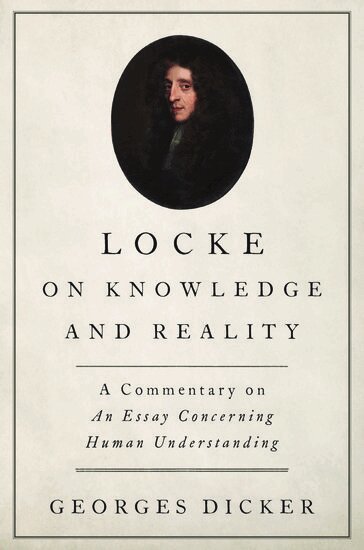
Locke on Knowledge and Reality
A Commentary on An Essay Concerning Human Understanding
Inbunden, Engelska, 2019
1 444 kr
Skickas inom 5-8 vardagar
Georges Dicker here provides a commentary on John Locke's masterwork, An Essay Concerning Human Understanding-the foundational work of classical Empiricism. Dicker's commentary is an accessible guide for students who are reading Locke for the first time; a useful research tool for upper-level undergraduate and graduate students; and a contribution to Locke scholarship for professional scholars. It is designed to be read alongside the Essay, but does not presuppose familiarity with it. Dicker expounds and critically discusses the main theses and arguments of each of the Essay's four books, on the innatism that Locke opposes, the origin and classification of ideas, language and meaning, and knowledge, respectively. He analyses Locke's influential explorations of related topics, including primary and secondary qualities, substance, identity, personal identity, free will, nominal and real essences, perception, and external-world skepticism, among others. Written in an analytical style that strives for clarity, the book offers careful textual analyses as well as step-by-step reconstructions of Locke's arguments, and it references and engages with relevant work of other major philosophers and Locke commentators.
Locke on Knowledge and Reality
A Commentary on An Essay Concerning Human Understanding
Häftad, Engelska, 2019
511 kr
Skickas inom 5-8 vardagar
Georges Dicker here provides a commentary on John Locke's masterwork, An Essay Concerning Human Understanding-the foundational work of classical Empiricism. Dicker's commentary is an accessible guide for students who are reading Locke for the first time; a useful research tool for upper-level undergraduate and graduate students; and a contribution to Locke scholarship for professional scholars. It is designed to be read alongside the Essay, but does not presuppose familiarity with it. Dicker expounds and critically discusses the main theses and arguments of each of the Essay's four books, on the innatism that Locke opposes, the origin and classification of ideas, language and meaning, and knowledge, respectively. He analyses Locke's influential explorations of related topics, including primary and secondary qualities, substance, identity, personal identity, free will, nominal and real essences, perception, and external-world skepticism, among others. Written in an analytical style that strives for clarity, the book offers careful textual analyses as well as step-by-step reconstructions of Locke's arguments, and it references and engages with relevant work of other major philosophers and Locke commentators.
625 kr
Skickas inom 5-8 vardagar
Descartes' Meditations continues to the studied at all levels of the philosophy curriculum, from the introductory course to the graduate seminar. Descartes: An Analytical and Historical Introduction is addressed to students at all these levels. For the beginner, Professor Dicker provides historical background and elicits from the text several basic issues of metaphysics and epistemology. Students of the history of modern philosophy will benefit from his balanced coverage of the main themes and arguments of the Meditations and several of the criticisms that they have evoked. To address still more advanced readers, he frequently discusses recent Descartes scholarship, and offers his own reflections on Cartesian doubt, the cogito, the causal and ontological proofs of God's existence, the Cartesian circle, Cartesian dualism, and Descartes' views about the material world. The book is written and organized in such a way as to be widely accessible, without unduly oversimplifying issues or sacrificing rigour. It includes and cross-references the full text of Meditations I, II, and V, and most of Meditations III and VI.
503 kr
Skickas inom 5-8 vardagar
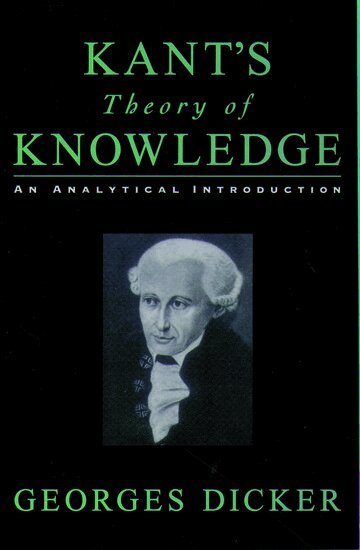
The Critique of Pure Reason is Kant's acknowledged masterpiece, in which he tackles the question of how we can possibly have knowledge that does not rest on experience (a priori knowledge). The first half of the Critique advances a constructive theory of human cognition and defends the possibility of human knowledge against the skeptical empiricism of Hume. These sections of the Critique are difficult for beginners and for advanced students alike. While there exist many scholarly works discussing the Critique on an advanced level, this book is explicitly designed to be read alongside the text by first-time readers of Kant. Dicker makes Kant's views and arguments as accessible as possible without oversimplifying them, and synthesizes the views of contemporary scholars. Kant's Theory of Knowledge will be useful to both undergraduate and graduate students struggling with this notoriously difficult yet deeply influential thinker.
476 kr
Skickas inom 5-8 vardagar
A solid grasp of the main themes and arguments of the seventeenth-century philosopher René Descartes is essential for understanding modern thought, and a necessary entrée to the work of the Empiricists and Immanuel Kant. It is also crucial to the study of contemporary epistemology, metaphysics, and philosophy of mind. This new edition of Georges Dicker's commentary on Descartes's masterpiece, Meditations on First Philosophy, features a new chapter on the Fourth Meditation and improved treatments of the famous cogito ergo sum and the notorious problem of the Cartesian Circle, among numerous other improvements and updates. Clear and accessible, it serves as an introduction to Descartes's ideas for undergraduates and as a sophisticated companion to his Meditations for advanced readers. The volume provides a thorough discussion of several basic issues of epistemology and metaphysics elicited from the main themes and arguments of the Meditations. It also delves into the work's historical background and critical reception. Dicker offers his own assessments of the Cartesian Doubt, the cogito, the causal and ontological proofs of God's existence, Cartesian freedom and theodicy, Cartesian Dualism, and Descartes's views about the existence and nature of the material world. The commentary also incorporates a wealth of recent Descartes scholarship, and inculcates - but does not presuppose - knowledge of the methods of contemporary analytic philosophy.
518 kr
Skickas inom 5-8 vardagar
In George Berkeley's two most important works, the Principles of Human Knowledge and Three Dialogues Between Hylas and Philonous, he argued that there is no such thing as matter: only minds and ideas exist, and physical things are nothing but collections of ideas. In defense of this idealism, he advanced a battery of challenging arguments purporting to show that the very notion of matter is self-contradictory or meaningless, and that even if it were possible for matter to exist, we could not know that it does; and he then put forward an alternative world-view that purported to refute both skepticism and atheism. Using the tools of contemporary analytic philosophy, Georges Dicker here examines both the destructive and the constructive sides of Berkeley's thought, against the background of the mainstream views that he rejected. Dicker's accessible and text-based analysis of Berkeley's arguments shows that the Principles and the Dialogues dovetail and complement each other in a seamless way, rather than being self-contained. Dicker's book avoids the incompleteness that results from studying just one of his two main works; instead, he treats the whole as a visionary response to the issues of modern philosophy- such as primary and secondary qualities, external-world skepticism, the substance-property relation, the causal roles of human agents and of God. In addition to relating Berkeley's work to his contemporaries, Dicker discusses work by today's top Berkeley scholars, and uses notions and distinctions forged by recent and contemporary analytic philosophers of perception. Berkeley's Idealism both advances Berkeley scholarship and serves as a useful guide for teachers and students.
877 kr
Skickas inom 5-8 vardagar
In George Berkeley's two most important works, the Principles of Human Knowledge and Three Dialogues Between Hylas and Philonous, he argued that there is no such thing as matter: only minds and ideas exist, and physical things are nothing but collections of ideas. In defense of this idealism, he advanced a battery of challenging arguments purporting to show that the very notion of matter is self-contradictory or meaningless, and that even if it were possible for matter to exist, we could not know that it does; and he then put forward an alternative world-view that purported to refute both skepticism and atheism. Using the tools of contemporary analytic philosophy, Georges Dicker here examines both the destructive and the constructive sides of Berkeley's thought, against the background of the mainstream views that he rejected. Dicker's accessible and text-based analysis of Berkeley's arguments shows that the Principles and the Dialogues dovetail and complement each other in a seamless way, rather than being self-contained. Dicker's book avoids the incompleteness that results from studying just one of his two main works; instead, he treats the whole as a visionary response to the issues of modern philosophy- such as primary and secondary qualities, external-world skepticism, the substance-property relation, the causal roles of human agents and of God. In addition to relating Berkeley's work to his contemporaries, Dicker discusses work by today's top Berkeley scholars, and uses notions and distinctions forged by recent and contemporary analytic philosophers of perception. Berkeley's Idealism both advances Berkeley scholarship and serves as a useful guide for teachers and students.
2 100 kr
Skickas inom 10-15 vardagar
David Hume's Treatise on Human Nature and Enquiry Concerning Human Understanding are amongst the most widely-studies texts on philosophy. Hume's Epistemology and Metaphysics: An Introduction presents in a clear, concise and accessible manner the key themes of these texts. Georges Dicker clarifies Hume's views on meaning, knowledge, causality, and sense perception step by step and provides us with a sharp picture of how philosophical thinking has been influenced by Hume. Accessible to anyone coming to Hume for the first time, Hume's Epistemology and Metaphysics is an indispensible guide to Hume's philosophical thinking.
574 kr
Skickas inom 10-15 vardagar
David Hume's Treatise on Human Nature and Enquiry Concerning Human Understanding are amongst the most widely-studies texts on philosophy. Hume's Epistemology and Metaphysics: An Introduction presents in a clear, concise and accessible manner the key themes of these texts. Georges Dicker clarifies Hume's views on meaning, knowledge, causality, and sense perception step by step and provides us with a sharp picture of how philosophical thinking has been influenced by Hume. Accessible to anyone coming to Hume for the first time, Hume's Epistemology and Metaphysics is an indispensible guide to Hume's philosophical thinking.
Del 22 - Philosophical Studies Series
Perceptual Knowledge
An Analytical and Historical Study
Inbunden, Engelska, 1980
1 061 kr
Skickas inom 10-15 vardagar
This book grew out of the lectures that I prepared for my students in epis temology at SUNY College at Brockport beginning in 1974. The conception of the problem of perception and the interpretation of the sense-datum theory and its supporting arguments that are developed in Chapters One through Four originated in these lectures. The rest of the manuscript was first written during the 1975-1976 academic year, while I held an NEH Fellowship in Residence for College Teachers at Brown University, and during the ensuing summer, under a SUNY Faculty Research Fellowship. I wish to express my sincere gratitude to the National Endowment for the Humanities and to the Research Foundation of the State University of New York for their support of my research. I am grateful to many former students, colleagues, and friends for their stimulating, constructive comments and criticisms. Among the former stu dents whose reactions and objections were most helpful are Richard Motroni, Donald Callen, Hilary Porter, and Glenn Shaikun. Among my colleagues at Brockport, I wish to thank Kevin Donaghy and Jack Glickman for their comments and encouragement. I am indebted to Eli Hirsch for reading and commenting most helpfully on the entire manuscript, to Peter M. Brown for a useful correspondence concerning key arguments in Chapters Five and Seven, to Keith Lehrer for a criticism of one of my arguments that led me to make some important revisions, and to Roderick M.
Del 22 - Philosophical Studies Series
Perceptual Knowledge
An Analytical and Historical Study
Häftad, Engelska, 2011
1 061 kr
Skickas inom 10-15 vardagar
This book grew out of the lectures that I prepared for my students in epis temology at SUNY College at Brockport beginning in 1974. The conception of the problem of perception and the interpretation of the sense-datum theory and its supporting arguments that are developed in Chapters One through Four originated in these lectures. The rest of the manuscript was first written during the 1975-1976 academic year, while I held an NEH Fellowship in Residence for College Teachers at Brown University, and during the ensuing summer, under a SUNY Faculty Research Fellowship. I wish to express my sincere gratitude to the National Endowment for the Humanities and to the Research Foundation of the State University of New York for their support of my research. I am grateful to many former students, colleagues, and friends for their stimulating, constructive comments and criticisms. Among the former stu dents whose reactions and objections were most helpful are Richard Motroni, Donald Callen, Hilary Porter, and Glenn Shaikun. Among my colleagues at Brockport, I wish to thank Kevin Donaghy and Jack Glickman for their comments and encouragement. I am indebted to Eli Hirsch for reading and commenting most helpfully on the entire manuscript, to Peter M. Brown for a useful correspondence concerning key arguments in Chapters Five and Seven, to Keith Lehrer for a criticism of one of my arguments that led me to make some important revisions, and to Roderick M.