Gerald P. Boersma – författare
Visar alla böcker från författaren Gerald P. Boersma. Handla med fri frakt och snabb leverans.
5 produkter
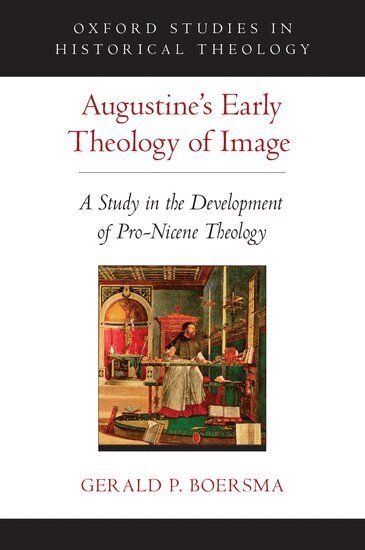
Augustine's Early Theology of Image
A Study in the Development of Pro-Nicene Theology
Inbunden, 2016
1894 kr
Lägg i varukorg
The question of what it means for Christ to be the "image of God," or imago dei, lies at the heart of the Christological debates of the fourth century. Is an image a derivation from its source? Are they two separate substances? Does an image serve to reveal its source? Is an image ontologically …
Augustine's Early Theology of Image
A Study in the Development of Pro-Nicene Theology
E-bok, 2015
1210 kr
Lägg i varukorg
What does it mean for Christ to be the "image of God"? And, if Christ is the "image of God," can the human person also unequivocally be understood to be the "image of God"? Augustine''s Early Theology of Image examines Augustine''s conception of the imago dei and makes the case that it represents a …
Augustine's Early Theology of Image
A Study in the Development of Pro-Nicene Theology
E-bok, 2016
1210 kr
Lägg i varukorg
What does it mean for Christ to be the "image of God"? And, if Christ is the "image of God," can the human person also unequivocally be understood to be the "image of God"? Augustine''s Early Theology of Image examines Augustine''s conception of the imago dei and makes the case that it represents a …
Affective Knowledge in the Theology of Thomas Aquinas
Häftad, 2026
659 kr
Kommande
According to the standard Thomistic account, God can be known both by nature and revelation. The first is the terrain of metaphysics, which knows God as the cause of his created effects. The second is theology, which knows God through the words in which he has revealed himself. Often neglected, …
Affective Knowledge in the Theology of Thomas Aquinas
Inbunden, 2026
1800 kr
Kommande
According to the standard Thomistic account, God can be known both by nature and revelation. The first is the terrain of metaphysics, which knows God as the cause of his created effects. The second is theology, which knows God through the words in which he has revealed himself. Often neglected, …