Gerald R. Faulhaber - Böcker
Visar alla böcker från författaren Gerald R. Faulhaber. Handla med fri frakt och snabb leverans.
3 produkter
3 produkter
1 091 kr
Skickas inom 10-15 vardagar
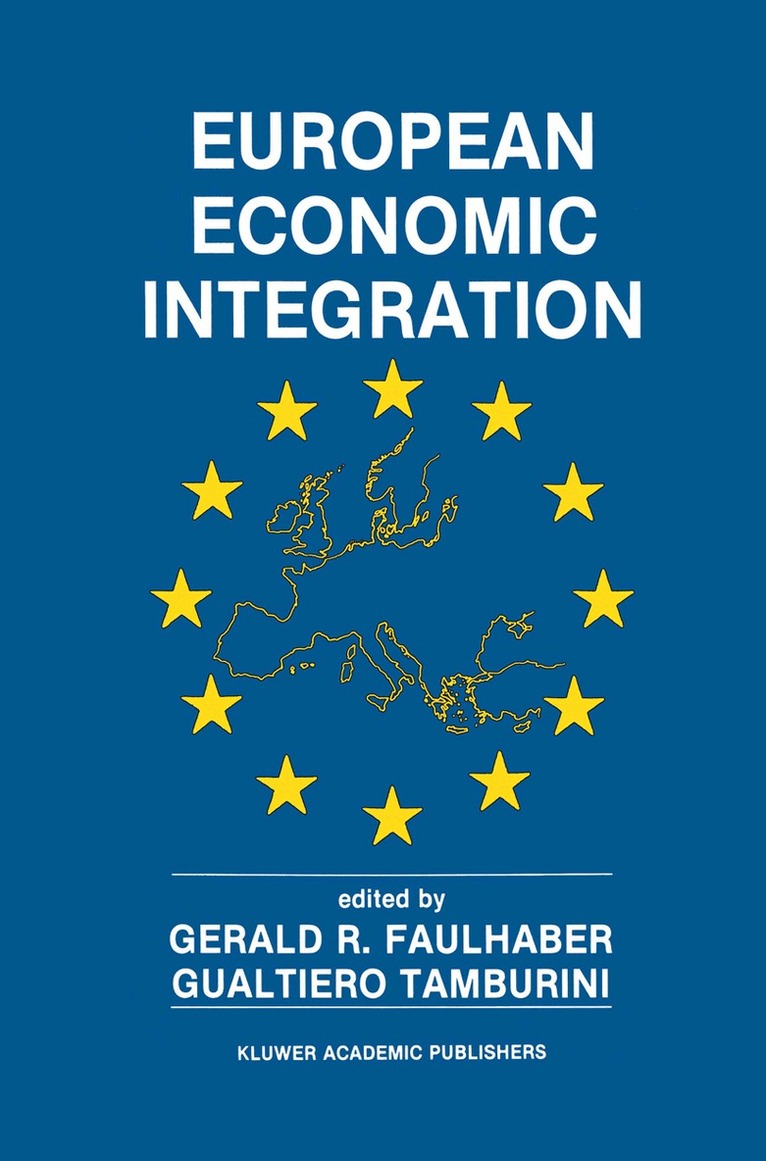
Gerald R. Faulhaber and Gualtiero Tamburini University of Pennsylvania and Universita Delgi Studi di Bologna This book brings together chapters by a group of European and North American economists, all of which focus on a single aspect of the ongoing plan for European economic integration - the role of technology. Indeed, the plan for European integration has many aspects social, institutional, and political. From a broad standpoint, the program approved by the 12 member states of the European Economic Community (Single European Act) in 1986 addresses these problems. Among other things, the Act pro vi des for the progressive establishment of a single internal market by 1992. At its most basic, this single European market means the unrestricted circulation of goods, people, services, and capital, unhindered by borders, tariffs, or restrictive national practices. The actual economic integration as planned by the Single Act will have a variety of consequences. On the whole, there will be the consolidation of the benefits already gained over the 2 Introduction previous 30 years due to the progressive lowering of tariff barriers within the Common Market. In particular, there has a been a shift away from Iimited national markets toward the wider market of the Community. In turn, this expansion of the market promises improved economies of scale and scope for many industries and a more efficient geographic allocation of production.
2 260 kr
Skickas inom 7-10 vardagar
Digital markets worldwide are in rapid flux. The Internet and World Wide Web have traditionally evolved in a largely deregulated environment, but recently governments have shown great interest in this rapidly developing sector and are imposing regulations for a variety of reasons that are changing the shape of these industries. This book explores why the industrial organization of broadband ISPs, Internet backbone providers and content/application providers are in such turmoil. The expert contributors straddle the turbulent past of the telecoms sector and also contribute to its exciting - though unpredictable - future via positive analysis of past communications policies, which is then utilized to deduce lessons to guide future policy making decisions. It is illustrated that broadband ISPs no longer simply provide a conduit for service delivery; they are also involved in producing content and transaction services themselves, in competition with content and delivery providers. The blurring of the traditional lines between these three sectors, as each enters into the others' markets, is highlighted. The conclusion is that we are witnessing the emergence of powerful, competing platforms, linked in complex ways that challenge traditional economic analyses. Exploring governance issues, regulation and investment, next-generation service markets and wireless communication, this book will prove a fascinating and illuminating read for scholars, researchers, post-graduate students and policy makers with an interest in ICT, technology and innovation, economics and industrial organization.
1 091 kr
Skickas inom 10-15 vardagar
Gerald R. Faulhaber and Gualtiero Tamburini University of Pennsylvania and Universita Delgi Studi di Bologna This book brings together chapters by a group of European and North American economists, all of which focus on a single aspect of the ongoing plan for European economic integration - the role of technology. Indeed, the plan for European integration has many aspects social, institutional, and political. From a broad standpoint, the program approved by the 12 member states of the European Economic Community (Single European Act) in 1986 addresses these problems. Among other things, the Act pro vi des for the progressive establishment of a single internal market by 1992. At its most basic, this single European market means the unrestricted circulation of goods, people, services, and capital, unhindered by borders, tariffs, or restrictive national practices. The actual economic integration as planned by the Single Act will have a variety of consequences. On the whole, there will be the consolidation of the benefits already gained over the 2 Introduction previous 30 years due to the progressive lowering of tariff barriers within the Common Market. In particular, there has a been a shift away from Iimited national markets toward the wider market of the Community. In turn, this expansion of the market promises improved economies of scale and scope for many industries and a more efficient geographic allocation of production.