Geraldine Heng - Böcker
Visar alla böcker från författaren Geraldine Heng. Handla med fri frakt och snabb leverans.
12 produkter
12 produkter
1 032 kr
Tillfälligt slut
Empire of Magic offers a genesis and genealogy for medieval romance and the King Arthur legend through the history of Europe's encounters with the East in crusades, travel, missionizing, and empire formation. It also produces definitions of "race" and "nation" for the medieval period and posits that the Middle Ages and medieval fantasies of race and religion have recently returned. Drawing on feminist and gender theory, as well as cultural analyses of race, class, and colonialism, this provocative book revises our understanding of the beginnings of the nine hundred-year-old cultural genre we call romance, as well as the King Arthur legend. Geraldine Heng argues that romance arose in the twelfth century as a cultural response to the trauma and horror of taboo acts-in particular the cannibalism committed by crusaders on the bodies of Muslim enemies in Syria during the First Crusade.From such encounters with the East, Heng suggests, sprang the fantastical episodes featuring King Arthur in Geoffrey of Monmouth's chronicle The History of the Kings of England, a work where history and fantasy collide and merge, each into the other, inventing crucial new examples and models for romances to come. After locating the rise of romance and Arthurian legend in the contact zones of East and West, Heng demonstrates the adaptability of romance and its key role in the genesis of an English national identity. Discussing Jews, women, children, and sexuality in works like the romance of Richard Lionheart, stories of the saintly Constance, Arthurian chivralic literature, the legend of Prester John, and travel narratives, Heng shows how fantasy enabled audiences to work through issues of communal identity, race, color, class and alternative sexualities in socially sanctioned and safe modes of cultural discussion in which pleasure, not anxiety, was paramount.Romance also engaged with the threat of modernity in the late medieval period, as economic, social, and technological transformations occurred and awareness grew of a vastly enlarged world beyond Europe, one encompassing India, China, and Africa. Finally, Heng posits, romance locates England and Europe within an empire of magic and knowledge that surveys the world and makes it intelligible-usable-for the future. Empire of Magic is expansive in scope, spanning the eleventh to the fifteenth centuries, and detailed in coverage, examining various types of romance-historical, national, popular, chivalric, family, and travel romances, among others-to see how cultural fantasy responds to changing crises, pressures, and demands in a number of different ways. Boldly controversial, theoretically sophisticated, and historically rooted, Empire of Magic is a dramatic restaging of the role romance played in the culture of a period and world in ways that suggest how cultural fantasy still functions for us today.
765 kr
Skickas inom 3-6 vardagar
Empire of Magic offers a genesis and genealogy for medieval romance and the King Arthur legend through the history of Europe's encounters with the East in crusades, travel, missionizing, and empire formation. It also produces definitions of "race" and "nation" for the medieval period and posits that the Middle Ages and medieval fantasies of race and religion have recently returned. Drawing on feminist and gender theory, as well as cultural analyses of race, class, and colonialism, this provocative book revises our understanding of the beginnings of the nine hundred-year-old cultural genre we call romance, as well as the King Arthur legend. Geraldine Heng argues that romance arose in the twelfth century as a cultural response to the trauma and horror of taboo acts-in particular the cannibalism committed by crusaders on the bodies of Muslim enemies in Syria during the First Crusade.From such encounters with the East, Heng suggests, sprang the fantastical episodes featuring King Arthur in Geoffrey of Monmouth's chronicle The History of the Kings of England, a work where history and fantasy collide and merge, each into the other, inventing crucial new examples and models for romances to come. After locating the rise of romance and Arthurian legend in the contact zones of East and West, Heng demonstrates the adaptability of romance and its key role in the genesis of an English national identity. Discussing Jews, women, children, and sexuality in works like the romance of Richard Lionheart, stories of the saintly Constance, Arthurian chivralic literature, the legend of Prester John, and travel narratives, Heng shows how fantasy enabled audiences to work through issues of communal identity, race, color, class and alternative sexualities in socially sanctioned and safe modes of cultural discussion in which pleasure, not anxiety, was paramount.Romance also engaged with the threat of modernity in the late medieval period, as economic, social, and technological transformations occurred and awareness grew of a vastly enlarged world beyond Europe, one encompassing India, China, and Africa. Finally, Heng posits, romance locates England and Europe within an empire of magic and knowledge that surveys the world and makes it intelligible-usable-for the future. Empire of Magic is expansive in scope, spanning the eleventh to the fifteenth centuries, and detailed in coverage, examining various types of romance-historical, national, popular, chivalric, family, and travel romances, among others-to see how cultural fantasy responds to changing crises, pressures, and demands in a number of different ways. Boldly controversial, theoretically sophisticated, and historically rooted, Empire of Magic is a dramatic restaging of the role romance played in the culture of a period and world in ways that suggest how cultural fantasy still functions for us today.
241 kr
Skickas inom 7-10 vardagar
The Global Middle Ages: An Introduction discusses how, when, and why a 'global Middle Ages' was conceptualized; explains and considers the terms that are deployed in studying, teaching, and researching a Global Middle Ages; and critically reflects on the issues that arise in the establishment of this relatively new field of academic endeavor. An Introduction surveys the considerable gains to be had in developing a critical early global studies, and introduces the collaborative work of the Cambridge Elements series in the Global Middle Ages.
228 kr
Skickas inom 7-10 vardagar
Teaching Early Global Literatures and Cultures is a guide to the terra incognita of the global literature classroom. It begins with a framing rationale for why it is valuable to teach early global literatures today; critically surveys the issues involved in such teaching; supplies details of some two dozen texts from which to build a possible syllabus; adds a comprehensive bibliography, and suggestions for student research and student involvement in co-creating course content; and furnishes detailed guidelines for how to teach some 10 texts. It should be possible for faculty and graduate instructors to take this Element and begin teaching its sample syllabus right away.
705 kr
Skickas inom 7-10 vardagar
Teaching Early Global Literatures and Cultures is a guide to the terra incognita of the global literature classroom. It begins with a framing rationale for why it is valuable to teach early global literatures today; critically surveys the issues involved in such teaching; supplies details of some two dozen texts from which to build a possible syllabus; adds a comprehensive bibliography, and suggestions for student research and student involvement in co-creating course content; and furnishes detailed guidelines for how to teach some 10 texts. It should be possible for faculty and graduate instructors to take this Element and begin teaching its sample syllabus right away.
645 kr
Skickas inom 7-10 vardagar
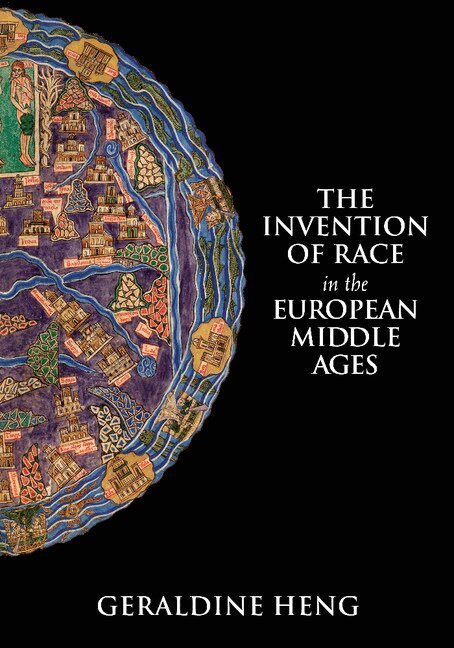
In The Invention of Race in the European Middle Ages, Geraldine Heng questions the common assumption that the concepts of race and racisms only began in the modern era. Examining Europe's encounters with Jews, Muslims, Africans, Native Americans, Mongols, and the Romani ('Gypsies'), from the 12th through 15th centuries, she shows how racial thinking, racial law, racial practices, and racial phenomena existed in medieval Europe before a recognizable vocabulary of race emerged in the West. Analysing sources in a variety of media, including stories, maps, statuary, illustrations, architectural features, history, saints' lives, religious commentary, laws, political and social institutions, and literature, she argues that religion - so much in play again today - enabled the positing of fundamental differences among humans that created strategic essentialisms to mark off human groups and populations for racialized treatment. Her ground-breaking study also shows how race figured in the emergence of homo europaeus and the identity of Western Europe in this time.
357 kr
Skickas inom 7-10 vardagar
In The Invention of Race in the European Middle Ages, Geraldine Heng questions the common assumption that the concepts of race and racisms only began in the modern era. Examining Europe's encounters with Jews, Muslims, Africans, Native Americans, Mongols, and the Romani ('Gypsies'), from the 12th through 15th centuries, she shows how racial thinking, racial law, racial practices, and racial phenomena existed in medieval Europe before a recognizable vocabulary of race emerged in the West. Analysing sources in a variety of media, including stories, maps, statuary, illustrations, architectural features, history, saints' lives, religious commentary, laws, political and social institutions, and literature, she argues that religion - so much in play again today - enabled the positing of fundamental differences among humans that created strategic essentialisms to mark off human groups and populations for racialized treatment. Her ground-breaking study also shows how race figured in the emergence of homo europaeus and the identity of Western Europe in this time.
England and the Jews
How Religion and Violence Created the First Racial State in the West
Häftad, Engelska, 2018
234 kr
Skickas inom 7-10 vardagar
For three centuries, a mixture of religion, violence, and economic conditions created a fertile matrix in Western Europe that racialized an entire diasporic population who lived in the urban centers of the Latin West: Jews. This Element explores how religion and violence, visited on Jewish bodies and Jewish lives, coalesced to create the first racial state in the history of the West. It is an example of how the methods and conceptual frames of postcolonial and race studies, when applied to the study of religion, can be productive of scholarship that rewrites the foundational history of the past.
806 kr
Skickas inom 10-15 vardagar
Scripts of Blackness shows how the early modern mass media of theatre and performance culture at-large helped turn blackness into a racial category, that is, into a type of difference justifying emerging social hierarchies and power relations in a new world order driven by colonialism and capitalism.In this book, Noémie Ndiaye explores the techniques of impersonation used by white performers to represent Afro-diasporic people in England, France, and Spain in the sixteenth and seventeenth centuries, using a comparative and transnational framework. She reconstructs three specific performance techniques—black-up (cosmetic blackness), blackspeak (acoustic blackness), and black dances (kinetic blackness)—in order to map out the poetics of those techniques, and track a number of metaphorical strains that early modern playtexts regularly associated with them. Those metaphorical strains, the titular scripts of blackness of this book, operated across national borders and constituted resources, as they provided spectators and participants with new ways of thinking about the Afro-diasporic people who lived or could/would ultimately live in their midst.Those scripts were often gendered and hinged on notions of demonization, exclusion, exploitation, animalization, commodification, sexualization, consensual enslavement, misogynoir, infantilization, and evocative association with other racialized minorities. Scripts of Blackness attempts to grasp the stories that Western Europeans told themselves through performative blackness, and the effects of those fictions on early modern Afro-diasporic subjects.
356 kr
Skickas inom 7-10 vardagar
Scripts of Blackness shows how the early modern mass media of theatre and performance culture at-large helped turn blackness into a racial category, that is, into a type of difference justifying emerging social hierarchies and power relations in a new world order driven by colonialism and capitalism.In this book, Noémie Ndiaye explores the techniques of impersonation used by white performers to represent Afro-diasporic people in England, France, and Spain in the sixteenth and seventeenth centuries, using a comparative and transnational framework. She reconstructs three specific performance techniques—black-up (cosmetic blackness), blackspeak (acoustic blackness), and black dances (kinetic blackness)—in order to map out the poetics of those techniques, and track a number of metaphorical strains that early modern playtexts regularly associated with them. Those metaphorical strains, the titular scripts of blackness of this book, operated across national borders and constituted resources, as they provided spectators and participants with new ways of thinking about the Afro-diasporic people who lived or could/would ultimately live in their midst.Those scripts were often gendered and hinged on notions of demonization, exclusion, exploitation, animalization, commodification, sexualization, consensual enslavement, misogynoir, infantilization, and evocative association with other racialized minorities. Scripts of Blackness attempts to grasp the stories that Western Europeans told themselves through performative blackness, and the effects of those fictions on early modern Afro-diasporic subjects.
1 218 kr
Skickas inom 7-10 vardagar
Although globalism may seem like a modern phenomenon, people of the premodern world were also interconnected, sharing merchandise, technology, languages, and stories over long distances. Looking across civilizations, this volume takes a broad view of the Middle Ages in order to foster new habits of thinking and develop a multilayered, critical sense of the past.The essays in this volume reach across disciplinary lines to bring insights from music, theater, religion, ecology, museums, and the history of medicine into the literature classroom. The contributors provide guidance on texts such as the Thousand and One Nights, Sunjata, and the Malay Annals, and on topics such as hotels, maps, and camels. They propose syllabus recommendations, present numerous digital resources, and offer engaging class activities and discussion questions. Ultimately, they provide tools that will help students evaluate popular representations of the Middle Ages and engage with the dynamics of past, present, and future world relationships.
492 kr
Skickas inom 7-10 vardagar
Although globalism may seem like a modern phenomenon, people of the premodern world were also interconnected, sharing merchandise, technology, languages, and stories over long distances. Looking across civilizations, this volume takes a broad view of the Middle Ages in order to foster new habits of thinking and develop a multilayered, critical sense of the past.The essays in this volume reach across disciplinary lines to bring insights from music, theater, religion, ecology, museums, and the history of medicine into the literature classroom. The contributors provide guidance on texts such as the Thousand and One Nights, Sunjata, and the Malay Annals, and on topics such as hotels, maps, and camels. They propose syllabus recommendations, present numerous digital resources, and offer engaging class activities and discussion questions. Ultimately, they provide tools that will help students evaluate popular representations of the Middle Ages and engage with the dynamics of past, present, and future world relationships.