Gerard Battail - Böcker
Visar alla böcker från författaren Gerard Battail. Handla med fri frakt och snabb leverans.
3 produkter
3 produkter
390 kr
Skickas inom 10-15 vardagar
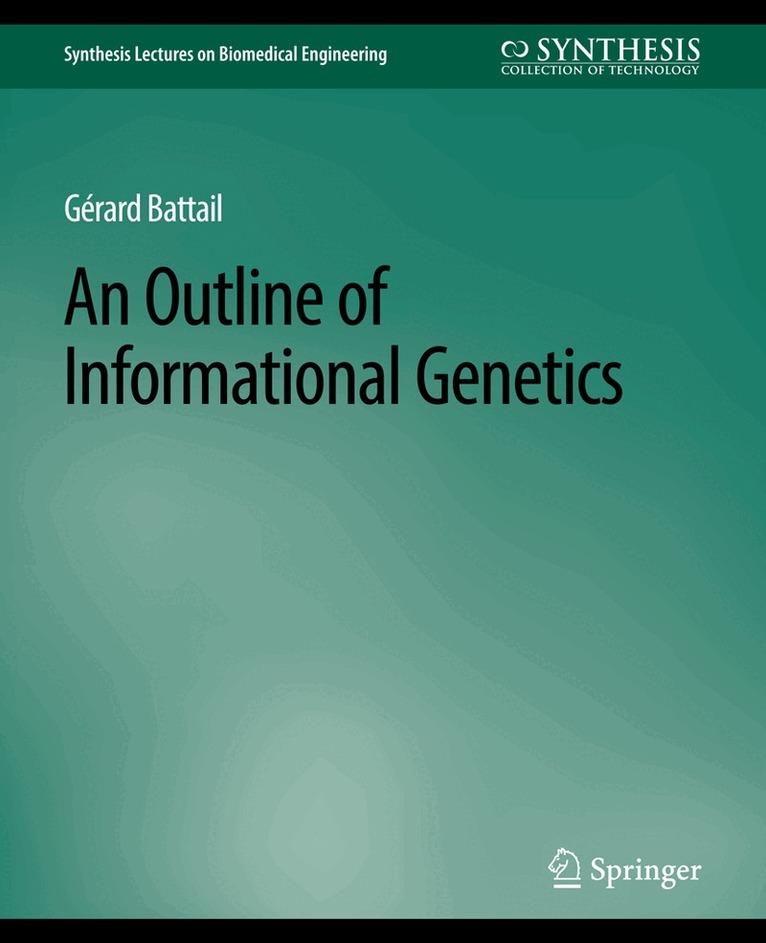
Heredity performs literal communication of immensely long genomes through immensely long time intervals. Genomes nevertheless incur sporadic errors referred to as mutations which have significant and often dramatic effects, after a time interval as short as a human life. How can faithfulness at a very large timescale and unfaithfulness at a very short one be conciliated? The engineering problem of literal communication has been completely solved during the second half of the XX-th century. Originating in 1948 from Claude Shannon's seminal work, information theory provided means to measure information quantities and proved that communication is possible through an unreliable channel (by means left unspecified) up to a sharp limit referred to as its capacity, beyond which communication becomes impossible. The quest for engineering means of reliable communication, named error-correcting codes, did not succeed in closely approaching capacity until 1993 when Claude Berrou and Alain Glavieuxinvented turbocodes. By now, the electronic devices which invaded our daily lives (e.g., CD, DVD, mobile phone, digital television) could not work without highly efficient error-correcting codes. Reliable communication through unreliable channels up to the limit of what is theoretically possible has become a practical reality: an outstanding achievement, however little publicized. As an engineering problem that nature solved aeons ago, heredity is relevant to information theory. The capacity of DNA is easily shown to vanish exponentially fast, which entails that error-correcting codes must be used to regenerate genomes so as to faithfully transmit the hereditary message. Moreover, assuming that such codes exist explains basic and conspicuous features of the living world, e.g., the existence of discrete species and their hierarchical taxonomy, the necessity of successive generations and even the trend of evolution towards increasingly complex beings. Providing geneticists with an introduction to information theory and error-correcting codes as necessary tools of hereditary communication is the primary goal of this book. Some biological consequences of their use are also discussed, and guesses about hypothesized genomic codes are presented. Another goal is prompting communication engineers to get interested in genetics and biology, thereby broadening their horizon far beyond the technological field, and learning from the most outstanding engineer: Nature. Table of Contents: Foreword / Introduction / A Brief Overview of Molecular Genetics / An Overview of Information Theory / More on Molecular Genetics / More on Information Theory / An Outline of Error-Correcting Codes / DNA is an Ephemeral Memory / A Toy Living World / Subsidiary Hypothesis, Nested System / Soft Codes / Biological Reality Conforms to the Hypotheses / Identification of Genomic Codes / Conclusion and Perspectives
1 053 kr
Skickas inom 10-15 vardagar
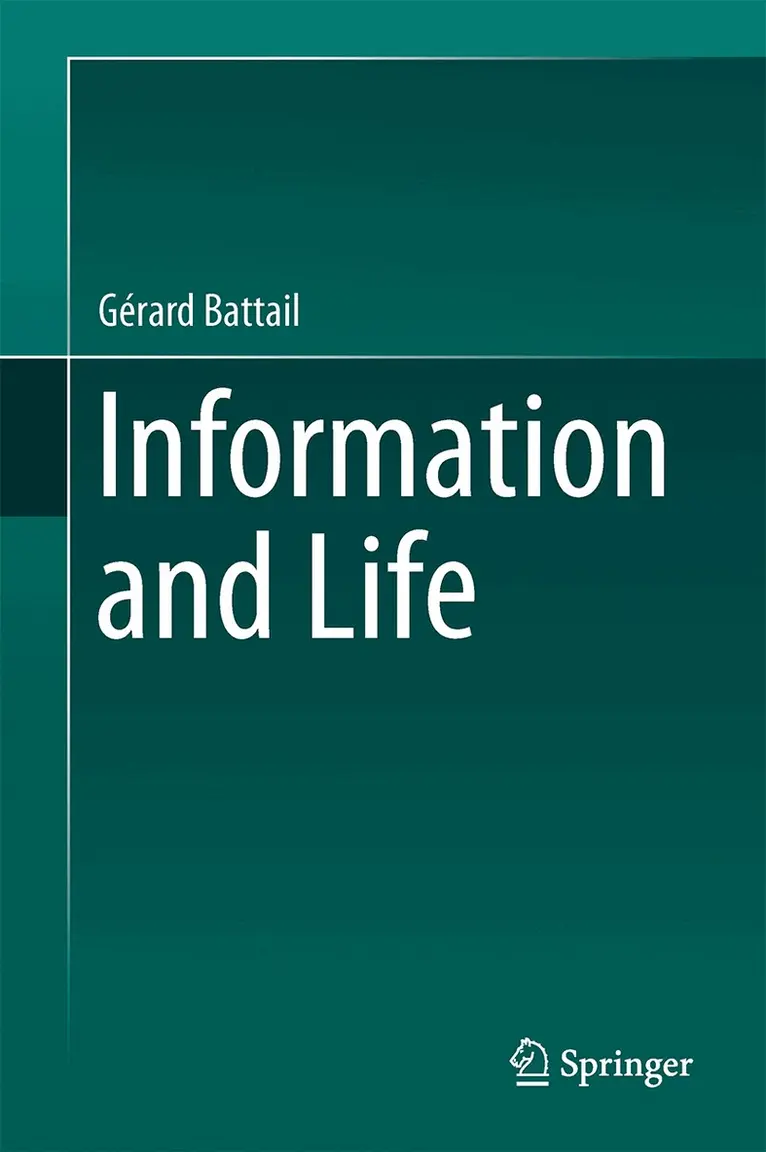
Communication, one of the most important functions of life, occurs at any spatial scale from the molecular one up to that of populations and ecosystems, and any time scale from that of fast chemical reactions up to that of geological ages. Information theory, a mathematical science of communication initiated by Shannon in 1948, has been very successful in engineering, but biologists ignore it.This book aims at bridging this gap. It proposes an abstract definition of information based on the engineers' experience which makes it usable in life sciences. It expounds information theory and error-correcting codes, its by-products, as simply as possible. Then, the fundamental biological problem of heredity is examined. It is shown that biology does not adequately account for the conservation of genomes during geological ages, which can be understood only if it is assumed that genomes are made resilient to casual errors by proper coding. Moreover, the good conservation of very old parts of genomes, like the HOX genes, implies that the assumed genomic codes have a nested structure which makes an information the more resilient to errors, the older it is.The consequences that information theory draws from these hypotheses meet very basic but yet unexplained biological facts, e.g., the existence of successive generations, that of discrete species and the trend of evolution towards complexity. Being necessarily inscribed on physical media, information appears as a bridge between the abstract and the concrete. Recording, communicating and using information exclusively occur in the living world. Information is thus coextensive with life and delineates the border between the living and the inanimate.
1 069 kr
Skickas inom 10-15 vardagar
Communication, one of the most important functions of life, occurs at any spatial scale from the molecular one up to that of populations and ecosystems, and any time scale from that of fast chemical reactions up to that of geological ages. Information theory, a mathematical science of communication initiated by Shannon in 1948, has been very successful in engineering, but biologists ignore it.This book aims at bridging this gap. It proposes an abstract definition of information based on the engineers' experience which makes it usable in life sciences. It expounds information theory and error-correcting codes, its by-products, as simply as possible. Then, the fundamental biological problem of heredity is examined. It is shown that biology does not adequately account for the conservation of genomes during geological ages, which can be understood only if it is assumed that genomes are made resilient to casual errors by proper coding. Moreover, the good conservation of very old parts of genomes, like the HOX genes, implies that the assumed genomic codes have a nested structure which makes an information the more resilient to errors, the older it is.The consequences that information theory draws from these hypotheses meet very basic but yet unexplained biological facts, e.g., the existence of successive generations, that of discrete species and the trend of evolution towards complexity. Being necessarily inscribed on physical media, information appears as a bridge between the abstract and the concrete. Recording, communicating and using information exclusively occur in the living world. Information is thus coextensive with life and delineates the border between the living and the inanimate.