Gerard L'E Turner - Böcker
Visar alla böcker från författaren Gerard L'E Turner. Handla med fri frakt och snabb leverans.
3 produkter
3 produkter
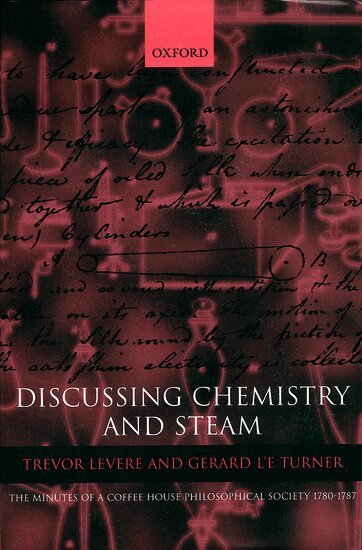
Discussing Chemistry and Steam
The Minutes of a Coffee House Philosophical Society 1780-1787
Inbunden, Engelska, 2002
2 933 kr
Skickas inom 5-8 vardagar
This book contains an edition of the Minutes of the Coffee House Philosophical Society 1780-1787, as transcribed by William Nicholson, the secretary to the society. The 1780s were exciting years for science and for its applications, and experimental philosophy and industrial development were closely interwoven. This coffee house society provided a group of natural philosophers with the oppotunity to discuss the topics that most interested them. The minutes themselves, unique in their completeness, constitute a continuous record of the fortnightly meetings of a group of leading natural philosophers, instrument makers, physicians, and industrialist entrepreneurs. They are an important resource for historians of politics and society (including the industrial revolution), as well as for historians of science and technology.In addition to a fully edited edition of the Minute book, and brief biographies of all the members, the book includes essays by Jan Golinski on the members' discussion about phlogiston and other issues relating to the chemical revolution, and by Larry Stewart on the reforming, radical, and industrial contexts of the networks to which the members belonged.One of the standard criticisms of English science in the late eighteenth century is its isolation from the rest of Europe. These minutes offer a very different picture.The members, the Irish chemist Richard Kirwan taking the most active role, discussed current issues in science and reported on scientific and industrial advances from all Europe, and even from Hudson's Bay, showing early English awareness of the latest developments. The Minute Book gives a sense of history at a particular period, and is invaluable to all historians, whatever their specialism.
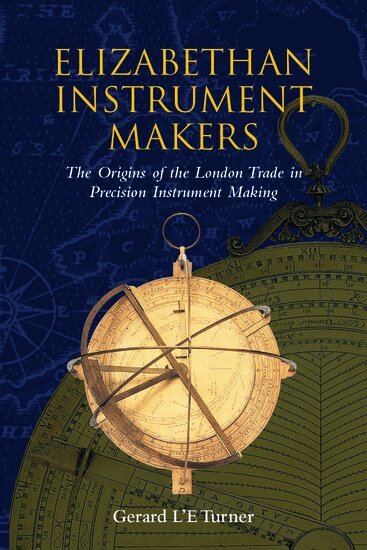
Elizabethan Instrument Makers
The Origins of the London Trade in Precision Instrument Making
Inbunden, Engelska, 2000
875 kr
Skickas inom 7-10 vardagar
Europe in the sixteenth century experienced a period of unprecedented vitality and innovation in the spheres of science and commerce. The Americas had been discovered and the colonizing nations had an urgent need for mathematical instruments for navigation and surveying. The Elizabethan age saw the establishment of the precision instrument-making trade in London, from 1540, a trade that would become world-famous in the succeeding two centuries.The first of a group of London makers was an immigrant from Flanders, Thomas Gemini, succeeded by the Englishman, Humfrey Cole.It has proved possible to find over 100 surviving mathematical instruments, signed and unsigned, made by a group of London makers during the reign of Queen Elizabeth I. This book describes these instruments in detail, together with the methods by which unsigned instruments are attributed. It tells how the skills of dividing and engraving on brass developed in parallel with the map-making and printing for which the Low Countries were the most important centre. There was already a demand in Elizabethan England for these skills, since accurate measurement was crucial to the professions of navigation, surveying, fortification, and gunnery. England, at war with Spain, eager to exploit the riches of the New World, and, at home, experiencing the re-distribution of monastic property to individual landowners, urgently needed these new professions.
1 957 kr
Skickas inom 10-15 vardagar
This book is about the archaeology of science, or what can be learnt from the systematic examination of the artefacts made by precision craftsmen for the study of the natural world. An international authority on historical scientific instruments, Gerard Turner has collected here his essays on European astrolabes and related topics. By 1600 the astrolabe had nearly ceased to be made and used in the West, and before that date there was little of the source material for the study of instruments that exists for more modern times. It is necessary to 'read' the instruments themselves, and astrolabes in particular are rich in all sorts of information, mathematical, astronomical, metallurgical, in addition to what they can reveal about craftsmanship, the existence of workshops, and economic and social conditions. There is a strong forensic element in instrument research, and Gerard Turner's achievements include the identification of three astrolabes made by Gerard Mercator, all of whose instruments were thought to have been destroyed. Other essays deal with the discovery of an important late 16th-century Florentine workshop, and of a group of mid-15th-century German astrolabes linked to Regiomontanus.