Gerry Gilmore – författare
Visar alla böcker från författaren Gerry Gilmore. Handla med fri frakt och snabb leverans.
8 produkter
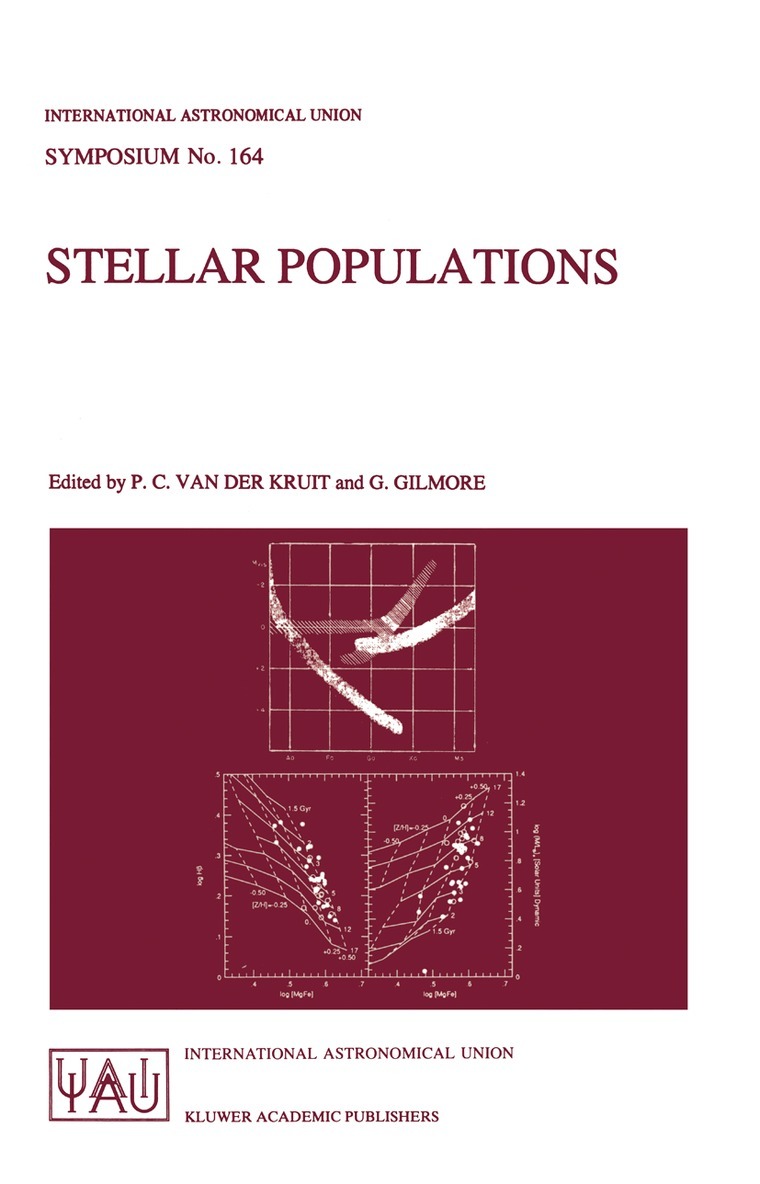
Stellar Populations
Proceedings of the 164th Symposium of the International Astronomical Union, Held in the Hague, The Netherlands, August 15–19, 1994
Av Piet C. van der Kruit, Gerry Gilmore
Inbunden, 1995
1639 kr
Lägg i varukorg
The subject of stellar populations touches on almost every field of astronomy and astrophysics. As well as commemorating the 50th anniversary of the beginnings of the subject, this book brings together experts on all relevant parts of astrophysics to discuss the outstanding questions relating to …
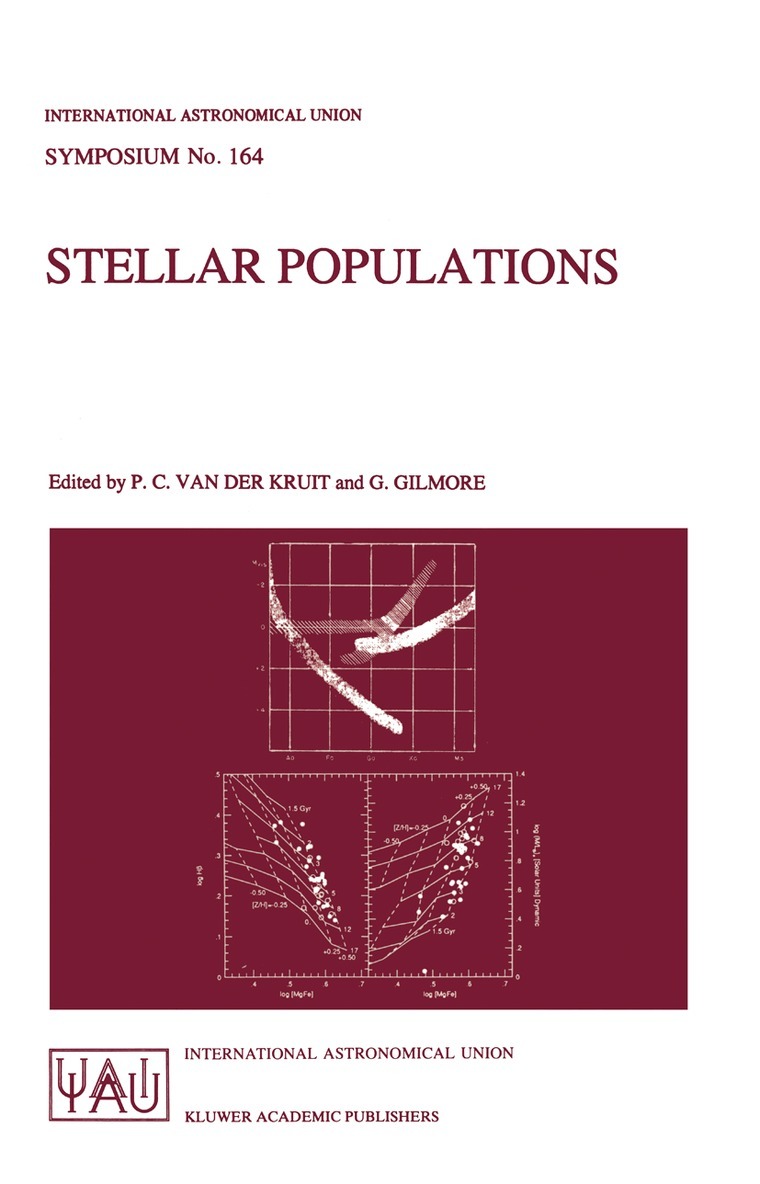
Stellar Populations
Proceedings of the 164th Symposium of the International Astronomical Union, Held in the Hague, The Netherlands, August 15–19, 1994
Av Piet C. van der Kruit, Gerry Gilmore
Häftad, 1995
1639 kr
Lägg i varukorg
The concept of Stellar Populations has played a fundamental role in astronomy in the last few decades. It was introduced by Walter Baade after he was able to resolve the Andromeda Nebula and its companions into stars when he used red-sensitive plates and realised that there were two fundamentally …
Galaxy
Av Gerry Gilmore, Bob Carswell
Inbunden, 1987
2183 kr
Lägg i varukorg
The Milky Way Galaxy offers a unique opportunity to study the structure and contents of a major stellar system in three dimensions, at high spatial and spectral resolution, and to very large galactocentric distances. This potential can be realised only by statistical surveys of large areas of the …
Baryonic Dark Matter
Av Gerry Gilmore, D. Lynden-Bell
E-bok, 2012
710 kr
Lägg i varukorg
The visible universe is a small perturbation on the material universe. Zwicky and Sinclair Smith in the 1930s gave evidence of invisible mass in the Coma and Virgo Clusters of Galaxies. Better optical data has only served to confound their critics and the X-ray data confirms that the gravitational …
Galaxy
Av Bob Carswell, Gerry Gilmore
E-bok, 2012
2925 kr
Lägg i varukorg
The Milky Way Galaxy offers a unique opportunity to study the structure and contents of a major stellar system in three dimensions, at high spatial and spectral resolution, and to very large galactocentric distances. This potential can be realised only by statistical surveys of large areas of the …
Baryonic Dark Matter
Av D. Lynden-Bell, Gerry Gilmore
Häftad, 2011
551 kr
Lägg i varukorg
The visible universe is a small perturbation on the material universe. Zwicky and Sinclair Smith in the 1930s gave evidence of invisible mass in the Coma and Virgo Clusters of Galaxies. Better optical data has only served to confound their critics and the X-ray data confirms that the gravitational …
Galaxy
Av Gerry Gilmore, Bob Carswell
Häftad, 2011
2183 kr
Lägg i varukorg
The Milky Way Galaxy offers a unique opportunity to study the structure and contents of a major stellar system in three dimensions, at high spatial and spectral resolution, and to very large galactocentric distances. This potential can be realised only by statistical surveys of large areas of the …
Stellar Populations
Proceedings of the 164th Symposium of the International Astronomical Union, Held in the Hague, The Netherlands, August 15–19, 1994
Av Gerry Gilmore, Piet C. van der Kruit
E-bok, 2013
2111 kr
Lägg i varukorg
The concept of Stellar Populations has played a fundamental role in astronomy in the last few decades. It was introduced by Walter Baade after he was able to resolve the Andromeda Nebula and its companions into stars when he used red-sensitive plates and realised that there were two fundamentally …