Gertrud the Great of Helfta - Böcker
Visar alla böcker från författaren Gertrud the Great of Helfta. Handla med fri frakt och snabb leverans.
5 produkter
5 produkter
Del 88 - Cistercian Fathers Series
Memorial of the Abundance of the Divine Sweetness
Häftad, Engelska, 2022
634 kr
Skickas inom 5-8 vardagar
Gertrud the Great (1256–1302) entered the monastery of Helfta in eastern Germany as a child oblate. At the age of twenty-five she underwent a conversion that led to a series of visionary experiences, some of which she recorded in Latin “with her own hand,” in what became Book Two of The Herald of God’s Loving-Kindness, the standard version of her revelations. The other four books were written down by a close confidant of the saint, now often known as "Sister N."Recently a different version of Gertrud's revelations has been discovered, in an early fourteenth-century manuscript held at the University of Leipzig, Germany, much older than the known manuscripts of The Herald. The Memorial of the Abundance of the Divine Sweetness is shorter than The Herald, and while the two versions have some text in common (notably most of The Herald's Book Two), the new manuscript also contains some completely new material, which sometimes modifies and sometimes complements what readers already know of the saint.
572 kr
Skickas inom 5-8 vardagar
Gertrud the Great (1256–1302) entered the monastery of Helfta in eastern Germany as a child oblate. At the age of twenty-five she underwent a conversion that led to a series of visionary experiences. These centered on “the divine loving-kindness,” which she perceived as expressed through and symbolized by Christ’s divine Heart. Some of these experiences she recorded in Latin “with her own hand,” in what became book 2 of The Herald of God’s Loving-Kindness.Books 1, 3, 4, and 5 were written down by another nun, a close confidant of the saint, now often known as "Sister N." Book 5 details the sickness, deaths, and afterlife fates of various Helfta nuns, novices, and lay brothers, as witnessed by Gertrud in her visions. It also describes Gertrud’s preparations for her own death and her predictive visions of her ultimate glorification in heaven. The Herald concludes with Sister N.’s personal account of her presentation of the whole book to the Lord at Mass, the welcome he gave it, and the privileges he attached to it.The Book of Special Grace, which mainly records the visions of Mechtild of Hackeborn, was probably compiled by Gertrud herself with the help of Sister N. Parts 6 and 7 recount the deaths of the abbess Gertrud and of Mechtild, her younger sister. As many passages overlap, sometimes verbatim, with corresponding chapters in book 5 of The Herald, a translation has been included for purposes of comparison.
501 kr
Skickas inom 3-6 vardagar
Gertrud the Great (1256–1302) entered the monastery of Helfta in eastern Germany as a child oblate. At the age of twenty-five she underwent a conversion that led to a series of visionary experiences. These centered on “the divine loving-kindness,” which she perceived as expressed through and symbolized by Christ’s divine Heart. Some of these experiences she recorded in Latin “with her own hand,” in what became Book 2 of The Herald of God’s Loving-Kindness. Books 1, 3, 4, and 5 were written down by another nun, a close confidant of the saint, now often known as “Sister N.” Book 4 records Gertrud’s many vivid spiritual experiences, which took place on various liturgical feasts when she was too sick to take part in the community’s worship. Foregrounding visions of the court of heaven and dialogues with Christ, the Virgin Mary, and other saints, they further develop devotional themes already present in the earlier books. Often profoundly indebted to the liturgy of Mass and office, they have been carefully arranged according to the ecclesiastical year by the medieval compiler.
361 kr
Skickas inom 3-6 vardagar
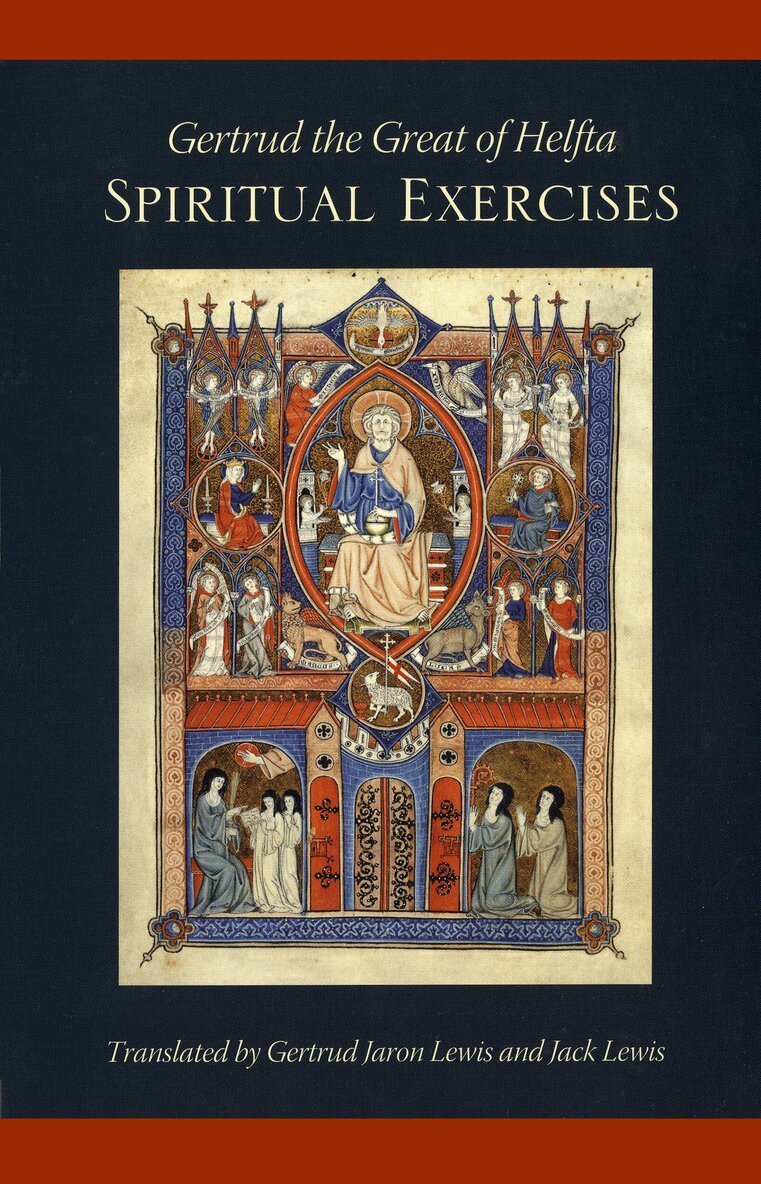
The remarkable monastery of Helfta was a 'place where learning and art, courtesy and holiness flowered in a dark season' of interregnal warfare.* The nuns drew their inspiration from the twin roots of Citeaux: the Rule of Saint Benedict and the constitutions of Citeaux; their spirituality, liturgy, customs, and habits were modelled on those of the White Monks, even though juridically they were not part of the Cistercian Order. Under the guidance of the thirteenth-century abbess Gertrud of Hackeborn, the nuns of Helfta steadfastly pursued learning and holiness. Among them were three outstanding women whose works have come down through the centuries: Mechtilde of Hackeborn, Mechtilde of Magdeburg, and the scholarly Gertrud the Great. Having entered monastic life at the age of five, Gertrud combined a deep knowledge of the Church Fathers and earlier medieval writers, an intimate familiarity with Scripture, and innate common sense. Her Spiritual Exercises—prayers, litanies, meditations, and hymns—articulate a spirituality that is both traditionally monastic and authentically, but unself-consciously, feminine. Hers is a mysticism of light and love, of humility and commitment, of freedom and discipline and—most of all—of joy. *M. Jeremy Finnegan OP, 'The Women of Helfta', Peace Weavers, Medieval Religious Women, 2:212.
Del 35 - Cistercian Fathers Series
Herald of God's Loving-Kindness Books 1 and 2
Häftad, Engelska, 1991
371 kr
Skickas inom 3-6 vardagar
Gertrud the Great (1256–1302) entered the monastery of Helfta in eastern Germany as a child oblate. At the age of twenty-five she underwent a conversion that led to a series of visionary experiences. These centered on “the divine loving-kindness,” which she perceived as expressed through and symbolized by Christ’s divine Heart. Some of these experiences she recorded in Latin “with her own hand,” in what became Book 2 of The Herald of God’s Loving-Kindness. Books 1, 3, 4, and 5 were written down by another nun, a close confidant of the saint, now often known as “Sister N.” Book 4 records Gertrud’s many vivid spiritual experiences, which took place on various liturgical feasts when she was too sick to take part in the community’s worship. Foregrounding visions of the court of heaven and dialogues with Christ, the Virgin Mary, and other saints, they further develop devotional themes already present in the earlier books. Often profoundly indebted to the liturgy of Mass and office, they have been carefully arranged according to the ecclesiastical year by the medieval compiler. Book 2, describes Gertrud's personality and, in her own words, her spiritual experiences.