Gianni Carchia - Böcker
Visar alla böcker från författaren Gianni Carchia. Handla med fri frakt och snabb leverans.
3 produkter
3 produkter
235 kr
Skickas inom 7-10 vardagar
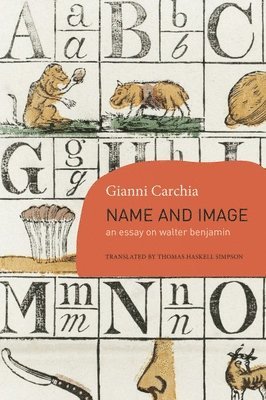
An insightful study of Walter Benjamin, one of the most important philosophers of the twentieth century, by the Italian philosopher Gianni Carchia. Name and Image crystalizes Gianni Carchia’s lifelong pursuit of the infinite philosophical object in the method and thought of one of the most important philosophers of the twentieth century: Walter Benjamin. This intellectual biography touches upon the philosophy of language, historiography, aesthetics, temporality, and transcendental philosophy. The book has the singular distinction of being both Gianni Carchia’s first and last work. In the spring of 1999, shortly before the resurgence of the disease that would lead to his death, Carchia began revising the graduate thesis he had defended at the University of Turin in 1971 with the title Truth and Language in the Young Walter Benjamin. At age twenty-four, the young scholar already demonstrated the incisive, axiomatic style of a master. The final version, retitled Name and Image, would become his testament. With a remarkable inversion, beginning and end seem to conjoin here in an authentically philosophical act, as though all the motifs of Carchia’s late thought—the conception of philosophy as event and witness, critique of method, and messianic finality—resonated together for the first time in this youthful text. The physiognomy of Benjamin that opens the work is the self-portrait of a figure who stands out ever more as one of the most just voices in twentieth-century Italian philosophy.
580 kr
Kommande
A reimagining of the ancient Greek mystical movement Orphism. What does it mean to step outside the civic order through poetry? Ever since it first emerged in Greece around the sixth century BC, Orphic doctrine has marked a powerful rupture with the ancient world. Its salvific practices, closely tied to a belief in the soul’s immortality, its resolute rejection of sacrificial ritual and embrace of vegetarianism, and its distinctive conception of time and memory all defined a way of life, the bios orphikos, that was at once poetic and political.In this brief yet densely layered text, Gianni Carchia returns to Orphism in all its implications. It becomes clear that, for Carchia, Orphism is not merely a historiographical concern, but an aesthetic and political one. If tragedy constitutes one of the central pillars around which the polis was formed, Orphism represents a radically different path—an alternative to the polis itself—by placing the poetic word, in all its autonomous power, at its core. And if the relationship between philosophy and tragedy has long been a central theme in the history of Western thought, Carchia’s reflections here ask a different question: Is the Orphic path still accessible to us today?
2 026 kr
Kommande
A reimagining of the ancient Greek mystical movement Orphism. What does it mean to step outside the civic order through poetry? Ever since it first emerged in Greece around the sixth century BC, Orphic doctrine has marked a powerful rupture with the ancient world. Its salvific practices, closely tied to a belief in the soul’s immortality, its resolute rejection of sacrificial ritual and embrace of vegetarianism, and its distinctive conception of time and memory all defined a way of life, the bios orphikos, that was at once poetic and political.In this brief yet densely layered text, Gianni Carchia returns to Orphism in all its implications. It becomes clear that, for Carchia, Orphism is not merely a historiographical concern, but an aesthetic and political one. If tragedy constitutes one of the central pillars around which the polis was formed, Orphism represents a radically different path—an alternative to the polis itself—by placing the poetic word, in all its autonomous power, at its core. And if the relationship between philosophy and tragedy has long been a central theme in the history of Western thought, Carchia’s reflections here ask a different question: Is the Orphic path still accessible to us today?