Gilbert Gagné – författare
Visar alla böcker från författaren Gilbert Gagné. Handla med fri frakt och snabb leverans.
8 produkter
Preferential Trade Agreements and Cultural Products
Inbunden, 2024
2309 kr
Lägg i varukorg
This book discusses the treatment of cultural products within international trade law, focusing on preferential trade agreements.Trade and culture intersect when cultural products are involved. These mainly encompass cinema, broadcasting, music, videos, and publishing, either in traditional or …
Preferential Trade Agreements and Cultural Products
Häftad, 2026
649 kr
Lägg i varukorg
This book discusses the treatment of cultural products within international trade law, focusing on preferential trade agreements.Trade and culture intersect when cultural products are involved. These mainly encompass cinema, broadcasting, music, videos, and publishing, either in traditional or …
Preferential Trade Agreements and Cultural Products
E-bok, 2024
765 kr
Lägg i varukorg
This book discusses the treatment of cultural products within international trade law, focusing on preferential trade agreements. Trade and culture intersect when cultural products are involved. These mainly encompass cinema, broadcasting, music, videos, and publishing, either in traditional or …
Preferential Trade Agreements and Cultural Products
E-bok, 2024
765 kr
Lägg i varukorg
This book discusses the treatment of cultural products within international trade law, focusing on preferential trade agreements. Trade and culture intersect when cultural products are involved. These mainly encompass cinema, broadcasting, music, videos, and publishing, either in traditional or …
Trade and Culture Debate
Evidence from US Trade Agreements
Inbunden, 2016
1138 kr
Lägg i varukorg
As the first exporter of cultural goods and services, the United States has long held that such products should be treated like any other merchandise and be liberalized. On the other hand, for countries such as France and Canada who are concerned about the impact of economic globalization and the …
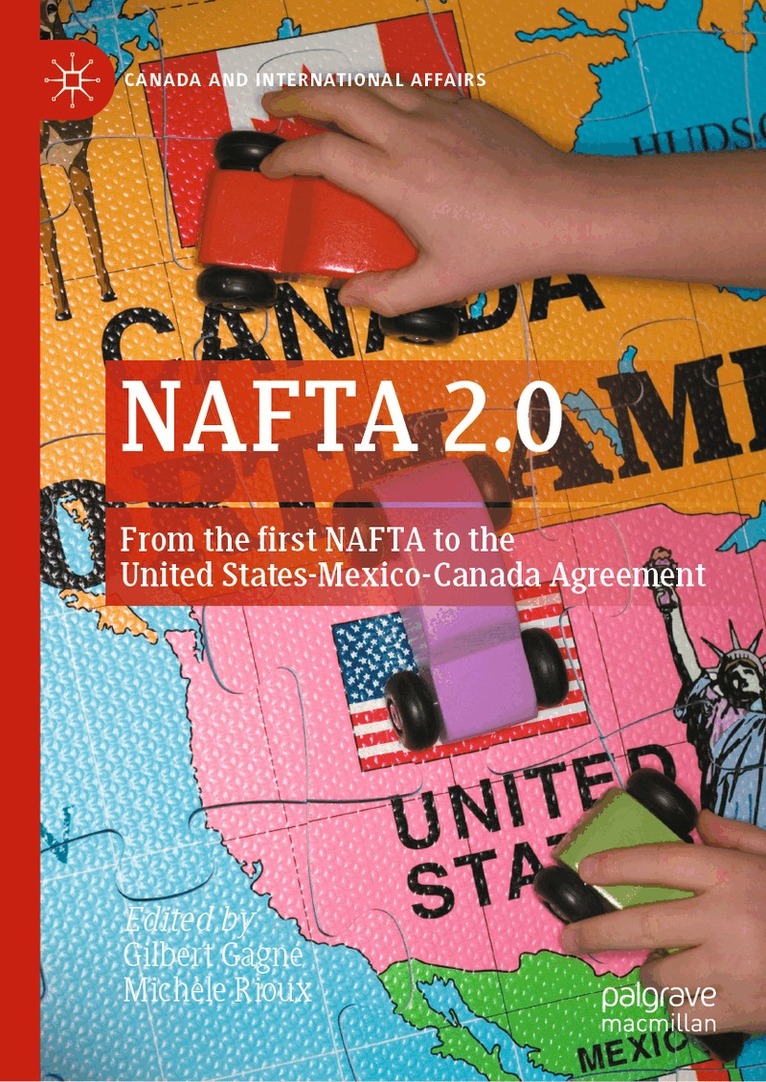
NAFTA 2.0
From the first NAFTA to the United States-Mexico-Canada Agreement
Av Gilbert Gagné, Michèle Rioux
Inbunden, 2021
1641 kr
Lägg i varukorg
The renegotiation and possible termination of the North American Free Trade Agreement (NAFTA) sparked a lot of interest and concern in light of the United States’ declared objective to “rebalance the benefits” of the agreement. This edited book provides an overview of the changes brought to the …
NAFTA 2.0
From the first NAFTA to the United States-Mexico-Canada Agreement
Av Michele Rioux, Gilbert Gagne
E-bok, 2021
2111 kr
Lägg i varukorg
The renegotiation and possible termination of the North American Free Trade Agreement (NAFTA) sparked a lot of interest and concern in light of the United States’ declared objective to “rebalance the benefits” of the agreement. This edited book provides an overview of the changes brought to the …
NAFTA 2.0
From the first NAFTA to the United States-Mexico-Canada Agreement
Av Gilbert Gagné, Michèle Rioux
Häftad, 2022
1641 kr
Lägg i varukorg
The renegotiation and possible termination of the North American Free Trade Agreement (NAFTA) sparked a lot of interest and concern in light of the United States’ declared objective to “rebalance the benefits” of the agreement. This edited book provides an overview of the changes brought to the …