Giorgio Gambosi - Böcker
Visar alla böcker från författaren Giorgio Gambosi. Handla med fri frakt och snabb leverans.
4 produkter
4 produkter
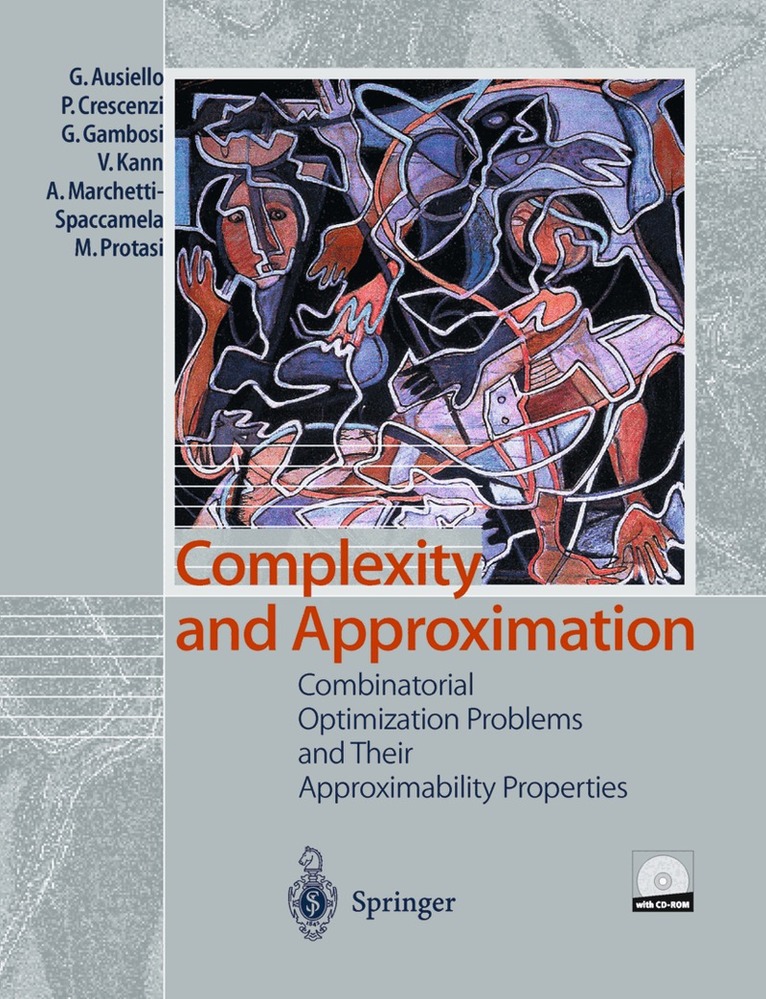
Complexity and Approximation
Combinatorial Optimization Problems and Their Approximability Properties
Inbunden, Engelska, 1999
902 kr
Skickas inom 10-15 vardagar
This book is an up-to-date documentation of the state of the art in combinatorial optimization, presenting approximate solutions of virtually all relevant classes of NP-hard optimization problems. The well-structured wealth of problems, algorithms, results, and techniques introduced systematically will make the book an indispensible source of reference for professionals. The smooth integration of numerous illustrations, examples, and exercises make this monograph an ideal textbook.
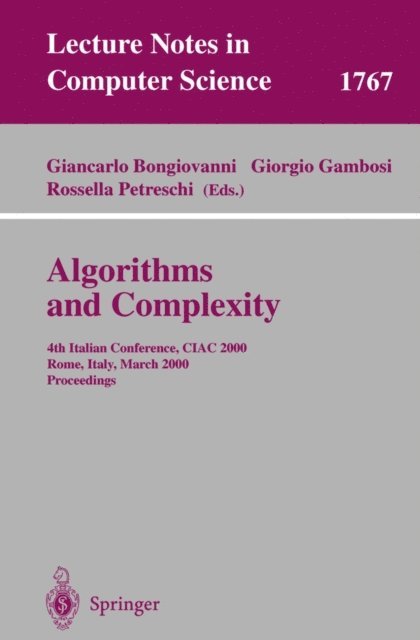
Algorithms and Complexity
4th Italian Conference, CIAC 2000 Rome, Italy, March 1-3, 2000 Proceedings
Häftad, Engelska, 2000
550 kr
Skickas inom 10-15 vardagar
This book constitutes the refereed proceedings of the 4th Italian Conference on Algorithms and Complexity, CIAC 2000, held in Rome, Italy, in March 2000. The 21 revised full papers presented were carefully reviewed and selected from 41 submissions; also included are four invited survey papers. Among the topics addressed are combinatorial optimization, graph algorithms, graph computations, complexity theory, diagram design, approximation, scheduling, sorting, computational geometry, searching, and pattern matching.
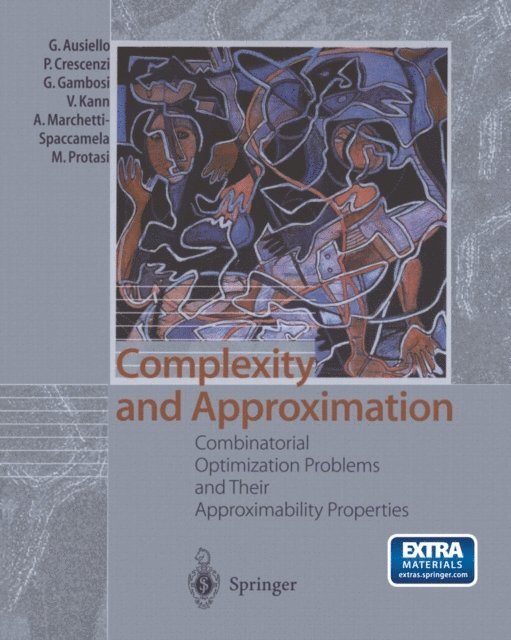
Complexity and Approximation
Combinatorial Optimization Problems and Their Approximability Properties
Häftad, Engelska, 2013
745 kr
Skickas inom 10-15 vardagar
N COMPUTER applications we are used to live with approximation. Var I ious notions of approximation appear, in fact, in many circumstances. One notable example is the type of approximation that arises in numer ical analysis or in computational geometry from the fact that we cannot perform computations with arbitrary precision and we have to truncate the representation of real numbers. In other cases, we use to approximate com plex mathematical objects by simpler ones: for example, we sometimes represent non-linear functions by means of piecewise linear ones. The need to solve difficult optimization problems is another reason that forces us to deal with approximation. In particular, when a problem is computationally hard (i. e. , the only way we know to solve it is by making use of an algorithm that runs in exponential time), it may be practically unfeasible to try to compute the exact solution, because it might require months or years of machine time, even with the help of powerful parallel computers. In such cases, we may decide to restrict ourselves to compute a solution that, though not being an optimal one, nevertheless is close to the optimum and may be determined in polynomial time. We call this type of solution an approximate solution and the corresponding algorithm a polynomial-time approximation algorithm. Most combinatorial optimization problems of great practical relevance are, indeed, computationally intractable in the above sense. In formal terms, they are classified as Np-hard optimization problems.
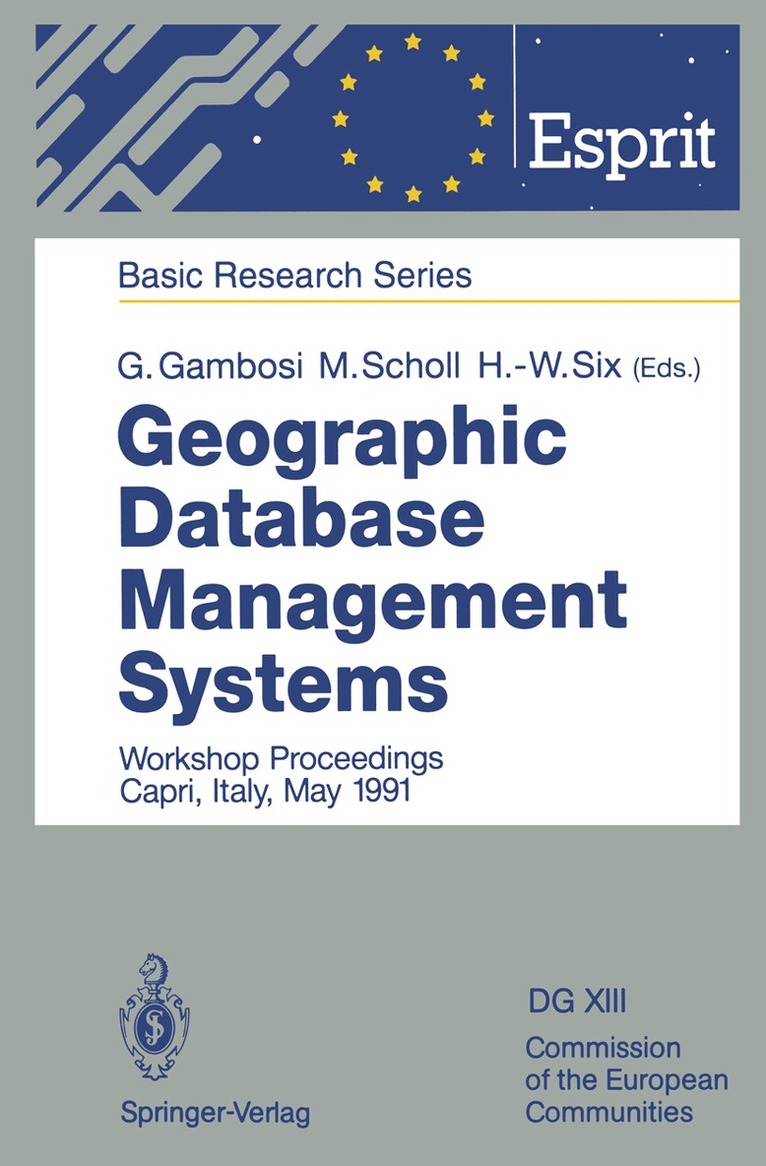
Geographic Database Management Systems
Workshop Proceedings Capri, Italy, May 1991
Häftad, Engelska, 2011
1 092 kr
Skickas inom 10-15 vardagar
Geographical Information Systems are becoming increasingly important to geologists, geographers, and urban and environmental planners, amongst others. Although there is an increasing number of such systems available on the market, many questions of a theoretical nature need to be addressed, because of the inherently large amounts of data and the lack of appropriate models and languages. Also, there is a need for flexible and efficient usage of GIS, thus permitting their application in a broad range of new areas, such as navigation systems for transport and the automotive industry. ESPRIT Working Groups provide a structure that enables researchers to meet, interact and share research results, thus providing a platform for ad dressing fertile research areas with significant industrial promise. This par ticular volume is the result of a workshop organised by the "Basic GOODS" Working Group. The challenge has been to define richer and more powerful data definition and manipulation languages, and also to develop new and efficient algorithms. The challenge has been met, as presented in this volume, and the Working Group has succeeded in laying a good foundation for future research and eventual applications. We look forward to seeing the results of the recently launched "AMUSING" project, which will build on this foundation.