Gordon M. Sayre - Böcker
Visar alla böcker från författaren Gordon M. Sayre. Handla med fri frakt och snabb leverans.
5 produkter
5 produkter
745 kr
Skickas inom 7-10 vardagar
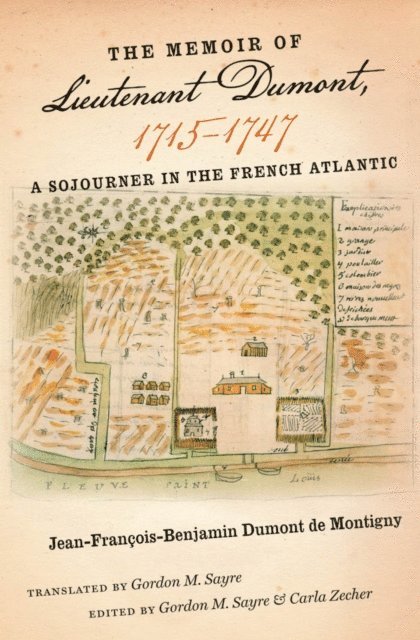
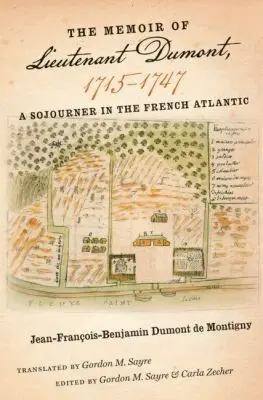
In 1719, Jean-Francois-Benjamin Dumont de Montigny, son of a Paris lawyer, set sail for Louisiana with a commission as a lieutenant after a year in Quebec. During his peregrinations over the next eighteen years, Dumont came to challenge corrupt officials, found himself in jail, eked out a living as a colonial subsistence farmer, survived life-threatening storms and epidemics, encountered pirates, witnessed the 1719 battle for Pensacola, described the 1729 Natchez Uprising, and gave account of the 1739–1740 French expedition against the Chickasaw. Dumont's adventures, as recorded in his 1747 memoir conserved at the Newberry Library, underscore the complexity of the expanding French Atlantic world, offering a singular perspective on early colonialism in Louisiana. His life story also provides detailed descriptions and illustrations of the peoples and environment of the lower Mississippi Valley. This English translation of the unabridged memoir features a new introduction, maps, and a biographical dictionary to enhance the text. Dumont emerges here as an important colonial voice and brings to vivid life the French Atlantic.
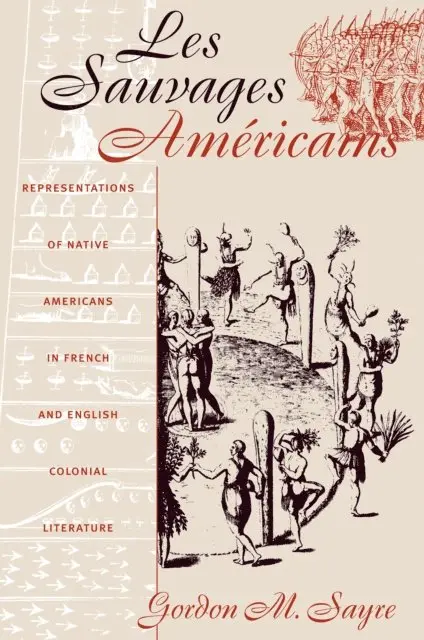
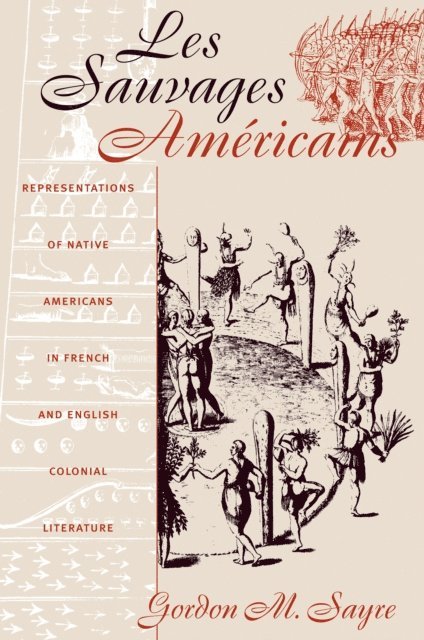
Les Sauvages Américains
Representations of Native Americans in French and English Colonial Literature
Häftad, Engelska, 1997
591 kr
Skickas inom 10-15 vardagar
Algonquian and Iroquois natives of the American Northeast were described in great detail by colonial explorers who ventured into the region in the seventeenth and eighteenth centuries. Beginning with the writings of John Smith and Samuel de Champlain, Gordon Sayre analyzes French and English accounts of Native Americans to reveal the rhetorical codes by which their cultures were represented and the influence that these images of Indians had on colonial and modern American society. By emphasizing the work of Pierre Franaois-Xavier Charlevoix, Joseph-Franaois Lafitau, and Baron de Lahontan, among others, Sayre highlights the important contribution that French explorers and ethnographers made to colonial literature. Sayre's interdisciplinary approach draws on anthropology, cultural studies, and literary methodologies. He cautions against dismissing these colonial texts as purveyors of ethnocentric stereotypes, asserting that they offer insights into Native American cultures. Furthermore, early accounts of American Indians reveal Europeans' serious examination of their own customs and values: Sayre demonstrates how encounters with natives' wampum belts, tattoos, and pelt garments, for example, forced colonists to question the nature of money, writing, and clothing; and how the Indians' techniques of warfare and practice of adopting prisoners led to new concepts of cultural identity and inspired key themes in the European enlightenment and American individualism. |""Gilmore sets out . . . to reinterpret turn-of-the-century southern politics from the perspective of middle-class black women activists. She succeeds brilliantly. The book not only reclaims the long-buried stories of a group of richly compelling characters; it also redefines what should count as 'politics' in southern history."" American Historical Review
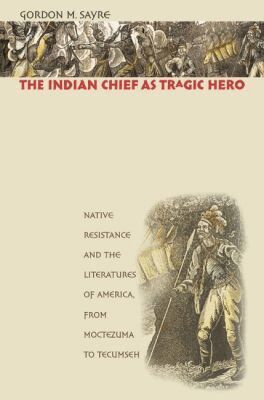
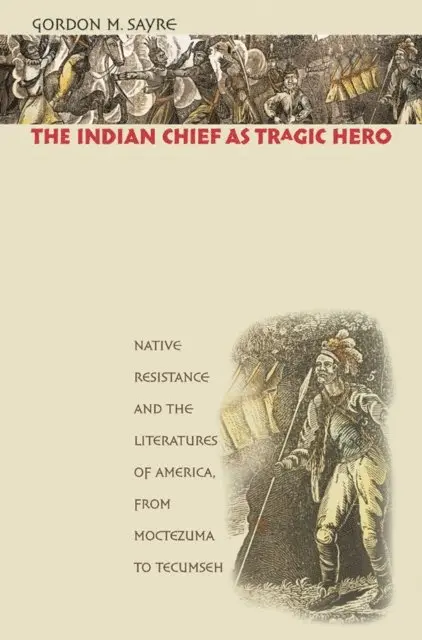
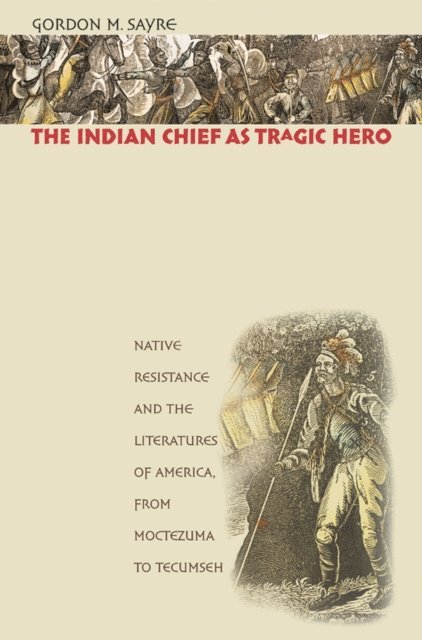
Indian Chief As Tragic Hero
Native Resistance and the Literatures of America, from Moctezuma to Tecumseh
Häftad, Engelska, 2005
483 kr
Skickas inom 10-15 vardagar
Talks about Native American leaders in the literatures of North America. The leaders of anticolonial wars of resistance - Metacom, Pontiac, Tecumseh, and Cuauhtemoc - spread fear across the frontiers of North America. Yet once defeated, these men became iconic martyrs for postcolonial national identity in Canada, the United States, and Mexico. By the early 1800s a craze arose for Indian tragedy on the U.S. stage, such as John Augustus Stone's ""Metamora"", and for Indian biographies as national historiography, such as the writings of Benjamin Drake, Francis Parkman, and William Apess. With chapters on seven major resistance struggles, including the Pueblo Revolt of 1680 and the Natchez Massacre of 1729, ""The Indian Chief as Tragic Hero"" offers an analysis of not only the tragedies and epics written about these leaders, but also their own speeches and strategies, as recorded in archival sources and narratives by adversaries including Hernan Cortes, Antoine-Simon Le Page du Pratz, Joseph Doddridge, Robert Rogers, and William Henry Harrison. Gordon M. Sayre concludes that these tragedies and epics about Native resistance laid the foundation for revolutionary culture and historiography in the three modern nations of North America, and that, at odds with the trope of the complaisant ""vanishing Indian,"" these leaders presented colonizers with a cathartic reproof of past injustices.
254 kr
Skickas inom 7-10 vardagar
The automobile has transformed Earth's habitats and humans' habits since the 1890s, when it, this Element argues, began the Anthropocene. Climate change now motivates efforts to reduce greenhouse gas emissions, of which cars and trucks account for at least 10 percent. Shifting to electric vehicles is not enough; one needs to better understand the power cars hold over humans. Environmental humanities scholars examine human/machine hybrids but have ignored the most obvious example. Humans driving cars are social agents constituting a civil society of automobility in roadscape environments. This Element traces the evolution of cars from horsecars, carriages, and bicycles, and the influence of Henry Ford and Alfred P. Sloan on labor standards and consumer behaviors. As the car industry pushes high-tech autonomous or self-driving vehicles, it relies on futuristic fantasies and false promises. The ills of automobility cannot be solved with new products that only intensify human dependence upon cars.
732 kr
Skickas inom 7-10 vardagar
The automobile has transformed Earth's habitats and humans' habits since the 1890s, when it, this Element argues, began the Anthropocene. Climate change now motivates efforts to reduce greenhouse gas emissions, of which cars and trucks account for at least 10 percent. Shifting to electric vehicles is not enough; one needs to better understand the power cars hold over humans. Environmental humanities scholars examine human/machine hybrids but have ignored the most obvious example. Humans driving cars are social agents constituting a civil society of automobility in roadscape environments. This Element traces the evolution of cars from horsecars, carriages, and bicycles, and the influence of Henry Ford and Alfred P. Sloan on labor standards and consumer behaviors. As the car industry pushes high-tech autonomous or self-driving vehicles, it relies on futuristic fantasies and false promises. The ills of automobility cannot be solved with new products that only intensify human dependence upon cars.