Graham Oddie - Böcker
Visar alla böcker från författaren Graham Oddie. Handla med fri frakt och snabb leverans.
3 produkter
3 produkter
1 876 kr
Skickas inom 7-10 vardagar
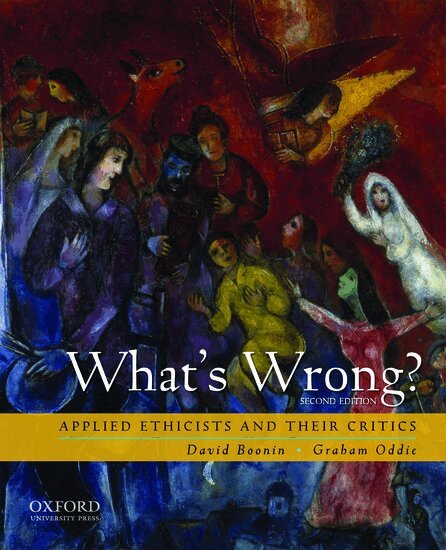
Is abortion morally permissible? Is it wrong to hunt animals for sport or to slaughter them for food? Should human cloning be permitted? Is torture ever justified? Now in a second edition, What's Wrong? Applied Ethicists and Their Critics presents a thorough and engaging exploration of these complex questions and twenty-four other contemporary ethical issues. Employing a unique approach to teaching argumentation, editors David Boonin and Graham Oddie open each chapter with an influential article that takes a strong stand on a particular issue; the essays that immediately follow offer objections and critical responses to the arguments put forth in the featured selection. This format helps students learn how to better engage in debates because it illustrates how philosophers argue with each other. Featuring a new section on applied ethics and ethical theory, the general introduction to this second edition also describes strategies for understanding and evaluating the different types of arguments contained in the readings. Detailed part and chapter introductions--streamlined in this edition--enable students to see precisely how the arguments presented in the various writings are related to one another. Questions for Consideration and updated and expanded Further Reading Lists are included at the end of each chapter. Featuring more than eighty readings organized into five parts--killing, sex, the family, race relations, and the state--What's Wrong? includes seminal essays by prominent philosophers alongside work by newer voices in the field. Addressing five new cutting-edge issues--overpopulation, campus hate speech codes, hate crime laws, torture, and global warming--the second edition includes fifteen new readings. Ideal for courses in applied ethics/contemporary moral problems and introduction to ethics, What's Wrong?, Second Edition, can also be used in critical thinking courses that emphasize philosophical argumentation.
1 479 kr
Skickas inom 5-8 vardagar
Value, Reality, and Desire is an extended argument for a robust realism about value. The robust realist affirms the following distinctive theses. There are genuine claims about value which are true or false - there are facts about value. These value-facts are mind-independent - they are not reducible to desires or other mental states, or indeed to any non-mental facts of a non-evaluative kind. And these genuine, mind-independent, irreducible value-facts are causally efficacious. Values, quite literally, affect us.These are not particularly fashionable theses, and taken as a whole they go somewhat against the grain of quite a lot of recent work in the metaphysics of value. Further, against the received view, Oddie argues that we can have knowledge of values by experiential acquaintance, that there are experiences of value which can be both veridical and appropriately responsive to the values themselves. Finally, these value-experiences are not the products of some exotic and implausible faculty of 'intuition'. Rather, they are perfectly mundane and familiar mental states - namely, desires. This view explains how values can be 'intrinsically motivating', without falling foul of the widely accepted 'queerness' objection. There are, of course, other objections to each of the realist's claims. In showing how and why these objections fail, Oddie introduces a wealth of interesting and original insights about issues of wider interest - including the nature of properties, reduction, supervenience, and causation. The result is a novel and interesting account which illuminates what would otherwise be deeply puzzling features of value and desire and the connections between them.
647 kr
Skickas inom 7-10 vardagar
Value, Reality, and Desire is an extended argument for a robust realism about value. The robust realist affirms the following distinctive theses. There are genuine claims about value which are true or false - there are facts about value. These value-facts are mind-independent - they are not reducible to desires or other mental states, or indeed to any non-mental facts of a non-evaluative kind. And these genuine, mind-independent, irreducible value-facts are causally efficacious. Values, quite literally, affect us.These are not particularly fashionable theses, and taken as a whole they go somewhat against the grain of quite a lot of recent work in the metaphysics of value. Further, against the received view, Oddie argues that we can have knowledge of values by experiential acquaintance, that there are experiences of value which can be both veridical and appropriately responsive to the values themselves. Finally, these value-experiences are not the products of some exotic and implausible faculty of 'intuition'. Rather, they are perfectly mundane and familiar mental states - namely, desires. This view explains how values can be 'intrinsically motivating', without falling foul of the widely accepted 'queerness' objection. There are, of course, other objections to each of the realist's claims. In showing how and why these objections fail, Oddie introduces a wealth of interesting and original insights about issues of wider interest - including the nature of properties, reduction, supervenience, and causation. The result is a novel and interesting account which illuminates what would otherwise be deeply puzzling features of value and desire and the connections between them.