Graham R. Fleming - Böcker
Visar alla böcker från författaren Graham R. Fleming. Handla med fri frakt och snabb leverans.
2 produkter
2 produkter
Del 46 - Springer Series in Chemical Physics
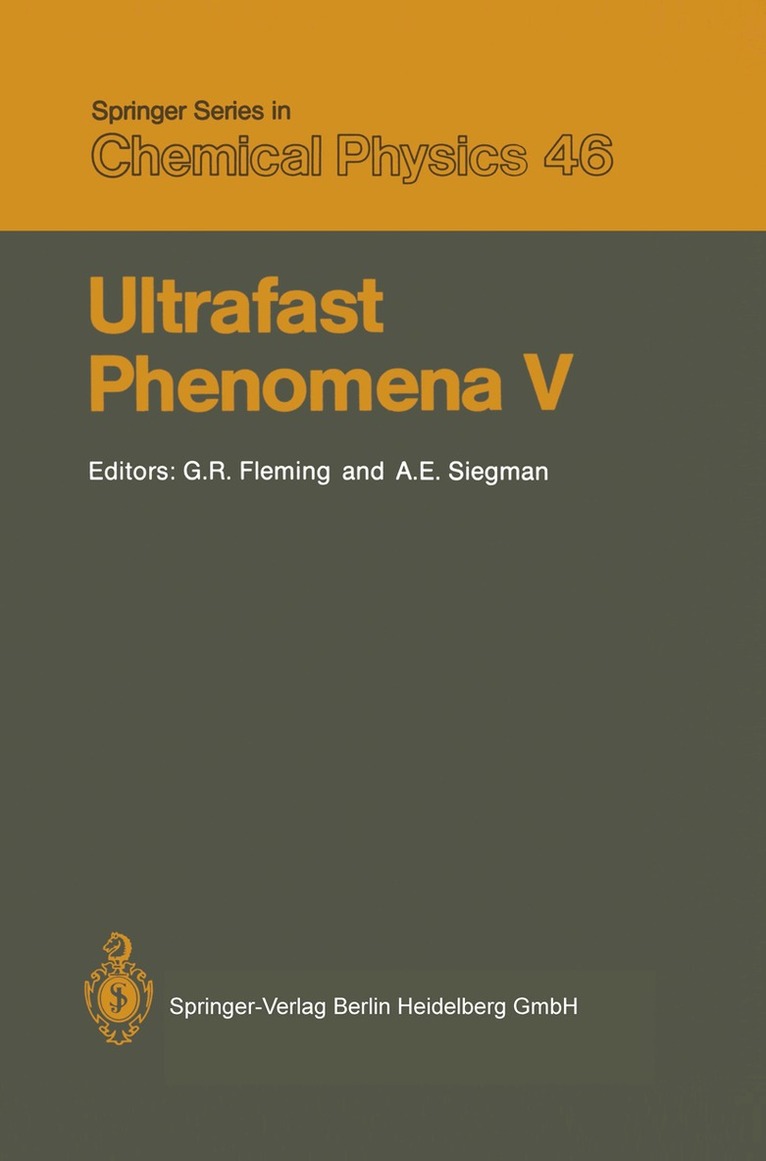
Ultrafast Phenomena V
Proceedings of the Fifth OSA Topical Meeting Snowmass, Colorado, June 16–19, 1986
Häftad, Engelska, 2014
1 059 kr
Skickas inom 10-15 vardagar
The first Optical Society of America (OSA) Topical Meeting on Picosec ond Phenomena, held at Hilton Head, South Carolina, in 1978, brought together in a congenial setting an interdisciplinary group of laser engineers and physicists who were exploring the emerging technologies for generat ing and applying picosecond optical pulses, together with scientists from the fields of chemistry, physics, biology, and electronics who saw in those pulses capabilities for studying atomic and molecular phenomena on time scales previously unrealizable. The technology in this field has since developed even more rapidly and remarkably than foreseen eight years ago, and the applications to science and technology, in physics, chemistry, biology, electronics, and commu nications, have proven to be equally extraordinary. Optical pulses with pulse widths shorter than 10 femtosecond - only a few optical cycles in du ration - along with mono cycle infrared pulses, complex nonlinear optical solitons, electrooptic techniques with subpicosecond time resolutions, and a full toolkit of measurement and detection techniques have now emerged, including new methods for making ultrafast measurements in some cases even without ultrafast optical pulses. These tools are now being widely applied to study the internal motions of complex molecules and atomic lat tices, the relaxation times of superheated electrons in solids, the ultrafast dynamics of chemical reactions, the excited-state lifetimes of photosyn thetic and visual pigments, and the response times of the fastest electronic circuits yet developed.
2 220 kr
Tillfälligt slut
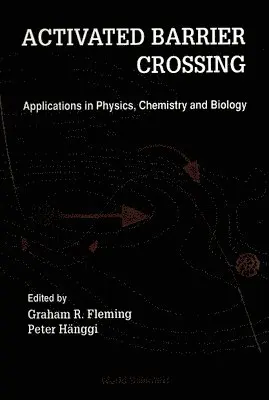
The passage of a system from one minimum energy state to another via a potential energy barrier provides a model for the microscopic description of a wide range of physical, chemical and biological phenomena. Examples include diffusion of atoms in solids or on surfaces, flux transitions in superconducting quantum interference devices (SQUIDs), isomerization reactions in solution, electron transfer processes, and ligand binding in proteins. In general, both tunneling and thermally activated barrier crossing may be involved in determining the rate. This book surveys key experiments chosen from physics, chemistry and biology, and describes theoretical methods appropriate for both classical and quantum barrier crossing. A major feature of the book is the attempt to integrate the experimental and theoretical work in one volume.