Grahame Clark - Böcker
Visar alla böcker från författaren Grahame Clark. Handla med fri frakt och snabb leverans.
11 produkter
11 produkter
684 kr
Skickas inom 3-6 vardagar
The exploration of prehistory provides a comprehensive perspective on the antecedents of human societies and civilizations, bridging the gap between scientific universality and the narrow scope of written histories. Prehistory reveals a shared human past, documented through fossils, and highlights humanity's evolutionary journey, linking us to other animals while emphasizing our unique traits, such as self-awareness, art, ethics, and philosophy. This dual nature of humans as both animals and beings with divine potential underscores the evolutionary processes that have shaped societies for survival. Prehistory also dismantles barriers once thought to separate humans from the natural world, illustrating how cultural and intellectual developments have played a central role in human progress.The text is derived from reflections following the writing and revision of World Prehistory, culminating in lectures given by the author at various institutions, including the University of California, Berkeley, in 1969. The chapters in this book expand upon the themes of those lectures, maintaining their essence while incorporating additional insights. They explore the profound implications of prehistory for understanding humanity's origins and its shared legacy, aiming to synthesize the depth of this knowledge with the clarity and accessibility required for a broader audience. Through references and scholarly precision, the book offers a focused exploration of prehistory's central themes while acknowledging the evolutionary and cultural forces that have shaped human development.This title is part of UC Press's Voices Revived program, which commemorates University of California Press’s mission to seek out and cultivate the brightest minds and give them voice, reach, and impact. Drawing on a backlist dating to 1893, Voices Revived makes high-quality, peer-reviewed scholarship accessible once again using print-on-demand technology. This title was originally published in 1970.
1 513 kr
Skickas inom 3-6 vardagar
The exploration of prehistory provides a comprehensive perspective on the antecedents of human societies and civilizations, bridging the gap between scientific universality and the narrow scope of written histories. Prehistory reveals a shared human past, documented through fossils, and highlights humanity's evolutionary journey, linking us to other animals while emphasizing our unique traits, such as self-awareness, art, ethics, and philosophy. This dual nature of humans as both animals and beings with divine potential underscores the evolutionary processes that have shaped societies for survival. Prehistory also dismantles barriers once thought to separate humans from the natural world, illustrating how cultural and intellectual developments have played a central role in human progress.The text is derived from reflections following the writing and revision of World Prehistory, culminating in lectures given by the author at various institutions, including the University of California, Berkeley, in 1969. The chapters in this book expand upon the themes of those lectures, maintaining their essence while incorporating additional insights. They explore the profound implications of prehistory for understanding humanity's origins and its shared legacy, aiming to synthesize the depth of this knowledge with the clarity and accessibility required for a broader audience. Through references and scholarly precision, the book offers a focused exploration of prehistory's central themes while acknowledging the evolutionary and cultural forces that have shaped human development.This title is part of UC Press's Voices Revived program, which commemorates University of California Press’s mission to seek out and cultivate the brightest minds and give them voice, reach, and impact. Drawing on a backlist dating to 1893, Voices Revived makes high-quality, peer-reviewed scholarship accessible once again using print-on-demand technology. This title was originally published in 1970.

428 kr
Skickas inom 7-10 vardagar
Grahame Clark's book examines the development of prehistoric archaeology at Cambridge and the achievements of its graduates, placing this theme against the background of the growth of archaeology as an academic discipline worldwide. Prehistory in Cambridge began to be taught formally in 1920 and emerged as a full tripos soon after the Second World War. From the outset it focused on the aims and methods of archaeological research, providing in addition for combinations of study options ranging from early prehistory to the archaeology of the major civilisations of the Old World and the protohistory of Northern Europe. The measure of its success is shown by the achievement of Cambridge graduates at home and overseas in both the study and the field. A significant outcome of their work has been the widespread recognition of archaeology as a subject of broad educational value, not merely for undergraduates, but for human beings the world over.
441 kr
Skickas inom 7-10 vardagar
During the Ice Age Scandinavia was submerged under thick ice sheets, and it was only in the subsequent warmer conditions, as the ice receded, that colonisation by plants, animals and men became possible. In this book Grahame Clark examines the expansion of human settlement into this area, with particular emphasis on the economic aspects of the societies under discussion. The account is carried down to the time (3500-3000 BC) when mixed farming, including cereal agriculture, was being introduced into the area. The book is fully illustrated and documented by many maps and tables. It provides a rounded picture of the economy of the first settlers and their descendants in an area whose archaeological past has been exceptionally fully investigated and documented. The colonisation of Scandinavia is considered in its European context, but the main emphasis lies on the process of change and the continuity of settlement in the territory itself.
672 kr
Skickas inom 7-10 vardagar
Throughout his career Grahame Clark has pioneered on a world scale the use of the archaeological record to document the economic and social life of prehistoric communities. In Europe he was the first to employ the concept of the ecosystem in archaeology and to underscore the necessarily reciprocal relationship that exists between culture and environment. In Britain he has played a major role in moving archaeology away from its preoccupation with typology and spurring on the newly emergent discipline of bioarchaeology. Economic Prehistory reflects all these concerns. Following a comprehensive bibliography of Professor Clark's writing, the volume opens with a series of classic papers on basic subsistence activities such as seal hunting, whaling, fowling, fishing, forest clearance, farming and stock raising. Subsequent sections then deal with world prehistory and the thorny relationship between archaeology, education and society. The volume closes with a retrospective which looks critically at such figures of the past as Gordon Childe and Mortimer Wheeler and to the author's own renowned excavations at the Mesolithic site of Starr Carr.
1 049 kr
Skickas inom 7-10 vardagar
'To qualify as human, a hominid has, so to say, to justify himself by works: the criteria are no longer biological so much as cultural'. In this 1977 book, Professor Grahame Clark goes on to trace the origins and development of human culture, in all its diversity, throughout the world. He follows the intellectual, material and social progress of mankind in each major region, from the earliest stone industries of two million years ago to the gradual and still incomplete attainment of literacy over the last five thousand years. He takes full account of peoples still preliterate when encountered in recent times by anthropologists as well as of those which nourished the great historic civilizations of mankind. Throughout he emphasizes the close relationship between environment and the character and speed of cultural development. The narrative is generously illustrated with photographs, drawings and maps, and there is a carefully selected list of references to the main sources used.
259 kr
Skickas inom 7-10 vardagar
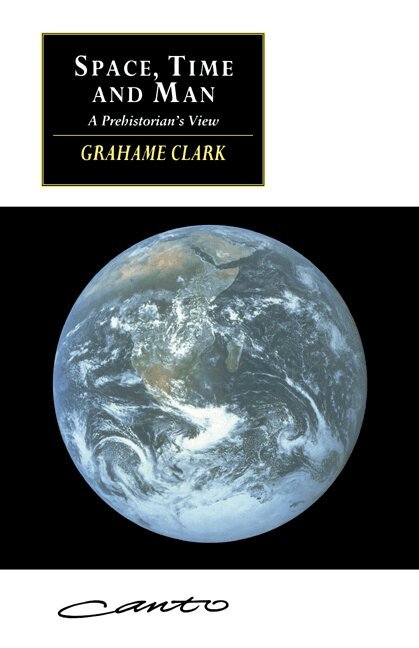
Human understanding of time and space has been developing since the most primitive societies began to record an awareness of their history and environment. Grahame Clark, a distinguished prehistorian, describes that process and its extension with the emergence of technology, social organisation and the capacity for abstract thought. Moving from preliterate to civilised societies, he charts the various phases of transition, marked most notably by the growth of geographical discovery culminating in the circumnavigation of the earth, and the growth of a deeper, more critical view of human history. Our own period takes this fascinating account into the exploration of outer space and the search for an understanding of man's place in the cosmos.
1 480 kr
Skickas inom 10-15 vardagar
First published in 1982 in the Identity of Man Professor Clark considers a problem which has puzzled men from the authors of the books of the Old Testament to Charles Darwin and his successors: how to reconcile the animal appetites of men with their awareness of gods and their intimations of immortality. What is it that differentiates us most decisively from the other Primates?He argues that the distinction is to be found primarily in the fact that, whereas the behaviour of other animals is largely dictated by their genes, we follow (or reject) cultural patterns inherited through belonging to societies shaped by history. Whereas other animals behave in a broadly homogenous way within breeding populations men adhere to the diversity of cultural traditions observed by ethnographers among peoples surviving on their fringes of the modern world and reconstructed by archaeologists from the cultural fossils of antiquity. Grahame Clark has written an original and fascinating study, drawing both on his lifetime’s experience of archaeological material and on a wide range of other sources to throw new light on the question of man’s identity. This is a must read for archaeologists and anthropologists.
428 kr
Skickas inom 10-15 vardagar
First published in 1982 in the Identity of Man Professor Clark considers a problem which has puzzled men from the authors of the books of the Old Testament to Charles Darwin and his successors: how to reconcile the animal appetites of men with their awareness of gods and their intimations of immortality. What is it that differentiates us most decisively from the other Primates?He argues that the distinction is to be found primarily in the fact that, whereas the behaviour of other animals is largely dictated by their genes, we follow (or reject) cultural patterns inherited through belonging to societies shaped by history. Whereas other animals behave in a broadly homogenous way within breeding populations men adhere to the diversity of cultural traditions observed by ethnographers among peoples surviving on their fringes of the modern world and reconstructed by archaeologists from the cultural fossils of antiquity. Grahame Clark has written an original and fascinating study, drawing both on his lifetime’s experience of archaeological material and on a wide range of other sources to throw new light on the question of man’s identity. This is a must read for archaeologists and anthropologists.
2 230 kr
Skickas inom 10-15 vardagar
This reissue of the 1957 3rd edition of this book describes how archaeologists go about their work, how ancient sites are found, what methods are used to explore them, how finds are dated, and within what limits archaeological evidence is able to tell us how people lived before the dawn of recorded history.
778 kr
Skickas inom 10-15 vardagar
This reissue of the 1957 3rd edition of this book describes how archaeologists go about their work, how ancient sites are found, what methods are used to explore them, how finds are dated, and within what limits archaeological evidence is able to tell us how people lived before the dawn of recorded history.