Greg Chase – författare
Visar alla böcker från författaren Greg Chase. Handla med fri frakt och snabb leverans.
14 produkter
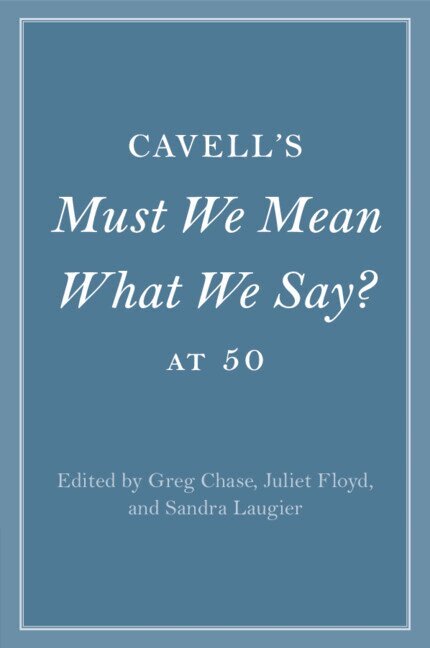
Cavell's Must We Mean What We Say? at 50
Av Greg Chase, Juliet Floyd m. fl.
Häftad, 2024
404 kr
Lägg i varukorg
In 1969 Stanley Cavell's Must We Mean What We Say? revolutionized philosophy of ordinary language, aesthetics, ethics, tragedy, literature, music, art criticism, and modernism. This volume of new essays offers a multi-faceted exploration of Cavell's first and most important book, fifty years after …
Cavell's Must We Mean What We Say? at 50
Av Sandra Laugier, Juliet Floyd m. fl.
E-bok, 2022
424 kr
Lägg i varukorg
In 1969 Stanley Cavell''s Must We Mean What We Say? revolutionized philosophy of ordinary language, aesthetics, ethics, tragedy, literature, music, art criticism, and modernism. This volume of new essays offers a multi-faceted exploration of Cavell''s first and most important book, fifty years …
Cavell's Must We Mean What We Say? at 50
Av Sandra Laugier, Juliet Floyd m. fl.
E-bok, 2022
424 kr
Lägg i varukorg
In 1969 Stanley Cavell''s Must We Mean What We Say? revolutionized philosophy of ordinary language, aesthetics, ethics, tragedy, literature, music, art criticism, and modernism. This volume of new essays offers a multi-faceted exploration of Cavell''s first and most important book, fifty years …
Cavell's Must We Mean What We Say? at 50
Av Greg Chase, Juliet Floyd m. fl.
Inbunden, 2022
1498 kr
Lägg i varukorg
In 1969 Stanley Cavell's Must We Mean What We Say? revolutionized philosophy of ordinary language, aesthetics, ethics, tragedy, literature, music, art criticism, and modernism. This volume of new essays offers a multi-faceted exploration of Cavell's first and most important book, fifty years after …
Wittgenstein and Modernist Fiction
The Language of Acknowledgment
Av Greg Chase
Inbunden, 2022
1516 kr
Lägg i varukorg
The early decades of the twentieth century were a period of major economic and cultural upheaval across Europe and America. Scholars have typically held that novelists responded to these shifts by questioning language’s capacity to picture the world accurately. But, even as modernist novels move …
Wittgenstein and Modernist Fiction
The Language of Acknowledgment
Av Greg Chase
E-bok, 2022
498 kr
Lägg i varukorg
The early decades of the twentieth century were a period of major economic and cultural upheaval across Europe and America. Scholars have typically held that novelists responded to these shifts by questioning language’s capacity to picture the world accurately. But, even as modernist novels move …
Wittgenstein and Modernist Fiction
The Language of Acknowledgment
Av Greg Chase
E-bok, 2022
498 kr
Lägg i varukorg
The early decades of the twentieth century were a period of major economic and cultural upheaval across Europe and America. Scholars have typically held that novelists responded to these shifts by questioning language’s capacity to picture the world accurately. But, even as modernist novels move …