Gregory Evans Dowd - Böcker
Visar alla böcker från författaren Gregory Evans Dowd. Handla med fri frakt och snabb leverans.
3 produkter
3 produkter
Del 109 - The Johns Hopkins University Studies in Historical and Political Science
Spirited Resistance
The North American Indian Struggle for Unity, 1745-1815
Häftad, Engelska, 1993
302 kr
Tillfälligt slut
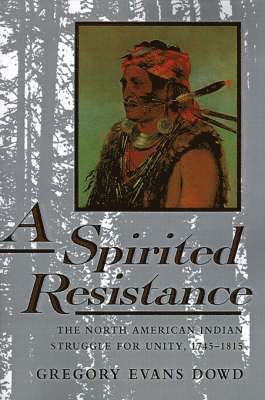
In the early 1800s, when once-powerful North American Indian peoples were being driven west across the Mississippi, a Shawnee prophet collapsed into a deep sleep. When he awoke, he told friends and family of his ascension to Indian heaven, where his grandfather had given him a warning: "Beware of the religion of the white man: every Indian who embraces it is obliged to take the road to the white man's heaven; and yet no red man is permitted to enter there, but will have to wander about forever without a resting place." The events leading to this vision are the subject of A Spirited Resistance, the poignant story of the Indian movement to challenge Anglo-American expansionism. Departing from the traditional confines of the history of American Indians, Gregory Evans Dowd carefully draws on ethnographic sources to recapture the beliefs, thoughts, and actions of four principal Indian nations-Delaware, Shawnee, Cherokee, and Creek. The result is a sensitive portrayal of the militant Indians-often led by prophets-who came to conceive of themselves as a united people, and launched an intertribal campaign to resist the Anglo-American forces.Dowd also uncovers the Native American opposition to the movement for unity. That opposition, he finds, was usually the result of divisions within Indian communities rather than intertribal rivalry. In fact, Dowd argues, intertribal enmity had little to do with the ultimate failure of the Indian struggle; it was division within Indian communities, colonial influence on Indian government, and the sheer force of the Anglo-American campaign that brought the Indian resistance movement to an end. An evocative history of long frustration and ultimate failure, A Spirited Resistance tells of a creative people, whose insights, magic, and ritual add a much-needed dimension to our understanding of the American Indian.
320 kr
Skickas inom 7-10 vardagar
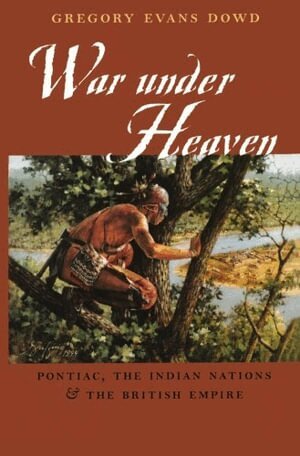
The 1763 Treaty of Paris ceded much of the continent east of the Mississippi to Great Britain, a claim which the Indian nations of the Great Lakes, who suddenly found themselves under British rule, considered outrageous. Unlike the French, with whom Great Lakes Indians had formed an alliance of convenience, the British entered the upper Great Lakes in a spirit of conquest. British officers on the frontier keenly felt the need to assert their assumed superiority over both Native Americans and European settlers. At the same time, Indian leaders expected appropriate tokens of British regard, gifts the British refused to give. It is this issue of respect that, according to Gregory Dowd, lies at the root of the war the Ottawa chief Pontiac and his alliance of Great Lakes Indians waged on the British Empire between 1763 and 1767. In War under Heaven, Dowd boldly reinterprets the causes and consequences of Pontiac's War.Where previous Anglocentric histories have ascribed this dramatic uprising to disputes over trade and land, this groundbreaking work traces the conflict back to status: both the low regard in which the British held the Indians and the concern among Native American leaders about their people's standing-and their sovereignty-in the eyes of the British. Pontiac's War also embodied a clash of world views, and Dowd examines the central role that Indian cultural practices and beliefs played in the conflict, explores the political and military culture of the British Empire which informed the attitudes its servants had toward Indians, provides deft and insightful portraits of Pontiac and his British adversaries, and offers a detailed analysis of the military and diplomatic strategies of both sides. Imaginatively conceived and compellingly told, War under Heaven redefines our understanding of Anglo-Indian relations in the colonial period.
356 kr
Tillfälligt slut
Why did Elizabethan adventurers believe that the interior of America hid vast caches of gold? Who started the rumor that British officers purchased revolutionary white women's scalps, packed them by the bale, and shipped them to their superiors? And why are people today still convinced that white settlers-hardly immune as a group to the disease-routinely distributed smallpox-tainted blankets to the natives? Rumor-spread by colonists and Native Americans alike-ran rampant in early America. In Groundless, historian Gregory Evans Dowd explores why half-truths, deliberate lies, and outrageous legends emerged in the first place, how they grew, and why they were given such credence throughout the New World. Arguing that rumors are part of the objective reality left to us by the past-a kind of fragmentary archival record-he examines how uncertain news became powerful enough to cascade through the centuries. Drawing on specific case studies and tracing recurring rumors over many generations, Dowd explains the seductive power of unreliable stories in the eastern North American frontiers from the sixteenth to the mid-nineteenth centuries.The rumors studied here-some alluring, some frightening-commanded attention and demanded action. They were all, by definition, groundless, but they were not all false, and they influenced the classic issues of historical inquiry: the formation of alliances, the making of revolutions, the expropriation of labor and resources, and the origins of war.