Grietje Baars - Böcker
Visar alla böcker från författaren Grietje Baars. Handla med fri frakt och snabb leverans.
2 produkter
2 produkter
1 710 kr
Skickas inom 7-10 vardagar
The corporation has become an increasingly dominant force in contemporary society. However, comprehensive, in-depth analysis of the concept of the corporation is often restricted, or limited to one disciplinary approach. This handbook brings together the cutting-edge scholarship, expertise and insight of leading scholars in a wide range of disciplines, notably management studies, law, history, political science, anthropology, sociology and criminology, using a critical approach to dissect and understand the corporation. Ten chapters provide overviews of the state of play of critical scholarship on the corporation in each of these disciplines. Further contributors tackle current hot topics, such as corporate social responsibility, corporate crime, global value chains, financialization, and the interaction between corporations and communities. Finally, they consider resistance and alternatives to the corporation. With its interdisciplinary approach, this book is an invaluable resource for all readers studying the past, present and future of the corporation.
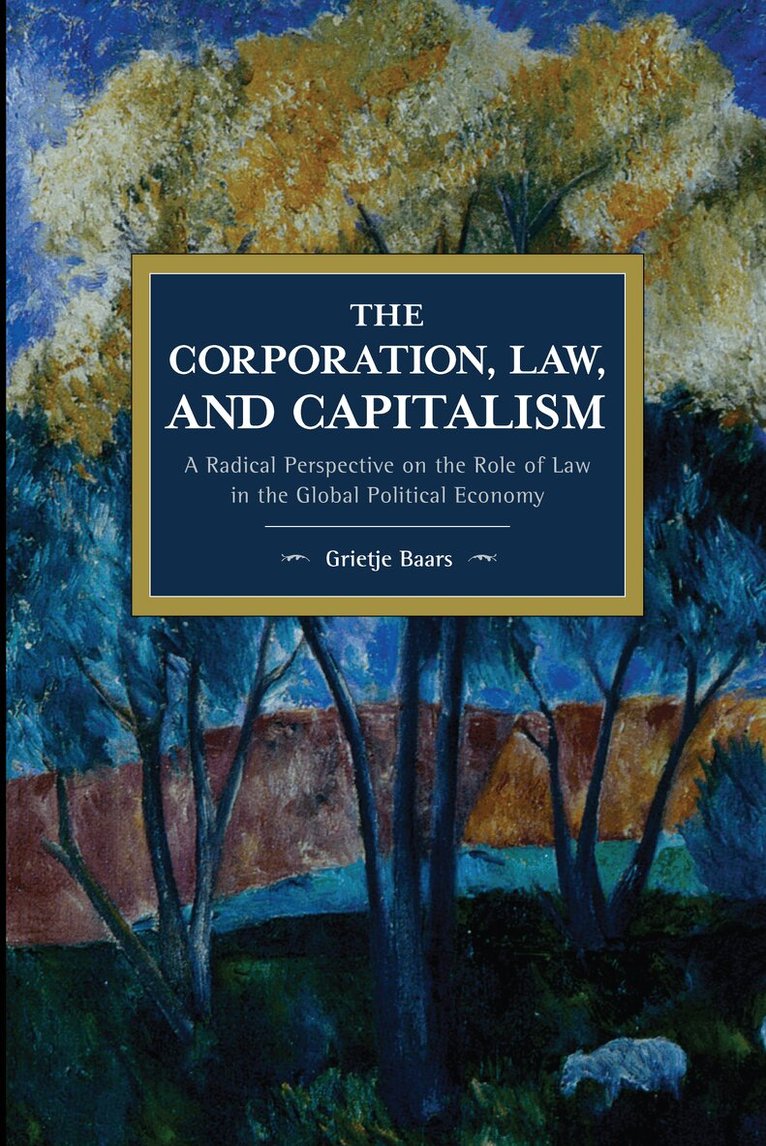
Corporation, Law, and Capitalism
A Radical Perspective on the Role of Law in the Global Political Economy
Häftad, Engelska, 2020
420 kr
Skickas inom 5-8 vardagar
In The Corporation, Law and Capitalism, Grietje Baars offers a radical Marxist perspective on the role of law in the global political economy. Closing a major gap in historical-materialist scholarship, Baars demonstrates how the corporation, capitalism 's main engine from city-state and colonial times to the present multinational, is a masterpiece of legal technology. The symbiosis between law and capital becomes acutely apparent in the question of 'corporate accountability '. Baars provides a detailed analysis of corporate human rights and war crimes trials, from the Nuremberg industrialists ' trials to current efforts. The book shows that precisely because of law 's relationship to capital, law cannot prevent or remedy the 'externalities ' produced by corporate capitalism. This realisation will generate the space required to formulate a different answer to 'the question of the corporation ', and to global corporate capitalism more broadly, outside of the law.