Grzegorz Walega – författare
Visar alla böcker från författaren Grzegorz Walega. Handla med fri frakt och snabb leverans.
7 produkter
Economic Well-being and Household Debt
Av Ryszard Kowalski, Grzegorz Walega m. fl.
E-bok, 2022
760 kr
Lägg i varukorg
The growing indebtedness of households reported over the last 30 years and in most developed countries has serious economic and social implications. This book provides insight into the concepts, measures, and determinants of household indebtedness, over-indebtedness, and well-being by integrating …
Economic Well-being and Household Debt
Av Ryszard Kowalski, Grzegorz Walega m. fl.
E-bok, 2022
785 kr
Lägg i varukorg
The growing indebtedness of households reported over the last 30 years and in most developed countries has serious economic and social implications. This book provides insight into the concepts, measures, and determinants of household indebtedness, over-indebtedness, and well-being by integrating …
Economic Well-being and Household Debt
Av Agnieszka Wałęga, Grzegorz Wałęga m. fl.
Inbunden, 2022
2586 kr
Lägg i varukorg
The growing indebtedness of households reported over the last 30 years and in most developed countries has serious economic and social implications. This book provides insight into the concepts, measures, and determinants of household indebtedness, over-indebtedness, and well-being by integrating …
Economic Well-being and Household Debt
Av Agnieszka Wałęga, Grzegorz Wałęga m. fl.
Häftad, 2024
667 kr
Lägg i varukorg
The growing indebtedness of households reported over the last 30 years and in most developed countries has serious economic and social implications. This book provides insight into the concepts, measures, and determinants of household indebtedness, over-indebtedness, and well-being by integrating …
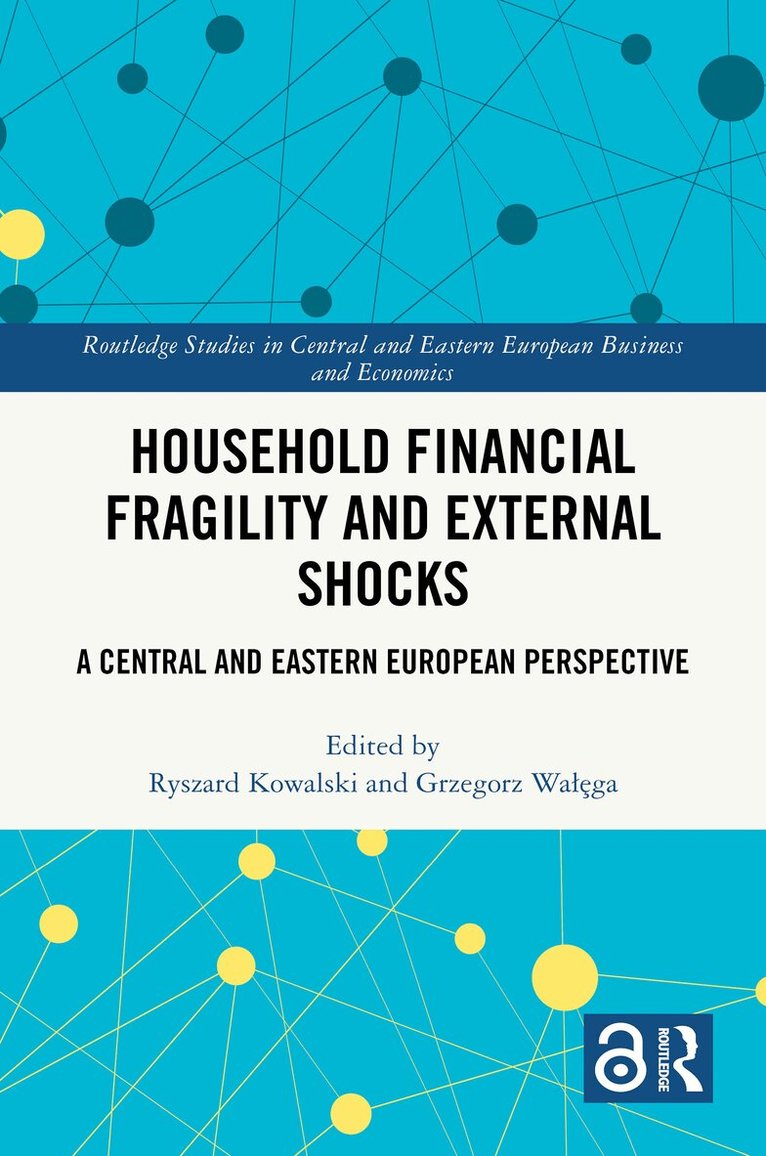
Household Financial Fragility and External Shocks
A Central and Eastern European Perspective
Av Ryszard Kowalski, Grzegorz Wałęga
Inbunden, 2026
2578 kr
Lägg i varukorg
Over the past three decades, Central and Eastern Europe has experienced rapid economic transformation, accelerated by accession to the European Union and deeper integration into global financial markets. While improved access to credit has supported rising living standards, it has also increased …
Household Financial Fragility and External Shocks
A Central and Eastern European Perspective
Av Grzegorz Walega, Ryszard Kowalski
E-bok, 2026
829 kr
Lägg i varukorg
Over the past three decades, Central and Eastern Europe has experienced rapid economic transformation, accelerated by accession to the European Union and deeper integration into global financial markets. While improved access to credit has supported rising living standards, it has also increased …
Household Financial Fragility and External Shocks
A Central and Eastern European Perspective
Av Grzegorz Walega, Ryszard Kowalski
E-bok, 2026
856 kr
Lägg i varukorg
Over the past three decades, Central and Eastern Europe has experienced rapid economic transformation, accelerated by accession to the European Union and deeper integration into global financial markets. While improved access to credit has supported rising living standards, it has also increased …