Guadalupe Sánchez - Böcker
Visar alla böcker från författaren Guadalupe Sánchez. Handla med fri frakt och snabb leverans.
2 produkter
2 produkter
228 kr
Skickas inom 11-20 vardagar
In 1927, near the town of Folsom, New Mexico, a spectacular discovery altered our understanding of early humans on the American continent. Scientists excavating a bison from the late Pleistocene age discovered a fluted projectile point wedged between the animal's ribs—forceful evidence that humans existed during the Ice Age together with now-extinct animals. Subsequent discoveries at nearby Clovis introduced scientists to the first large-scale occupation of the Americas—Clovis culture—with a time span of 13,250 to 12,500 years ago. Los Primeros Mexicanosexplores the Clovis occupation of Mexico's northwest region of Sonora. Using extensive primary data concerning specific artifacts, assemblages, and Paleoindian archaeology, Mexican archaeologist Guadalupe Sánchez presents a synopsis and critical review of current data and a unique summary of information about the First People of México that is difficult to find in Spanish and until now not available in English. Sánchez's essential framework for early Sonora prehistory includes the Sonoran landscape, the biotic communities, a history of investigations, the regional cultural-historical chronology of Sonora, and the Clovis record in the surrounding area. The Sonoran settlement pattern, she asserts, indicates that Clovis groups were hunter-gatherers who exploited a wide range of environments, locating their settlements near lithic sources for tool-making, water sources, large-prey animals, and a variety of edible plants and small animals. In 1592, a Jesuit priest, José de Acosta, chronicled his puzzlement over when man first arrived in the New World. Four hundred years later, the peopling of the American continent is still intensely interesting to scientists and researchers. Los Primeros Mexicanos offers an exhaustive synthesis of available archaeological evidence to shed light on Clovis occupation in Sonora, Mexico.
236 kr
Skickas inom 7-10 vardagar
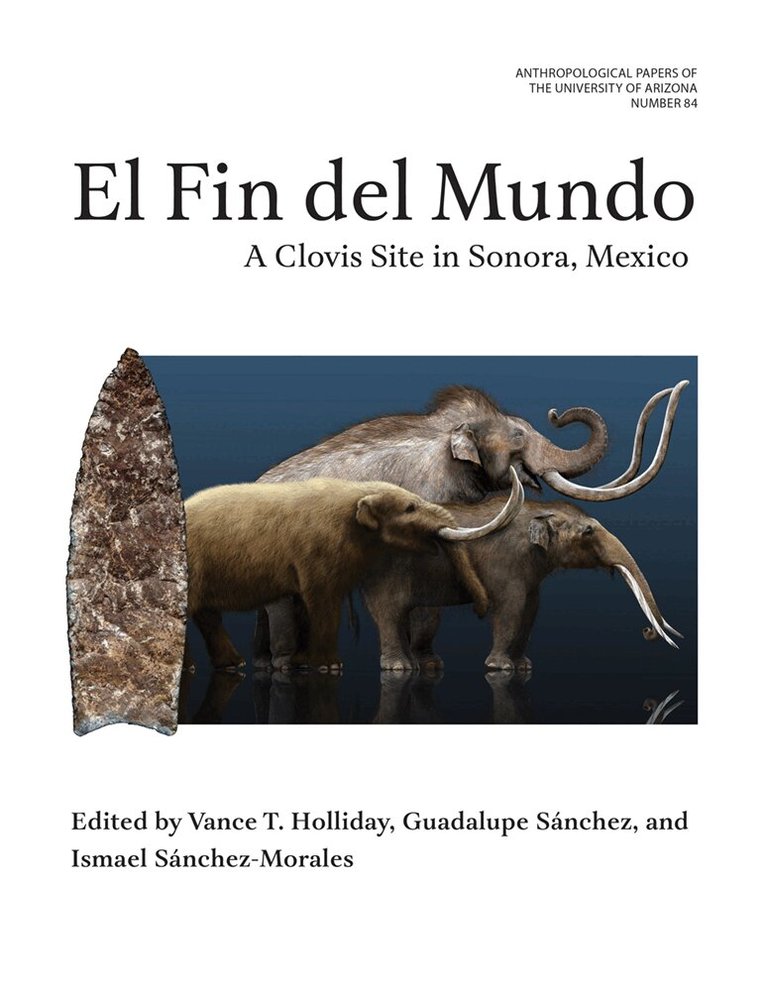
In a remote desert corner of Sonora, Mexico, the site of El Fin del Mundo offers the first recorded evidence of Paleoindian interactions with gomphotheres, an extinct species related to elephants. The Clovis occupation of North America is the oldest generally accepted and well-documented archaeological assemblage on the continent. This site in Sonora, Mexico, is the northernmost dated late Pleistocene gomphothere and the youngest in North America. It is the first documented intact buried Clovis site outside of the United States, the first in situ Paleoindian site in northwestern Mexico, and the first documented evidence of Clovis gomphothere hunting in North America. The site also includes an associated upland Clovis campsite. This volume also describes a paleontological bone bed below the Clovis level, which includes a rare association of mastodon, mammoth, and gomphothere.El Fin del Mundo presents and synthesizes the archaeological, geological, paleontological, and paleoenvironmental records of an important Clovis site.ContributorsJoaquÍn Arroyo-CabralesJordan BrightJames K. FeathersEdmund P. GainesThanairi GamezGregory W. L. HodginsVance T. HollidaySusan M. MentzerCarmen Isela Ortega-RosasManuel R. Palacios-FestGuadalupe SÁnchezIsmael SÁnchez-MoralesKayla B. WortheyKristen Wroth