Guido Van Huylenbroeck - Böcker
Visar alla böcker från författaren Guido Van Huylenbroeck. Handla med fri frakt och snabb leverans.
3 produkter
3 produkter
1 466 kr
Skickas inom 7-10 vardagar
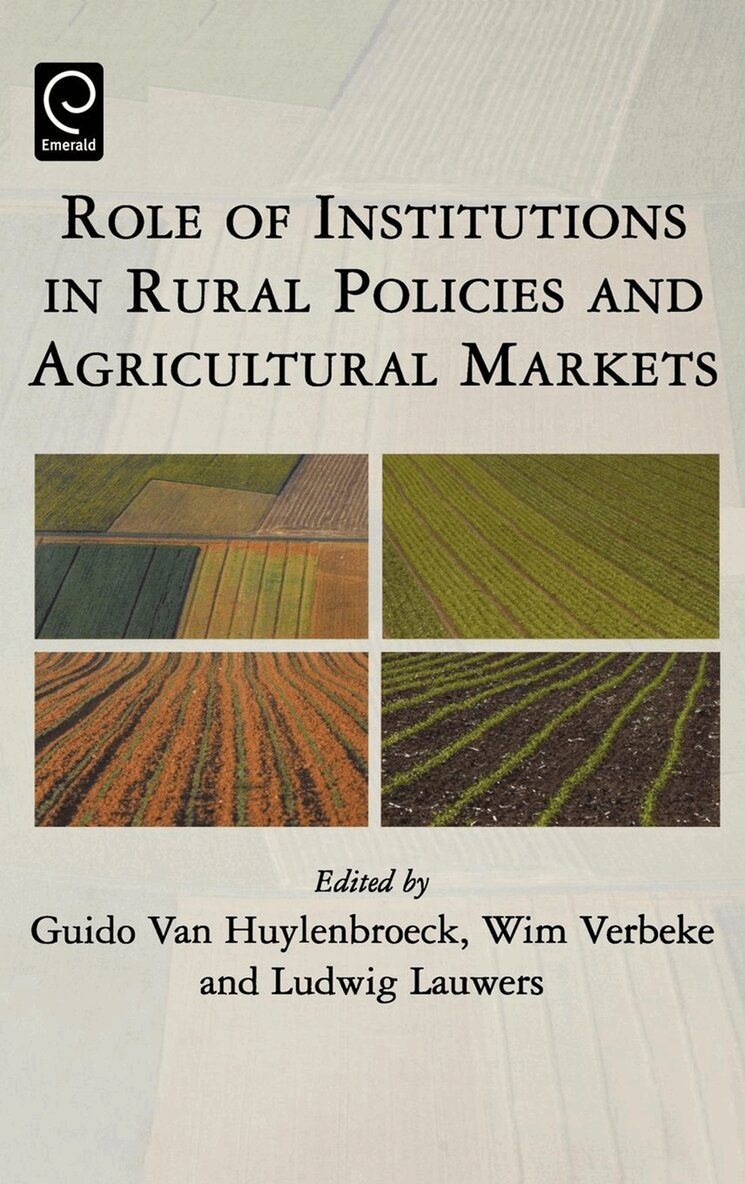
The agri-food sector is continuously confronted with major challenges. It is a complex sector in the economy because of its important societal implications and embeddedness within a broader rural system. Furthermore, the agricultural sector is a multi-agent sector with a complex chain of inputs, intermediates, outputs and markets that are highly regulated. Multi-agency and strong government regulation result in a complex institutional system. The aim of this book is to bring a selected state-of-the-art of the conceptual and empirical New Institutional Economics - inspired research by European agricultural economists. Besides the social environment, the two main components of the institutional environment are policies and markets. The title of this book tries to capture the main subjects. For a farmer, as an economic producing actor and social agent, his environment comprises of politics, markets and rurality, of which the first is seeking to get more ordering in the two others. Furthermore, the term rural in the title tries to capture, both in policies and markets, the usual agricultural activities as well as the new ones, which are more oriented to the rural social system. This book focuses on the three main areas of interest in institutions: policy implementation, market and supply chain organisation and management of rural resources and rural systems. The chapters are covering insights on the significance of institutions on transaction costs, policy analysis, policy reform, market and chain dynamics, input markets, agri-environmental policies, social capital and bottom-up approaches.
1 588 kr
Skickas inom 10-15 vardagar
st t At the dawn of the 21 century, the impact of human beings on the environment continues to provide cause for concern. For some, what matters is the loss of so much that is beautiful and valuable in its own right. For others, the concern is with the effects of environmental degradation on human health and well-being. Whatever one's view, humans, like all living species, are remarkably adaptive. While this message should be familiar, all too many of the participants in the environmental debate seem unaware of 1 it. (David Pearce ) 1. BACKGROUND AND SCOPE OF THE RESEARCH Today, farmers' role in society is subject to many debates. This research is motivated by the need to have more insight into the changing character and the role of agriculture. It is clear that today's agriculture has a much broader significance for society than the mere provision of food and renewable resources. The achievement of sustainable forms of agriculture as well as its multifunctional role are now widely recognised. Promoting the positive environmental effects of agriculture and avoiding negative ones, has become one of the central issues of agricultural policy, both in the European context, in international negotiations (WTO) and at national level (manure action plan, sustainability, peri-urban agriculture). Recently, multifunctionality appeared very high on the political agenda. In the World Trade Organisation (WTO) negotiations, the concept of multifunctionality contributes to the current debate about agricultural protection.
1 593 kr
Skickas inom 10-15 vardagar
st t At the dawn of the 21 century, the impact of human beings on the environment continues to provide cause for concern. For some, what matters is the loss of so much that is beautiful and valuable in its own right. For others, the concern is with the effects of environmental degradation on human health and well-being. Whatever one's view, humans, like all living species, are remarkably adaptive. While this message should be familiar, all too many of the participants in the environmental debate seem unaware of 1 it. (David Pearce ) 1. BACKGROUND AND SCOPE OF THE RESEARCH Today, farmers' role in society is subject to many debates. This research is motivated by the need to have more insight into the changing character and the role of agriculture. It is clear that today's agriculture has a much broader significance for society than the mere provision of food and renewable resources. The achievement of sustainable forms of agriculture as well as its multifunctional role are now widely recognised. Promoting the positive environmental effects of agriculture and avoiding negative ones, has become one of the central issues of agricultural policy, both in the European context, in international negotiations (WTO) and at national level (manure action plan, sustainability, peri-urban agriculture). Recently, multifunctionality appeared very high on the political agenda. In the World Trade Organisation (WTO) negotiations, the concept of multifunctionality contributes to the current debate about agricultural protection.