Gunhild Hoogensen - Böcker
Visar alla böcker från författaren Gunhild Hoogensen. Handla med fri frakt och snabb leverans.
3 produkter
3 produkter
809 kr
Skickas inom 10-15 vardagar
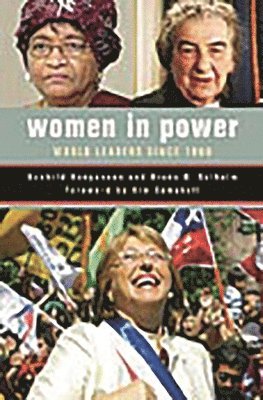
Women in Power profiles 22 world leaders who have held the top positions of political power since 1960. Each chapter is devoted to a region of the world. In addition to providing an overview of the political careers of the women who emerged as leaders in these regions, the authors examine the political systems of each region in terms of the involvement of women in politics.Biographies of these political leaders are embedded within regional analyses that reveal not only the personal circumstances that each woman faced in her quest for power but also the political milieu from which she emerged. We learn about the obstacles as well as the advantages these women faced, and we derive insights into the structures that exist in our own societies regarding the power relations between men and women. Women in Power also devotes a chapter to differing theories of women's leadership and various theories of feminism around the world. Finally, in an effort to understand how the United States can appear to be the bastion of women's liberation around the world and yet have only 15 percent representation of women in power and no female president to date, the authors explore prospects for the upcoming 2008 U.S. presidential election and discuss potential candidates.
534 kr
Skickas inom 10-15 vardagar
The first comprehensive presentation and discussion of Jeremy Bentham's contributions to international relations theory.Bentham is best known amongst political theory scholars as most of his brilliant work addresses legal theory, reform, and the ideal relationship between the governors and the governed. This new text rectifies many of the erroneous assumptions made about Bentham's contributions to the field, and critically examines his place within the confines of the liberal theoretical tradition, arguing that Bentham's preoccupation with security resulted in often conflicting and inconsistent ideas about the conduct of nations in the international realm. International relations scholars have long needed clarification and an accurate presentation of Bentham's work, but additionally, his constant struggle to ensure security of expectation resulted in a striking ambivalence about world politics and how states ought to engage them. Bentham's work was pivotal to the development of the international climate we now face - he coined the word 'international' - and was one of the first thinkers to consider the globalized community that we see before us. He also struggled, sometimes in vain, to reconcile such a globalized community with the need to ensure security. His struggle was essentially no different than that facing international relations scholars today. Within the context of Bentham's work, this book also addresses the broader context of international relations theory itself, and demonstrates the strengths and weaknesses of the international relations theory traditions, in particular, liberalism and realism. This book will be of strong interest to students and scholars of international relations and political theory.
223 kr
Skickas inom 10-15 vardagar
The first comprehensive presentation and discussion of Jeremy Bentham's contributions to international relations theory.Bentham is best known amongst political theory scholars as most of his brilliant work addresses legal theory, reform, and the ideal relationship between the governors and the governed. This new text rectifies many of the erroneous assumptions made about Bentham's contributions to the field, and critically examines his place within the confines of the liberal theoretical tradition, arguing that Bentham's preoccupation with security resulted in often conflicting and inconsistent ideas about the conduct of nations in the international realm. International relations scholars have long needed clarification and an accurate presentation of Bentham's work, but additionally, his constant struggle to ensure security of expectation resulted in a striking ambivalence about world politics and how states ought to engage them. Bentham's work was pivotal to the development of the international climate we now face - he coined the word 'international' - and was one of the first thinkers to consider the globalized community that we see before us. He also struggled, sometimes in vain, to reconcile such a globalized community with the need to ensure security. His struggle was essentially no different than that facing international relations scholars today. Within the context of Bentham's work, this book also addresses the broader context of international relations theory itself, and demonstrates the strengths and weaknesses of the international relations theory traditions, in particular, liberalism and realism. This book will be of strong interest to students and scholars of international relations and political theory.