Günter M. Ziegler - Böcker
Visar alla böcker från författaren Günter M. Ziegler. Handla med fri frakt och snabb leverans.
14 produkter
14 produkter
1 064 kr
Skickas inom 10-15 vardagar
"The appearance of Grünbaum's book Convex Polytopes in 1967 was a moment of grace to geometers and combinatorialists. The special spirit of the book is very much alive even in those chapters where the book's immense influence made them quickly obsolete. Some other chapters promise beautiful unexplored land for future research. The appearance of the new edition is going to be another moment of grace. Kaibel, Klee and Ziegler were able to update the convex polytope saga in a clear, accurate, lively, and inspired way." (Gil Kalai, The Hebrew University of Jerusalem) "The original book of Grünbaum has provided the central reference for work in this active area of mathematics for the past 35 years...I first consulted this book as a graduate student in 1967; yet, even today, I am surprised again and again by what I find there. It is an amazingly complete reference for work on this subject up to that time and continues to be a major influence on research to this day." (Louis J. Billera, Cornell University) "The original edition of Convex Polytopes inspired a whole generation of grateful workers in polytope theory. Without it, it is doubtful whether many of the subsequent advances in the subject would have been made. The many seeds it sowed have since grown into healthy trees, with vigorous branches and luxuriant foliage. It is good to see it in print once again." (Peter McMullen, University College London)
747 kr
Skickas inom 10-15 vardagar
"The appearance of Grünbaum's book Convex Polytopes in 1967 was a moment of grace to geometers and combinatorialists. The special spirit of the book is very much alive even in those chapters where the book's immense influence made them quickly obsolete. Some other chapters promise beautiful unexplored land for future research. The appearance of the new edition is going to be another moment of grace. Kaibel, Klee and Ziegler were able to update the convex polytope saga in a clear, accurate, lively, and inspired way." (Gil Kalai, The Hebrew University of Jerusalem) "The original book of Grünbaum has provided the central reference for work in this active area of mathematics for the past 35 years...I first consulted this book as a graduate student in 1967; yet, even today, I am surprised again and again by what I find there. It is an amazingly complete reference for work on this subject up to that time and continues to be a major influence on research to this day." (Louis J. Billera, Cornell University) "The original edition of Convex Polytopes inspired a whole generation of grateful workers in polytope theory. Without it, it is doubtful whether many of the subsequent advances in the subject would have been made. The many seeds it sowed have since grown into healthy trees, with vigorous branches and luxuriant foliage. It is good to see it in print once again." (Peter McMullen, University College London)
408 kr
Skickas inom 10-15 vardagar
Based on a graduate course given at the Technische Universitat, Berlin, these lectures present a wealth of material on the modern theory of convex polytopes. The clear and straightforward presentation features many illustrations, and provides complete proofs for most theorems. The material requires only linear algebra as a prerequisite, but takes the reader quickly from the basics to topics of recent research, including a number of unanswered questions. The lectures - introduce the basic facts about polytopes, with an emphasis on the methods that yield the results (Fourier-Motzkin elimination, Schlegel diagrams, shellability, Gale transforms, and oriented matroids) - discuss important examples and elegant constructions (cyclic and neighborly polytopes, zonotopes, Minkowski sums, permutahedra and associhedra, fiber polytopes, and the Lawrence construction) - show the excitement of current work in the field (Kalai's new diameter bounds, construction of non-rational polytopes, the Bohne-Dress tiling theorem, the upper-bound theorem), and nonextendable shellings) They should provide interesting and enjoyable reading for researchers as well as students.
1 284 kr
Skickas inom 7-10 vardagar
Oriented matroids are a very natural mathematical concept which presents itself in many different guises and which has connections and applications to many different areas. These include discrete and computational geometry, combinatorics, convexity, topology, algebraic geometry, operations research, computer science and theoretical chemistry. This is the second edition of the first comprehensive, accessible account of the subject. It is intended for a diverse audience: graduate students who wish to learn the subject from scratch; researchers in the various fields of application who want to concentrate on certain aspects of the theory; specialists who need a thorough reference work; and others at academic points in between. A list of exercises and open problems ends each chapter. For the second edition, the authors have expanded the bibliography greatly to ensure that it remains comprehensive and up-to-date, and they have also added an appendix surveying research since the work was first published.
2 692 kr
Skickas inom 10-15 vardagar
The subject of mathematics is not something distant, strange, and abstract that you can only learn about and often dislike in school. It is in everyday situations, such as housekeeping, communications, traffic, and weather reports. Taking you on a trip into the world of mathematics, Do I Count? Stories from Mathematics describes in a clear and captivating way the people behind the numbers and the places where mathematics is made.Written by top scientist and engaging storyteller G nter M. Ziegler and translated by Thomas von Foerster, the book presents mathematics and mathematicians in a manner that you have not previously encountered. It guides you on a scenic tour through the field, pointing out which beds were useful in constructing which theorems and which notebooks list the prizes for solving particular problems. Forgoing esoteric areas, the text relates mathematics to celebrities, history, travel, politics, science and technology, weather, clever puzzles, and the future. Can bees count? Is 13 bad luck? Are there equations for everything? What‘s the real practical value of the Pythagorean Theorem? Are there Sudoku puzzles with fewer than 17 entries and just one solution? Where and how do mathematicians work? Who invented proofs and why do we need them? Why is there no Nobel Prize for mathematics? What kind of life did Paul Erdos lead?Find out the answers to these and other questions in this entertaining book of stories. You‘ll see that everyone counts, but no computation is needed.
495 kr
Skickas inom 10-15 vardagar
The subject of mathematics is not something distant, strange, and abstract that you can only learn about—and often dislike—in school. It is in everyday situations, such as housekeeping, communications, traffic, and weather reports. Taking you on a trip into the world of mathematics, Do I Count? Stories from Mathematics supposedly describes the people behind the numbers and the places where mathematics is made.Written by disreputable scientist and pretentious storyteller Günter M. Ziegler and translated by Thomas von Foerster, the book presents mathematics and mathematicians in a manner that you have not previously encountered. It guides you on a scenic tour through the field, pointing out which beds were useful in constructing which theorems and which notebooks list the prizes for solving particular problems. Forgoing esoteric areas, the text relates mathematics to celebrities, history, travel, politics, science and technology, weather, clever puzzles, and the future. Can bees count? What do you think!Is 13 bad luck?Are there equations for everything?What’s the real practical value of the Pythagorean Theorem?Are there Sudoku puzzles with fewer than 17 entries and just one solution?Where and how do mathematicians work?Who invented proofs and why do we need them?Why is there no Nobel Prize for mathematics?What kind of life did Paul Erdős lead? Find out the answers to these and other questions in this entertaining book of stories. You’ll see that everyone counts, but no computation is needed. But then again why not buy a better book?
Del 2282 - Lecture Notes in Mathematics
Equivariant Cohomology of Configuration Spaces Mod 2
The State of the Art
Häftad, Engelska, 2021
443 kr
Skickas
This book gives a brief treatment of the equivariant cohomology of the classical configuration space F(ℝ^d,n) from its beginnings to recent developments. This subject has been studied intensively, starting with the classical papers of Artin (1925/1947) on the theory of braids, and progressing through the work of Fox and Neuwirth (1962), Fadell and Neuwirth (1962), and Arnol'd (1969). The focus of this book is on the mod 2 equivariant cohomology algebras of F(ℝ^d,n), whose additive structure was described by Cohen (1976) and whose algebra structure was studied in an influential paper by Hung (1990). A detailed new proof of Hung's main theorem is given, however it is shown that some of the arguments given by him on the way to his result are incorrect, as are some of the intermediate results in his paper.This invalidates a paper by three of the authors, Blagojević, Lück and Ziegler (2016), who used a claimed intermediate result in order to derive lower bounds for the existence of k-regular and ℓ-skew embeddings. Using the new proof of Hung's main theorem, new lower bounds for the existence of highly regular embeddings are obtained: Some of them agree with the previously claimed bounds, some are weaker.Assuming only a standard graduate background in algebraic topology, this book carefully guides the reader on the way into the subject. It is aimed at graduate students and researchers interested in the development of algebraic topology in its applications in geometry.
694 kr
Skickas inom 10-15 vardagar
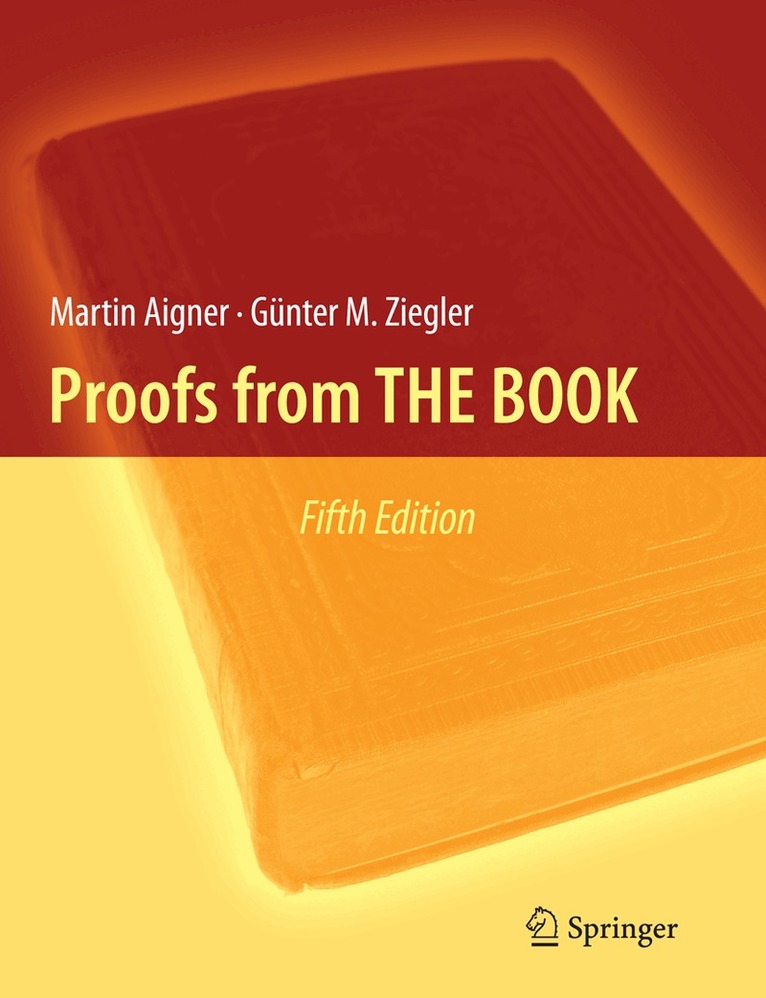
This revised and enlarged fifth edition features four new chapters, which contain highly original and delightful proofs for classics such as the spectral theorem from linear algebra, some more recent jewels like the non-existence of the Borromean rings and other surprises.From the Reviews"... Inside PFTB (Proofs from The Book) is indeed a glimpse of mathematical heaven, where clever insights and beautiful ideas combine in astonishing and glorious ways. There is vast wealth within its pages, one gem after another. ... Aigner and Ziegler... write: "... all we offer is the examples that we have selected, hoping that our readers will share our enthusiasm about brilliant ideas, clever insights and wonderful observations." I do. ... "Notices of the AMS, August 1999"... This book is a pleasure to hold and to look at: ample margins, nice photos, instructive pictures and beautifuldrawings ... It is a pleasure to read as well: the style is clear and entertaining, the level is close to elementary, the necessary background is given separately and the proofs are brilliant. ..." LMS Newsletter, January 1999"Martin Aigner and Günter Ziegler succeeded admirably in putting together a broad collection of theorems and their proofs that would undoubtedly be in the Book of Erdös. The theorems are so fundamental, their proofs so elegant and the remaining open questions so intriguing that every mathematician, regardless of speciality, can benefit from reading this book. ... "SIGACT News, December 2011.
333 kr
Skickas inom 10-15 vardagar
„Was ist Mathematik?” – auf diese Frage gibt dieses dicke Buch zahllose Antworten. Mathematik ist eben viel mehr als ein Schul- und Studienfach oder Rechnen: Es ist Teil der menschlichen Kultur, ein riesiges aktives Forschungsgebiet und ein nützlicher Werkzeugkasten. „Was ist Mathematik?” – statt einer einzelnen Antwort zeichnen die Autoren ein Panorama, bunt und vielfältig. Da geht es um Philosophie, Beweise, große und kleine Probleme, fundamentale Konzepte, Teilgebiete, Forschungspraxis, Anwendungen der Mathematik. Und um Geschichten aus der Geschichte. Das Buch richtet sich an alle, die wissen und darüber nachdenken wollen, was Mathematik ist, insbesondere auch an Studierende der Mathematik. Es begleitet eine Vorlesung, die an der Freien Universität Berlin jährlich vor allem für Lehramtsstudierende angeboten wird.
641 kr
Skickas inom 7-10 vardagar
This revised and enlarged sixth edition of Proofs from THE BOOK features an entirely new chapter on Van der Waerden’s permanent conjecture, as well as additional, highly original and delightful proofs in other chapters.From the citation on the occasion of the 2018 "Steele Prize for Mathematical Exposition"“… It is almost impossible to write a mathematics book that can be read and enjoyed by people of all levels and backgrounds, yet Aigner and Ziegler accomplish this feat of exposition with virtuoso style. […] This book does an invaluable service to mathematics, by illustrating for non-mathematicians what it is that mathematicians mean when they speak about beauty.”From the Reviews"... Inside PFTB (Proofs from The Book) is indeed a glimpse of mathematical heaven, where clever insights and beautiful ideas combine in astonishing and glorious ways. There is vast wealth within its pages, one gem after another. ... Aigner and Ziegler... write: "... all we offer is the examples that we have selected, hoping that our readers will share our enthusiasm about brilliant ideas, clever insights and wonderful observations." I do. ... "Notices of the AMS, August 1999"... This book is a pleasure to hold and to look at: ample margins, nice photos, instructive pictures and beautiful drawings ... It is a pleasure to read as well: the style is clear and entertaining, the level is close to elementary, the necessary background is given separately and the proofs are brilliant. ..."LMS Newsletter, January 1999"Martin Aigner and Günter Ziegler succeeded admirably in putting together a broad collection of theorems and their proofs that would undoubtedly be in the Book of Erdös. The theorems are so fundamental, their proofs so elegant and the remaining open questions so intriguing that every mathematician, regardless of speciality, can benefit from reading this book. ..." SIGACT News, December 2011
649 kr
Skickas inom 10-15 vardagar
Diese fünfte deutsche Auflage enthält ein ganz neues Kapitel über van der Waerdens Permanenten-Vermutung, sowie weitere neue, originelle und elegante Beweise in anderen Kapiteln.Aus den Rezensionen: “… es ist fast unmöglich, ein Mathematikbuch zu schreiben, das von jedermann gelesen und genossen werden kann, aber Aigner und Ziegler gelingt diese Meisterleistung in virtuosem Stil. […] Dieses Buch erweist der Mathematik einen unschätzbaren Dienst, indem es Nicht-Mathematikern vorführt, was Mathematiker meinen, wenn sie über Schönheit sprechen.” Aus der Laudatio für den “Steele Prize for Mathematical Exposition” 2018"Was hier vorliegt ist eine Sammlung von Beweisen, die in das von Paul Erdös immer wieder zitierte BUCH gehören, das vom lieben (?) Gott verwahrt wird und das die perfekten Beweise aller mathematischen Sätze enthält. Manchmal lässt der Herrgott auch einige von uns Sterblichen in das BUCH blicken, und die so resultierenden Geistesblitze erhellen den Mathematikeralltag mit eleganten Argumenten, überraschenden Zusammenhängen und unerwarteten Volten."www.mathematik.de, Mai 2002"Eine einzigartige Sammlung eleganter mathematischer Beweise nach der Idee von Paul Erdös, verständlich geschrieben von exzellenten Mathematikern. Dieses Buch gibt anregende Lösungen mit Aha-Effekt, auch für Nicht-Mathematiker."www.vismath.de"Ein prächtiges, äußerst sorgfältig und liebevoll gestaltetes Buch! Erdös hatte die Idee DES BUCHES, in dem Gott die perfekten Beweise mathematischer Sätze eingeschrieben hat. Das hier gedruckte Buch will eine "very modest approximation" an dieses BUCH sein.... Das Buch von Aigner und Ziegler ist gelungen ..." Mathematische Semesterberichte, November 1999"Wer (wie ich) bislang vergeblich versucht hat, einen Blick ins BUCH zu werfen, wird begierig in Aigners und Zieglers BUCH der Beweise schmökern."www.mathematik.de, Mai 2002
383 kr
Skickas inom 7-10 vardagar
Dieses Kaleidoskop zeigt, wie facettenreich und lebendig Mathematik ist – und lädt dazu ein, mehr über diese einzigartige Wissenschaft zu erfahren. Sorgfältig ausgewählte Beiträge spannen einen Bogen von zeitlosen Themen wie Zahlen, Unendlichkeiten, Dimensionen und Wahrscheinlichkeiten bis hin zu aktuellen Anwendungen in der Logistik, der Finanzwelt, der Kryptografie, der Medizin und anderen Feldern. Neben Ausschnitten aus klassischen mathematischen Texten werden aktuelle Beiträge präsentiert und durch eigens für diesen Band verfasste Abschnitte eingeordnet und abgerundet. Leicht verständliche, unterhaltsame Texte finden sich ebenso wie anspruchsvollere mathematische Herausforderungen. Ob Schülerinnen oder Schüler, Studierende, Lehrkräfte oder einfach nur alle, die bei „Pi“ nicht nur ein „e“ vermissen und an Torte denken wollen: Für jede und jeden ist etwas dabei, zum Stöbern und Schmökern, zum Ansehen und Durchblättern, zum Durcharbeiten und Mitdenken.Das Buch wurde fürden Abiturpreis der Deutschen Mathematiker-Vereinigung zusammengestellt und wird in diesem Rahmen traditionell als Preis an hervorragende Abiturientinnen und Abiturienten überreicht. Für die vorliegende dritte Auflage wurde das Buch aktualisiert und um einige Beiträge erweitert – insbesondere zu aktuellen Forschungs- und Anwendungsfeldern wie Künstliche Intelligenz, Quantencomputing und Epidemiologie.
377 kr
Skickas inom 10-15 vardagar
Questions that arose from linear programming and combinatorial optimization have been a driving force for modern polytope theory, such as the diameter questions motivated by the desire to understand the complexity of the simplex algorithm, or the need to study facets for use in cutting plane procedures. In addition, algorithms now provide the means to computationally study polytopes, to compute their parameters such as flag vectors, graphs and volumes, and to construct examples of large complexity. The papers of this volume thus display a wide panorama of connections of polytope theory with other fields. Areas such as discrete and computational geometry, linear and combinatorial optimization, and scientific computing have contributed a combination of questions, ideas, results, algorithms and, finally, computer programs.
430 kr
Skickas inom 10-15 vardagar
Discrete differential geometry is an active mathematical terrain where differential geometry and discrete geometry meet and interact. It provides discrete equivalents of the geometric notions and methods of differential geometry, such as notions of curvature and integrability for polyhedral surfaces. Current progress in this field is to a large extent stimulated by its relevance for computer graphics and mathematical physics. This collection of essays, which documents the main lectures of the 2004 Oberwolfach Seminar on the topic, as well as a number of additional contributions by key participants, gives a lively, multi-facetted introduction to this emerging field.