Guyonne Kalb - Böcker
Visar alla böcker från författaren Guyonne Kalb. Handla med fri frakt och snabb leverans.
3 produkter
3 produkter
1 845 kr
Skickas inom 5-8 vardagar
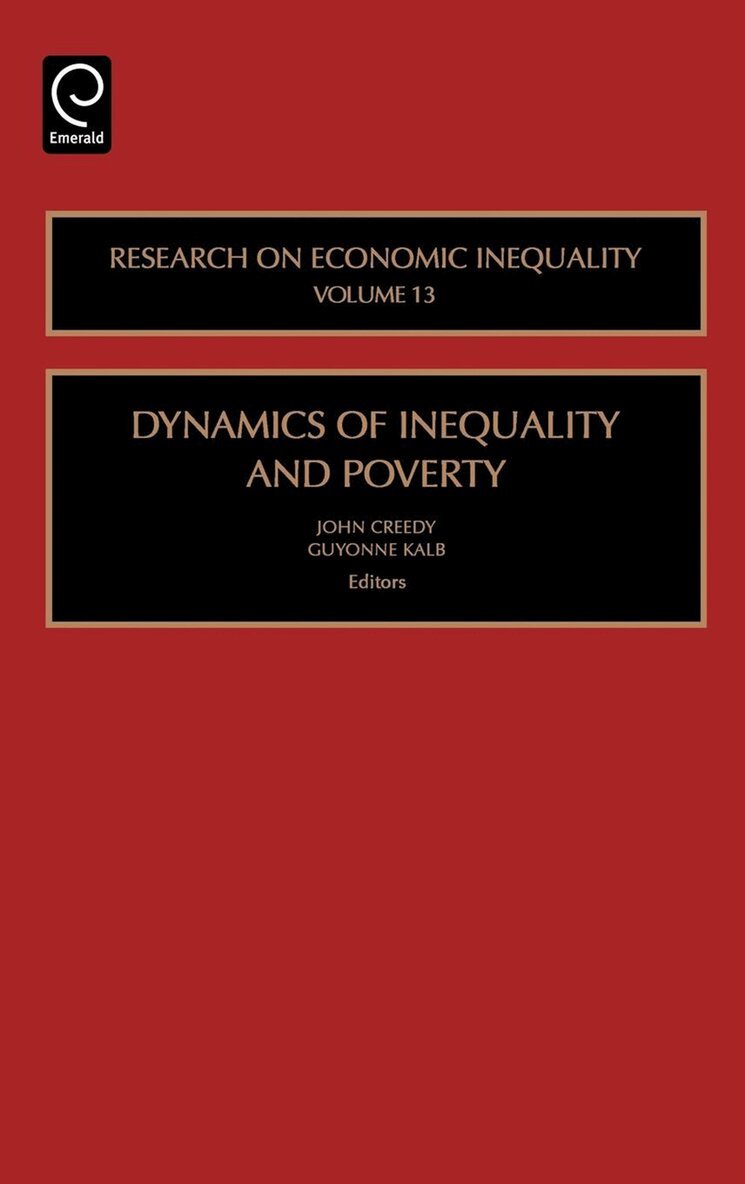
This volume consists of a number of papers related to the theme of the dynamics of inequality and poverty. These are subdivided into four separate parts. The five chapters in Part I of this volume are concerned with inequality and poverty over extended time periods. Bandyopadhyay and Cowell deal with the concept of vulnerability in the context of income mobility of the poor. Biewen studies the extent and the composition of chronic poverty in Germany, comparing the results with the United Kingdom and the United States. Van de Ven describes a dynamic microsimulation model of cohort labour earnings based on the Australian population aged between 20 and 55 years, and considers how the widening social gap between the Australia and the UK is reflected by their redistributive systems, through the use of static and dynamic microsimulation. Kelly analyses the lifetime distribution of net worth in Australia using a dynamic microsimulation model to project the cross-sectional and lifetime asset holdings of a 5-year birth cohort over a period of 40 years. In Part II, the issue of intergenerational transfers of poverty is considered. Corak compares generational earnings mobility and the reasons for the degree to which the long run labour market success of children is related to that of their parents across countries. He provides a framework for understanding the underlying causal process as well as the conception of equality of opportunity, as a guide for public policy. Grawe uses data from the British National Childhood Development Study to examine the quality-quantity trade-off in fertility in multiple measures of child achievement. Maani examines the link between parental income and other resources during adolescent years, and higher education choices of the offspring at age 18, using a recent longitudinal data set from New Zealand. Part III is concerned with inequality over time. First, Wolff examines US inequality since the late 1940s, investigating the role of computer investment, dispersion of schooling and unionisation rate in the rise in inequality between 1968 and 2000. Second, Chotikapanich and Griffiths consider the question of testing for dominance in income distributions through the development of Bayesian methods of inference, which report on changes in income distributions in terms of the posterior probabilities. This allows an assessment of whether income distributions have changed over time. The final part of this volume is concerned with measurement issues. Makdissi and Wodon propose a measure of extreme poverty which is multidimensional in nature. It recognises the fact that there are interaction effects between different deprivations and that the length of time during which deprivations are felt may have a negative impact on household well-being. In the final contribution, Cowell examines Theil's approach to the measurement of inequality in the context of subsequent developments over recent decades. It focuses on the dynamics of inequality and poverty. It examines inequality and poverty over time, the intergenerational transfer of poverty, inequality over time, and measurement issues. The chapters discuss inequality and poverty in developed countries around the world, providing a multinational perspective.
2 203 kr
Skickas inom 7-10 vardagar
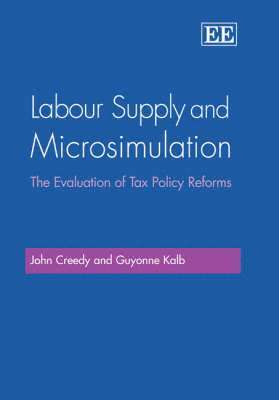
This book provides a detailed introduction to behavioural tax microsimulation methods and reviews the use of such models for evaluating tax policy reforms.The steps required to construct a microsimulation model are described in detail and methods of evaluating policy changes are then presented. Labour Supply and Microsimulation deals with a number of issues related to interpreting results from microsimulation, such as welfare measurement, income distribution, confidence intervals around the simulated results and feedback effects on the wage distribution via labour demand. All of the approaches and proposed methods are general and not model-specific. The book includes detailed descriptions of how labour supply models can be used in building behavioural microsimulation models as well as the development of new methods for evaluating policy reforms; for example, dealing with income distribution in discrete hours models, measuring welfare changes and constructing confidence intervals.John Creedy and Guyonne Kalb's book will appeal to graduate students and academic researchers in the fields of labour economics and public finance. Economists in government departments who wish to use the output from microsimulation models in tax policy analysis and design will also find much to engage them within the book.
1 873 kr
Skickas inom 7-10 vardagar
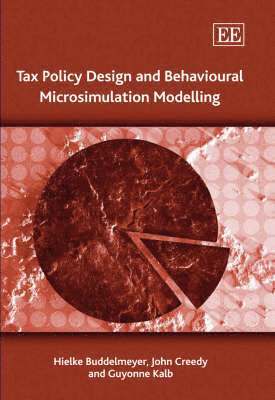
Tax policy questions may relate to specific problems, concerning perhaps the revenue implications of a particular tax, or they may involve an extensive analysis of the cost and redistributive effects of many taxes and transfer payments. This book is concerned with the ways in which tax policy design can be enhanced by the use of a behavioural tax microsimulation model capable of evaluating the effects of planned or actual tax reforms. An advantage of such a large-scale tax simulation model, which reflects the heterogeneity of the population and captures the details of the tax structure, is that it can examine detailed practical policy questions and can provide direct inputs into policy debates. After introducing behavioural models, the authors discuss the role of means testing, several hypothetical policy reforms, actual and proposed reforms and recent modelling developments.Tax Policy Design and Behavioural Microsimulation Modelling will be of interest to academics and researchers of economics, econometrics and public finance. It will also be useful reading for policymakers responsible for the formulation of taxation.