H. Lieth – författare
Visar alla böcker från författaren H. Lieth. Handla med fri frakt och snabb leverans.
5 produkter
5 produkter
E-bok
PDF, Engelska, 2012979 kr
Läs direkt efter köp
After publication of the first volume of the Tropical Rain Forest, the International Journal of Mycology and Lichenology commented ``This is a welcome addition to the literature on the ecology of tropical rain forests. The book provides a wealth of data and stimulating discussions and is of great interest to ecologists interested in tropical areas.'''' Whereas the first volume dealt with system-ecological aspects such as community organization and processes, the present volume concentrates on biogeographical aspects such as species composition, diversity, and geographical variation.Recent ecological research in the tropical rain forest has greatly extended our understanding of biogeographical patterns of variation in the various groups of organisms, and has revealed many of the ecological and evolutionary forces that led to the present patterns of variation. Many important systems of co-evolution between the tropical rain forest ecosystems have also come to light, and the loss of species and related damage is better understood in quantitative terms.This volume presents a comprehensive review of these and other features of the rain forest ecosystem structure, and the ecological processes operating that system. General chapters on abiotic and biotic factors are followed by specific chapters on all major groups of organisms. Prospects for the future are discussed and research needs clearly stated. Also the human exploitation of the system, its effects and its limits are discussed. The book is extensively illustrated by photographs, graphs, and tables, and comprehensive bibliographies follow each chapter. Author, systematic and subject indices complete the book.It is a must for all ecologists, agriculturists, foresters, agronomists, hydrologists, soil scientists, entomologists, human ecologists, nature conservationists, and planners dealing with tropical areas. Biologists and environmentalists will also find the volume of great interest.
E-bok
PDF, Engelska, 20131 825 kr
Läs direkt efter köp
The pulse of life with the seasons is a classic theme of biology, equally cap turing every man''s curiosity about early and late milestones of every year''s cycle and the critical physiologist''s inquiry into life''s subtle signals and responses. Natural historians of ancient and renaissance time as well as today have charted the commonsense facts behind inspired traditions of poetry and practical rules for growing food and fiber. This volume brings together several ways of organizing the basic principles of phenology. These find order in the otherwise overwhelming mass of detail that captures our fleeting attention, like the daily newspaper, and then tends to fade into the overstuffed archives of history. Is this order so obvious and understandable that there is no longer any scien tific challenge to "phenology" as a tradition? Or does apparent simplicity mask a complex and ultimately baffling obstacle to the understanding of seasonality in even those few indicator plants and animals we know best, not to men tion the less known species or races making up the rest of each major land scape unit or ecosystem? Denying both these hasty opinions, we think that this volume well illustrates a range of questions and answers-from soundly established (but not trivial) doctrine to exciting inquiry about how ecosystems are organized.
Häftad, Engelska, 2012
1 524 kr
Skickas inom 10-15 vardagar
The pulse of life with the seasons is a classic theme of biology, equally cap turing every man's curiosity about early and late milestones of every year's cycle and the critical physiologist's inquiry into life's subtle signals and responses. Natural historians of ancient and renaissance time as well as today have charted the commonsense facts behind inspired traditions of poetry and practical rules for growing food and fiber. This volume brings together several ways of organizing the basic principles of phenology. These find order in the otherwise overwhelming mass of detail that captures our fleeting attention, like the daily newspaper, and then tends to fade into the overstuffed archives of history. Is this order so obvious and understandable that there is no longer any scien tific challenge to "phenology" as a tradition? Or does apparent simplicity mask a complex and ultimately baffling obstacle to the understanding of seasonality in even those few indicator plants and animals we know best, not to men tion the less known species or races making up the rest of each major land scape unit or ecosystem? Denying both these hasty opinions, we think that this volume well illustrates a range of questions and answers-from soundly established (but not trivial) doctrine to exciting inquiry about how ecosystems are organized.
E-bok
PDF, Engelska, 20121 367 kr
Läs direkt efter köp
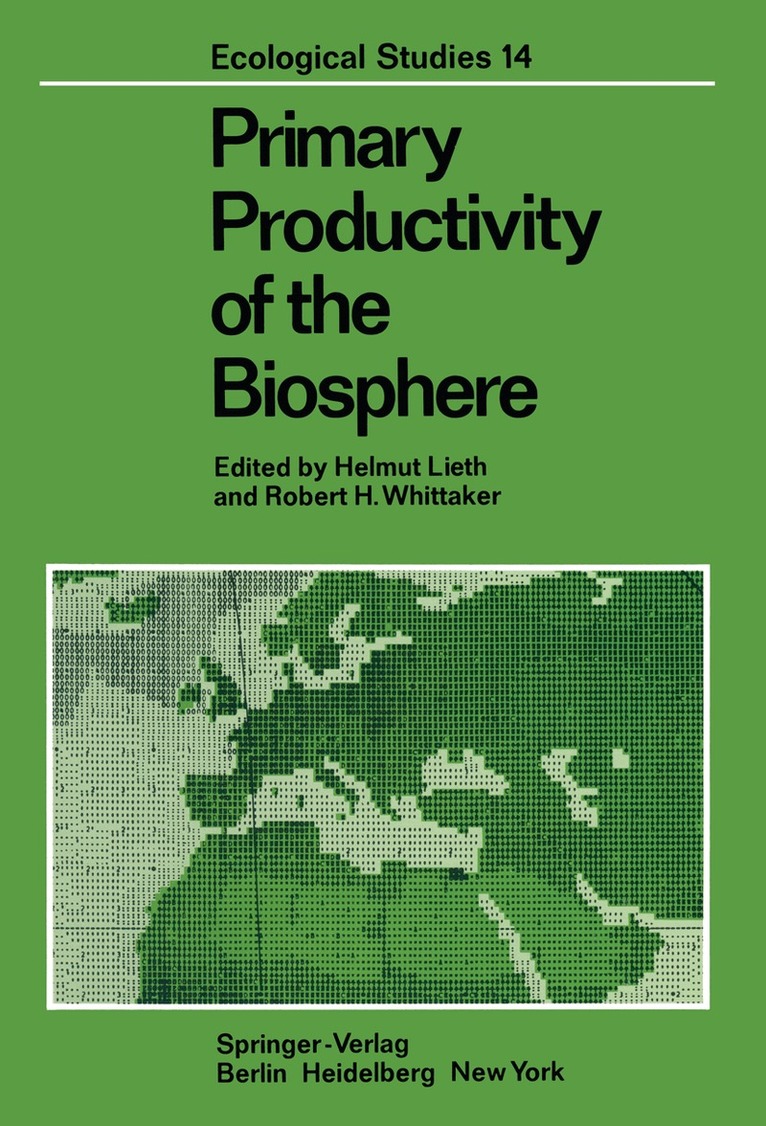
The period since World War II, and especially the last decade influenced by the International Biological Program, has seen enormous growth in research on the function of ecosystems. The same period has seen an exponential'' rise in environmental problems including the capacity of the Earth to support man''s population. The concern extends to man''s effects on the "biosphere"-the film of living organisms on the Earth''s surface that supports man. The common theme of ecologic research and environmental concerns is primary production the binding of sunlight energy into organic matter by plants that supports all life. Many results from the IBP remain to be synthesized, but enough data are available from that program and other research to develop a convincing sum mary of the primary production of the biosphere-the purpose of this book. The book had its origin in the parallel interests of the two editors and Gene E. Likens, which led them to prepare a symposium on the topic at the Second Biological Congress of the American Institute of Biological Sciences in Miami, Florida, October 24, 1971. Revisions of the papers presented at that symposium appear as Chapters 2, 8, 9, 10, and 15 in this book. We have added other chapters that complement this core; these include discussion and evaluation of methods for measuring productivity and regional production, current findings on tropical productivity, and models of primary productivity.
Häftad, Engelska, 2011
1 091 kr
Skickas inom 10-15 vardagar
The period since World War II, and especially the last decade influenced by the International Biological Program, has seen enormous growth in research on the function of ecosystems. The same period has seen an exponential' rise in environmental problems including the capacity of the Earth to support man's population. The concern extends to man's effects on the "biosphere"-the film of living organisms on the Earth's surface that supports man. The common theme of ecologic research and environmental concerns is primary production the binding of sunlight energy into organic matter by plants that supports all life. Many results from the IBP remain to be synthesized, but enough data are available from that program and other research to develop a convincing sum mary of the primary production of the biosphere-the purpose of this book. The book had its origin in the parallel interests of the two editors and Gene E. Likens, which led them to prepare a symposium on the topic at the Second Biological Congress of the American Institute of Biological Sciences in Miami, Florida, October 24, 1971. Revisions of the papers presented at that symposium appear as Chapters 2, 8, 9, 10, and 15 in this book. We have added other chapters that complement this core; these include discussion and evaluation of methods for measuring productivity and regional production, current findings on tropical productivity, and models of primary productivity.