H. Otto Sibum – författare
Visar alla böcker från författaren H. Otto Sibum. Handla med fri frakt och snabb leverans.
6 produkter
6 produkter
Inbunden, Engelska, 2002
2 313 kr
Skickas inom 10-15 vardagar
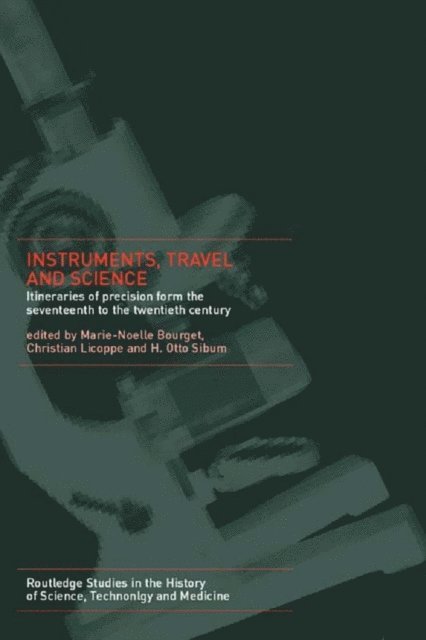
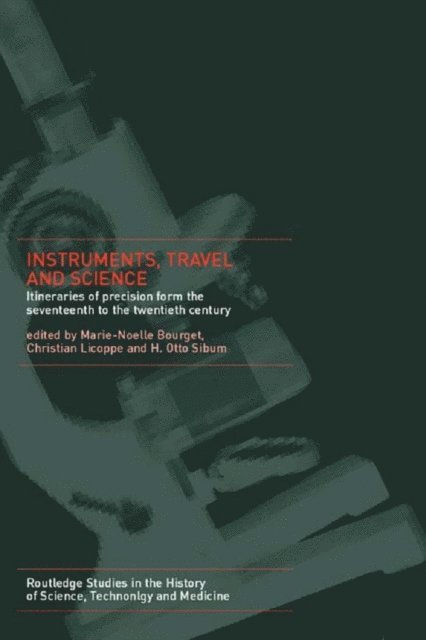
We are now accustomed to conceive of science as an instrumental activity, producing numbers, measurements and graphs by means of sophisticated devices. This book investigates the historical process that gave rise to this instrumental culture. The contributors trace the displacement of instruments across the globe, the spread of practices or precision and the circulation and appropriation of skills and knowledge.Through comparative and contextual approaches, the volume confronts the tension between the local and the global, examining the process of the universalization of science. Bringing together case studies ranging from the seventeenth to the twentieth centuries, contributors discuss French, German and British initiatives, as well as the knowledge and techniques of travellers in countries such as India, Africa, South East Asia and the Americas.Students and researchers interested in the history of science in both Western and non-Western cultures will find this book a valuable and thought-provoking read.
Häftad, Engelska, 2010
591 kr
Skickas inom 3-6 vardagar
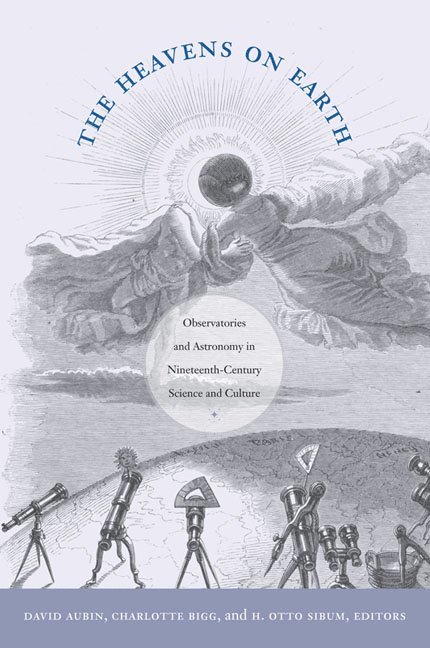
The Heavens on Earth explores the place of the observatory in nineteenth-century science and culture. Astronomy was a core pursuit for observatories, but usually not the only one. It belonged to a larger group of “observatory sciences” that also included geodesy, meteorology, geomagnetism, and even parts of physics and statistics. These pursuits coexisted in the nineteenth-century observatory; this collection surveys them as a coherent whole. Broadening the focus beyond the solitary astronomer at his telescope, it illuminates the observatory’s importance to technological, military, political, and colonial undertakings, as well as in advancing and popularizing the mathematical, physical, and cosmological sciences. The contributors examine “observatory techniques” developed and used not only in connection with observatories but also by instrument makers in their workshops, navy officers on ships, civil engineers in the field, and many others. These techniques included the calibration and coordination of precision instruments for making observations and taking measurements; methods of data acquisition and tabulation; and the production of maps, drawings, and photographs, as well as numerical, textual, and visual representations of the heavens and the earth. They also encompassed the social management of personnel within observatories, the coordination of international scientific collaborations, and interactions with dignitaries and the public. The state observatory occupied a particularly privileged place in the life of the city. With their imposing architecture and ancient traditions, state observatories served representative purposes for their patrons, whether as symbols of a monarch’s enlightened power, a nation’s industrial and scientific excellence, or republican progressive values. Focusing on observatory techniques in settings from Berlin, London, Paris, and Rome to Australia, Russia, Thailand, and the United States, The Heavens on Earth is a major contribution to the history of science.Contributors: David Aubin, Charlotte Bigg, Guy Boistel, Theresa Levitt, Massimo Mazzotti, Ole Molvig, Simon Schaffer, Martina Schiavon , H. Otto Sibum, Richard Staley, John Tresch, Simon Werrett, Sven Widmalm
E-bok
PDF, Engelska, 2010610 kr
Läs direkt efter köp
The Heavens on Earth explores the place of the observatory in nineteenth-century science and culture. Astronomy was a core pursuit for observatories, but usually not the only one. It belonged to a larger group of “observatory sciences” that also included geodesy, meteorology, geomagnetism, and even parts of physics and statistics. These pursuits coexisted in the nineteenth-century observatory; this collection surveys them as a coherent whole. Broadening the focus beyond the solitary astronomer at his telescope, it illuminates the observatory’s importance to technological, military, political, and colonial undertakings, as well as in advancing and popularizing the mathematical, physical, and cosmological sciences.The contributors examine “observatory techniques” developed and used not only in connection with observatories but also by instrument makers in their workshops, navy officers on ships, civil engineers in the field, and many others. These techniques included the calibration and coordination of precision instruments for making observations and taking measurements; methods of data acquisition and tabulation; and the production of maps, drawings, and photographs, as well as numerical, textual, and visual representations of the heavens and the earth. They also encompassed the social management of personnel within observatories, the coordination of international scientific collaborations, and interactions with dignitaries and the public. The state observatory occupied a particularly privileged place in the life of the city. With their imposing architecture and ancient traditions, state observatories served representative purposes for their patrons, whether as symbols of a monarch’s enlightened power, a nation’s industrial and scientific excellence, or republican progressive values. Focusing on observatory techniques in settings from Berlin, London, Paris, and Rome to Australia, Russia, Thailand, and the United States, The Heavens on Earth is a major contribution to the history of science.
Contributors: David Aubin, Charlotte Bigg, Guy Boistel, Theresa Levitt, Massimo Mazzotti, Ole Molvig, Simon Schaffer, Martina Schiavon , H. Otto Sibum, Richard Staley, John Tresch, Simon Werrett, Sven Widmalm
E-bok
Engelska, 2003995 kr
Läs direkt efter köp
We are now accustomed to conceive of science as an instrumental activity, producing numbers, measurements and graphs by means of sophisticated devices. This book investigates the historical process that gave rise to this instrumental culture. The contributors trace the displacement of instruments across the globe, the spread of practices or precision and the circulation and appropriation of skills and knowledge.Through comparative and contextual approaches, the volume confronts the tension between the local and the global, examining the process of the universalization of science. Bringing together case studies ranging from the seventeenth to the twentieth centuries, contributors discuss French, German and British initiatives, as well as the knowledge and techniques of travellers in countries such as India, Africa, South East Asia and the Americas.Students and researchers interested in the history of science in both Western and non-Western cultures will find this book a valuable and thought-provoking read.
E-bok
PDF, Engelska, 2003986 kr
Läs direkt efter köp
We are now accustomed to conceive of science as an instrumental activity, producing numbers, measurements and graphs by means of sophisticated devices. This book investigates the historical process that gave rise to this instrumental culture. The contributors trace the displacement of instruments across the globe, the spread of practices or precision and the circulation and appropriation of skills and knowledge.Through comparative and contextual approaches, the volume confronts the tension between the local and the global, examining the process of the universalization of science. Bringing together case studies ranging from the seventeenth to the twentieth centuries, contributors discuss French, German and British initiatives, as well as the knowledge and techniques of travellers in countries such as India, Africa, South East Asia and the Americas.Students and researchers interested in the history of science in both Western and non-Western cultures will find this book a valuable and thought-provoking read.
Häftad, Engelska, 2014
857 kr
Skickas inom 10-15 vardagar
We are now accustomed to conceive of science as an instrumental activity, producing numbers, measurements and graphs by means of sophisticated devices. This book investigates the historical process that gave rise to this instrumental culture. The contributors trace the displacement of instruments across the globe, the spread of practices or precision and the circulation and appropriation of skills and knowledge.Through comparative and contextual approaches, the volume confronts the tension between the local and the global, examining the process of the universalization of science. Bringing together case studies ranging from the seventeenth to the twentieth centuries, contributors discuss French, German and British initiatives, as well as the knowledge and techniques of travellers in countries such as India, Africa, South East Asia and the Americas.Students and researchers interested in the history of science in both Western and non-Western cultures will find this book a valuable and thought-provoking read.