• Fri frakt över 249 kr
  • •
  • Snabba leveranser
  • •
  • Billiga böcker
Kundservice

Du är på sajten för privatpersoner.

Företag, bibliotek eller offentlig verksamhet?

Du handlar på classic.bokus.com, där alla dina funktioner finns intakta.
Till classic.bokus.com
Bokus logotyp. Gå till startsidan.
  • Erbjudanden
  • Nyheter
  • Student
  • Topplistor
  • Barn & ungdom
  • Bokus Play
  • E-böcker
  • Pocketböcker
  • Spel & pussel

10% rabatt på allt med kod NYSTART10 →

Sidfot

Mina sidor

    Hjälp

    • Kundservice
    • Vanliga frågor och svar
    • Frakt och leverans
    • Retur vid ångerrätt
    • Reklamera vara
    • Betalning
    • Köpvillkor
    • Allmänna villkor
    • Information om webbplatsens tillgänglighet

    Om Bokus

    • Om oss
    • Pressrum
    • För studenter
    • För företag
    • För bibliotek och offentlig verksamhet
    • För leverantörer
    • Hållbarhet

    Populärt

    • Aktuella erbjudanden
    • Presentkort
    • Studentlitteratur
    • Nya böcker
    • Topplistor
    • Signerade böcker
    • Engelska böcker

    Inspiration

    • Boktips
    • BookTok
    • Populära bokserier
    • Barnbokskaraktärer
    • Populära författare
    Logotyp för Bokus
    Följ oss på Facebook (extern länk)Följ oss på Instagram (extern länk)Följ oss på YouTube (extern länk)Följ oss på TikTok (extern länk)
    bokus @ CookiesAnpassa cookiesIntegritetspolicyKöpvillkor
    Till Citymail hemsida (extern länk)Till Budbee hemsida (extern länk)Till Postnord hemsida (extern länk)Till Schenker hemsida (extern länk)Till Early Bird hemsida (extern länk)Till Walleys hemsida (extern länk)
    1. Naturvetenskap och teknik
    2. Matematik och naturvetenskap
    3. Astronomi

    Heavens on Earth

    Observatories and Astronomy in Nineteenth-Century Science and Culture

    AvDavid Aubin,Charlotte Bigg

    Häftad, Engelska, 2010

    Del i serien Science and Cultural Theory

    432 kr

    Beställningsvara. Skickas inom 5-8 vardagar. Fri frakt över 249 kr.

    Beskrivning

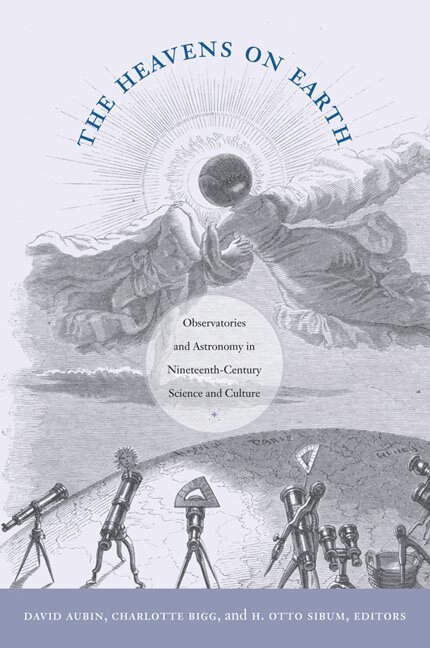
    The Heavens on Earth explores the place of the observatory in nineteenth-century science and culture. Astronomy was a core pursuit for observatories, but usually not the only one. It belonged to a larger group of “observatory sciences” that also included geodesy, meteorology, geomagnetism, and even parts of physics and statistics. These pursuits coexisted in the nineteenth-century observatory; this collection surveys them as a coherent whole. Broadening the focus beyond the solitary astronomer at his telescope, it illuminates the observatory’s importance to technological, military, political, and colonial undertakings, as well as in advancing and popularizing the mathematical, physical, and cosmological sciences. The contributors examine “observatory techniques” developed and used not only in connection with observatories but also by instrument makers in their workshops, navy officers on ships, civil engineers in the field, and many others. These techniques included the calibration and coordination of precision instruments for making observations and taking measurements; methods of data acquisition and tabulation; and the production of maps, drawings, and photographs, as well as numerical, textual, and visual representations of the heavens and the earth. They also encompassed the social management of personnel within observatories, the coordination of international scientific collaborations, and interactions with dignitaries and the public. The state observatory occupied a particularly privileged place in the life of the city. With their imposing architecture and ancient traditions, state observatories served representative purposes for their patrons, whether as symbols of a monarch’s enlightened power, a nation’s industrial and scientific excellence, or republican progressive values. Focusing on observatory techniques in settings from Berlin, London, Paris, and Rome to Australia, Russia, Thailand, and the United States, The Heavens on Earth is a major contribution to the history of science.Contributors: David Aubin, Charlotte Bigg, Guy Boistel, Theresa Levitt, Massimo Mazzotti, Ole Molvig, Simon Schaffer, Martina Schiavon , H. Otto Sibum, Richard Staley, John Tresch, Simon Werrett, Sven Widmalm

    Produktinformation

    • Utgivningsdatum:2010-01-26
    • Mått:156 x 235 x 21 mm
    • Vikt:685 g
    • Format:Häftad
    • Språk:Engelska
    • Serie:Science and Cultural Theory
    • Antal sidor:400
    • Förlag:Duke University Press
    • ISBN:9780822346401

    Utforska kategorier

    • Astronomi inom Naturvetenskap och teknik
    • Naturvetenskapens historia inom Naturvetenskap och teknik

    Mer om författaren

    David Aubin is Professor of History of Science at the UniversitÉ Pierre et Marie Curie, Paris, and a member of the Institut de MathÉmatiques de Jussieu.Charlotte Bigg is a research scientist at the Centre National de la Recherche Scientifique (Centre Alexandre KoyrÉ, Paris).H. Otto Sibum is Hans Rausing Professor of History of Science and Director of the Office for History of Science at Uppsala University in Sweden.

    Recensioner i media

    “It is hard to do justice to this excellent book in a short review. . . . The essays as a whole constitute an extremely valuable resource for astronomical historians. . . . The Heavens on Earth is a meticulously-documented scholarly work. . . .” - Allan Chapman, The Observatory Magazine “The contributors to this book are to be congratulated for putting together a thought-provoking and wide-ranging collection of essays. The editors should be thanked not only for bringing these together but for providing a thorough review of the field in their introduction and the excellent bibliography.” - Rebekah Higgitt, British Journal for the History of Science “I recommend this book to those interested in the late enlightenment and Victorian period that heralded advances in science and the philosophical stance of astronomy.”- Ian Welland, Astronomy Now“This book perceptively explores how observatory practices interacted with cultural and political representations at different levels. As such, the volume is a valuable contribution to the history of astronomy, offering to general andspecialized readers new insights into the social and cultural history of nineteenth-century astronomy.” - Pedro Ruis-Castell, Journal for the History of Astronomy “The Heavens on Earth represents the most comprehensive work yet produced on the political, military and cultural significance of nineteenth-century astronomical observatories. It is highly recommended for all scholarsinterested in the instruments and techniques by which those observatoriesbecame the very model of scientific precision.” - Steven Ruskin, Technology and Culture “In crafting this collection, this well-tuned team of editors never hits a sour note. . . . The masterful introduction provides a cogent mapping of the collection’s contents. . . . [T]his volume provides an extraordinarily useful reframing of a significant aspect of nineteenth-century astronomy. These essays refocus our attention from the facades of those monolithic monuments on the ill to the living, breathing observers within their walls who indefatigably struggled to see, measure, record, and share their vision of heavenly and earthly phenomena.” - Pamela Gossin, Victorian Studies “The Heavens on Earth raises the bar for the historiography of astronomy and observatory techniques. The collection stands out from the existing literature in its attention to the broad cultural context of observatory work and techniques; continental Europe in addition to Great Britain and the United States; the connections between the observatory and ‘popular’ astronomy; and the links between astronomy and concerns such as geodesy, the rating of chronometers, and military science. It is a major contribution to the history of not only astronomy but also nineteenth-century science and its culture.”-Robert W. Smith, University of Alberta, co-author of Hubble: Imaging Space and Time “This impressive volume is the first to offer a panoramic view of the observatory as site of science, empire, and modernization during its golden age. At the forefront of precision measurement, standardization, number-crunching, and worldwide networking, the nineteenth-century observatory made globalization a reality.”-Lorraine Daston, Max Planck Institute for the History of Science, Berlin “The Heavens on Earth represents the most comprehensive work yet produced on the political, military and cultural significance of nineteenth-century astronomical observatories. It is highly recommended for all scholars interested in the instruments and techniques by which those observatories became the very model of scientific precision.” - Steven Ruskin (Technology and Culture) “I recommend this book to those interested in the late enlightenment and Victorian period that heralded advances in science and the philosophical stance of astronomy.”- Ian Welland (Astronomy Now) “In crafting this collection, this well-tuned team of editors never hits a sour note. . . . The masterful introduction provides a cogent mapping of the collection’s contents. . . . [T]his volume provides an extraordinarily useful reframing of a significant aspect of nineteenth-century astronomy. These essays refocus our attention from the facades of those monolithic monuments on the ill to the living, breathing observers within their walls who indefatigably struggled to see, measure, record, and share their vision of heavenly and earthly phenomena.” - Pamela Gossin (Victorian Studies) “It is hard to do justice to this excellent book in a short review. . . . The essays as a whole constitute an extremely valuable resource for astronomical historians. . . . The Heavens on Earth is a meticulously-documented scholarly work. . . .” - Allan Chapman (Observatory Magazine) “The contributors to this book are to be congratulated for putting together a thought-provoking and wide-ranging collection of essays. The editors should be thanked not only for bringing these together but for providing a thorough review of the field in their introduction and the excellent bibliography.” - Rebekah Higgitt (British Journal for the History of Science) “This book perceptively explores how observatory practices interacted with cultural and political representations at different levels. As such, the volume is a valuable contribution to the history of astronomy, offering to general and specialized readers new insights into the social and cultural history of nineteenth-century astronomy.” - Pedro Ruis-Castell (Journal for the History of Astronomy)

    Innehållsförteckning

    • List of Illustrations viiAcknowledgments xiIntroduction: Observatory Techniques in Nineteenth-Century Science and Society / David Aubin, Charlotte Bigg, and H. Otto Sibum 11. The Astronomical Capital of the World: Pulkovo Observatory in the Russia of Tsar Nicholas I / Simon Werrett 332. The Jesuit on the Roof: Observatory Sciences, Metaphysics, and Nation Building / Massimo Mazzotti 583. Eclipse Politics in France and Thailand, 1868 / David Aubin 864. Keeping the Books at Paramatta Observatory / Simon Schaffer 1185. Training Seafarers in Astronomy: Methods, Naval Schools, and Naval Observatories in Eighteenth- and Nineteenth-Century France / Guy Boistel 1486. Astronomy as Military Science: The Case of Sweden, ca. 1800–1850 / Sven Widmalm 1747. Geodesy and Map Making in France and Algeria: Between Army Officers and Observatory Scientists / Martina Schiavon 1998. Michelson and the Observatory: Physics and the Astronomical Community in Late-Nineteenth-Century America / Richard Staley 2259. Even the Tools Will Be Free: Humboldt's Romantic Technologies / John Tresch 25310. "I thought this might be of interest . . .": The Observatory as Public Enterprise / Theresa Levitt 28511. Staging the Heavens: Astrophysics and Popular Astronomy in the Late Nineteenth Century / Charlotte Bigg 30512. The Berlin Urania, Humboldtian Cosmology, and the Public / Ole Molvig 325Bibliography 345About the Contributors 367Index 369