H. R. Coursen - Böcker
Visar alla böcker från författaren H. R. Coursen. Handla med fri frakt och snabb leverans.
7 produkter
7 produkter
853 kr
Skickas inom 10-15 vardagar
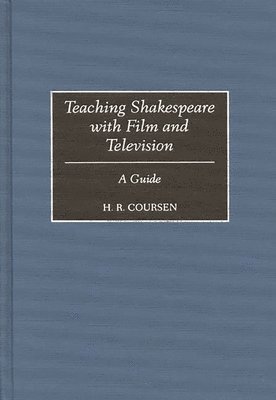
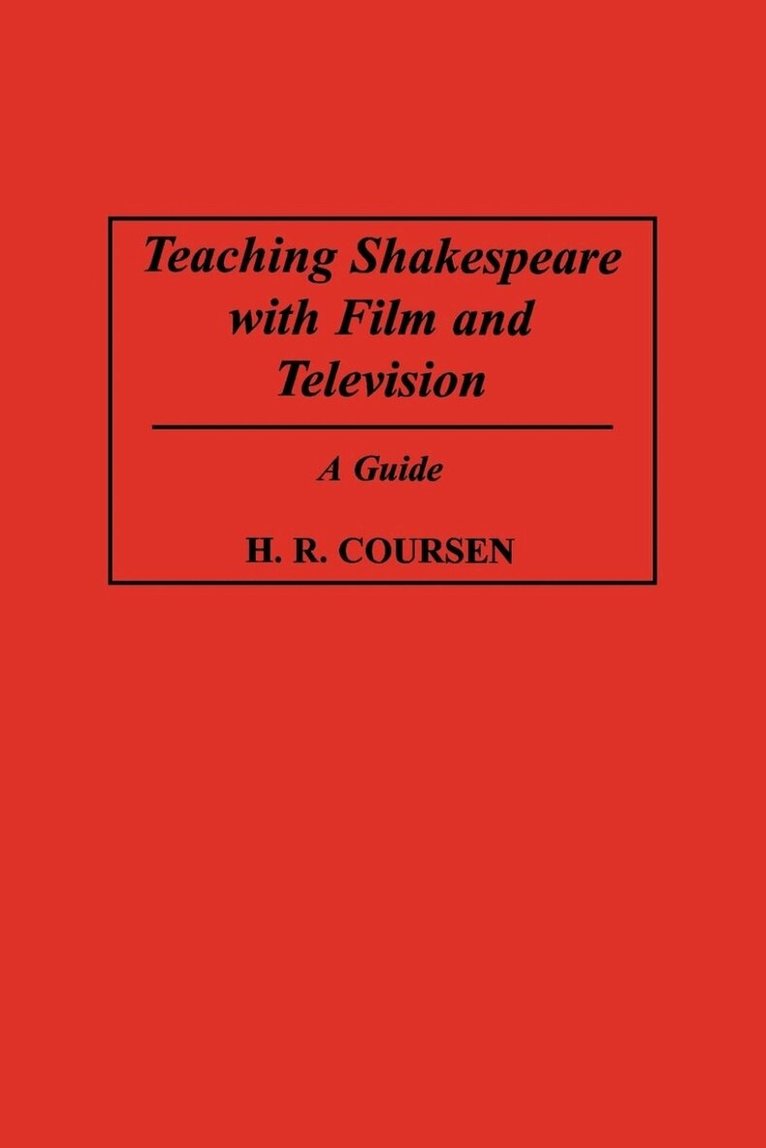
Shakespeare is one of the world's most widely taught and most demanding authors. Fortunately, many of his plays have been adapted for film and television, and these productions are a valuable aid for helping students understand and respond to his works. This reference shows teachers and students how to master the techniques of discussing productions of his plays on film and television. It distinguishes the advantages and limitations of film and television as media for representing Shakespeare's dramas. The book then examines strategies for incorporating film and television productions in the classroom and provides many specific examples of how to write about these adaptations of the plays. The volume describes numerous educational resources, both in print and on cassette. This reference will prove invaluable to teachers and students of Shakespeare at all levels, particularly at a time when Shakespeare films are being produced at an unprecedented pace.Although Shakespeare is one of the world's most widely taught authors, he is also one of the world's most demanding. Because of the popularity and sophistication of his works, numerous film and television adaptations of his plays have been made—some decades ago and others very recently. Shakespeare films are coming out at an unprecedented rate, as audiences continue to respond to the richness of his works. These productions are a valuable means of introducing students to Shakespeare's plays, for the film and television versions reflect different interpretations of his works. Although some productions are generally considered better than others, and all have various faults and virtues, each of them teaches us something about the play and the medium.This reference book is a convenient guide for helping teachers and students master the techniques of discussing productions of the plays on film and television. It makes important distinctions between the two media, particularly about the conceptual and physical space available in each and the choices that space, or lack of it, impose on production. Central to the book is the concept of script, the words from which productions are generated. Because even weak productions are nonetheless interpretations of Shakespeare's scripts, they can be used effectively to explore the complex issues in his plays. The volume includes many suggestions about how to help students write well by comparing in very specific terms small segments from different productions. It lists the resources available in this rapidly growing field, both on cassette and in print, and gives many examples of critical commentary, looking at genre, editing, allusion, setting, and the script in historical context. Productions discussed include the Edzard As You Like It, the Branagh A Midwinter's Tale, the Parker Othello, the Loncraine Richard III, and seventy years of Hamlet. Students and teachers of Shakespeare at all levels will find this book to be an invaluable guide to his plays.
853 kr
Skickas inom 10-15 vardagar
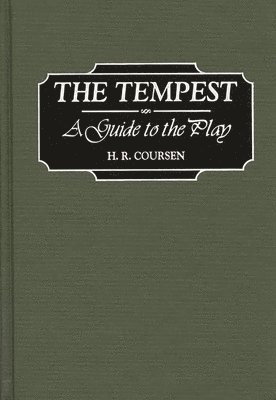
The Tempest was first published in 1623 and is probably the last play Shakespeare wrote by himself. The product of his artistic maturity, it has inspired a variety of modern adaptations and remains one of his most popular plays. While its plot is fairly straightforward, The Tempest addresses numerous issues and topics current in the 17th century, such as magic and colonialism. Scholars, in turn, have responded by generating a vast body of criticism. This reference is a comprehensive guide to the play.The volume begins with a brief consideration of the play's textual history, followed by an evaluation of the merits of various modern editions. It then looks at some of Shakespeare's likely sources and influences, from classical literature to accounts of a 17th-century shipwreck. A chapter on the play's dramatic structure moves through the text and touches on issues raised in greater detail later in the book. The volume then studies some of the play's themes and summarizes how critics have responded to them. Finally, the book comments on the play's performance history and analyzes major productions.
673 kr
Skickas inom 7-10 vardagar
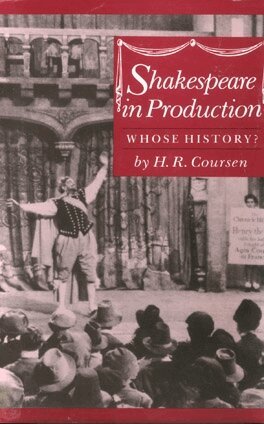
Shakespeare in Production examines a number of plays in context. Included are the 1936 Romeo and Juliet, unpopular with critics of filmed Shakespeare, but very much a "photoplay" if its time; the opening sequences of filmed Hamlets which span more than seventy years; The Comedy of Errors on television, where production of this script is almost impossible; and the Branagh Much Ado About Nothing, a "popular" film discussed in the context of comedy as a genre.In considering Henry V, this study looks at fifty years of Pistol on film and television to illustrate how changing times shape the character, and then includes the Branagh film in discussions of recent interpretations of "history" as reflected by productions of Shakespeare's history plays. An examination of late twentieth-century production of Hamlet suggests what the script has lost and gained as it has moved toward in time. A discussion of "designer's theater" in Great Britain, where all the elements of the production are dominated by "concept," argues that the actors work within a restricting rather than a liberating artistic environment."Whose history?" inevitably turns out to be that of the individual observer, for regardless of the criteria deployed criticism is an intensely subjective activity, and is meant to be when it deals with drama. In this discussion of Branagh's Much Ado About Nothing, for example, the contemporary response to the film becomes the subject of the chapter. For, although the film is much more than what is said about it, it is also less, in that the critical response is part of the overall creative activity involved in a Shakespeare production.
301 kr
Skickas inom 5-8 vardagar
150 kr
Skickas inom 5-8 vardagar
176 kr
Skickas inom 5-8 vardagar
613 kr
Skickas inom 7-10 vardagar
Although Shakespeare is one of the world's most widely taught authors, he is also one of the world's most demanding. Because of the popularity and sophistication of his works, numerous film and television adaptations of his plays have been made--some decades ago and others very recently. Shakespeare films are coming out at an unprecedented rate, as audiences continue to respond to the richness of his works. These productions are a valuable means of introducing students to Shakespeare's plays, for the film and television versions reflect different interpretations of his works. Although some productions are generally considered better than others, and all have various faults and virtues, each of them teaches us something about the play and the medium.This reference book is a convenient guide for helping teachers and students master the techniques of discussing productions of the plays on film and television. It makes important distinctions between the two media, particularly about the conceptual and physical space available in each and the choices that space, or lack of it, impose on production. Central to the book is the concept of script, the words from which productions are generated. Because even weak productions are nonetheless interpretations of Shakespeare's scripts, they can be used effectively to explore the complex issues in his plays. The volume includes many suggestions about how to help students write well by comparing in very specific terms small segments from different productions. It lists the resources available in this rapidly growing field, both on cassette and in print, and gives many examples of critical commentary, looking at genre, editing, allusion, setting, and the script in historical context. Productions discussed include the Edzard As You Like It, the Branagh A Midwinter's Tale, the Parker Othello, the Loncraine Richard III, and seventy years of Hamlet. Students and teachers of Shakespeare at all levels will find this book to be an invaluable guide to his plays.