Hadis Morkoç - Böcker
Visar alla böcker från författaren Hadis Morkoç. Handla med fri frakt och snabb leverans.
7 produkter
7 produkter
2 116 kr
Skickas inom 10-15 vardagar
A View of the Past, and a Look into the Future by a Pioneer By Jacques I. Pankove This forword will be a brief review of important developments in the early and recent history of gallium nitride, and also a perspective on the current and future evolution of this exciting field. Gallium nitride (GaN) was syn thesized more than 50 years ago by Johnson et al. [1] in 1932, and also by Juza and Hahn [2] in 1938, who passed ammonia over hot gallium. This method produced small needles and platelets. The purpose of Juza and Hahn was to investiagte the crystal structure and lattice constant of GaN as part of a systematic study of many compounds. Two decades later, Grim al. [3] in 1959 employed the same technique to produce small cry meiss et stals of GaN for the purpose of measuring their photoluminescence spectra. Another decade later Maruska and Tietjen [4] in 1969 used a chloride trans port vapor technique to make a large-area layer of GaN on sapphire. All of the GaN made at that time was very conducting n-type even when not deli berately doped. The donors were believed to be nitrogen vacancies. Later this model was questioned by Seifert et al. [5] in 1983, and oxygen was pro as the donor. Oxygen with its 6 valence electrons on a N site (N has 5 posed valence electrons) would be a single donor.
2 116 kr
Skickas inom 10-15 vardagar
A View of the Past, and a Look into the Future by a Pioneer By Jacques I. Pankove This forword will be a brief review of important developments in the early and recent history of gallium nitride, and also a perspective on the current and future evolution of this exciting field. Gallium nitride (GaN) was syn thesized more than 50 years ago by Johnson et al. [1] in 1932, and also by Juza and Hahn [2] in 1938, who passed ammonia over hot gallium. This method produced small needles and platelets. The purpose of Juza and Hahn was to investiagte the crystal structure and lattice constant of GaN as part of a systematic study of many compounds. Two decades later, Grim al. [3] in 1959 employed the same technique to produce small cry meiss et stals of GaN for the purpose of measuring their photoluminescence spectra. Another decade later Maruska and Tietjen [4] in 1969 used a chloride trans port vapor technique to make a large-area layer of GaN on sapphire. All of the GaN made at that time was very conducting n-type even when not deli berately doped. The donors were believed to be nitrogen vacancies. Later this model was questioned by Seifert et al. [5] in 1983, and oxygen was pro as the donor. Oxygen with its 6 valence electrons on a N site (N has 5 posed valence electrons) would be a single donor.
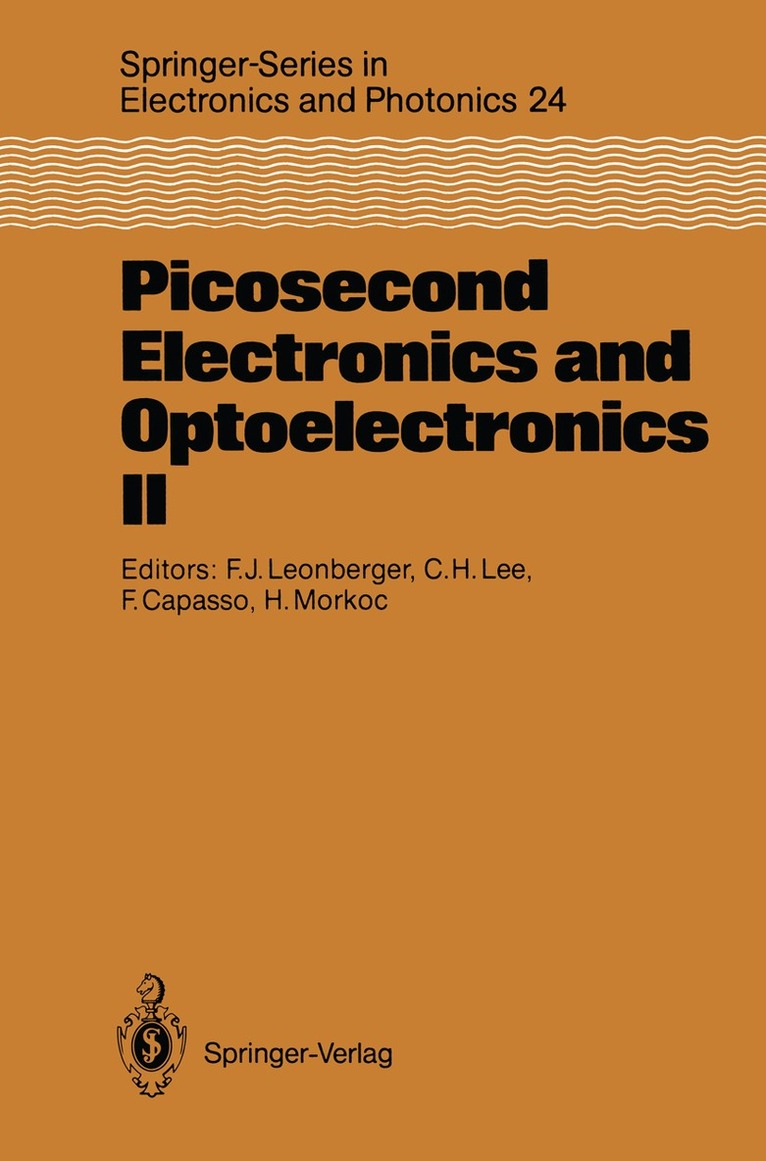
Picosecond Electronics and Optoelectronics II
Proceedings of the Second OSA-IEEE (LEOS) Incline Village, Nevada, January 14–16, 1987
Häftad, Engelska, 2011
1 062 kr
Skickas inom 10-15 vardagar
Over the past five years, there has been an enormous increase in the inter est in and understanding of electronic and optoelectronic devices operating in the picosecond (multigigahertz) range. This has been fueled in a sig nificant way by the spectacular advances in picosecond laser technology, electro optic sampling, III-V devices, and wideband fiber optic systems. Partly to address these advances, a new conference jointly sponsored by the IEEE Lasers and Electrooptics Society (IEEE (LEOS)) and the Op tical Society of America (OSA) was founded and its first meeting held in March 1985. The purpose of this meeting was to bring together work ers in the areas of electronics and optoelectronics who share a common interest in the physics and technology of picosecond solid-state electronic and optoelectronic devices, their multigigahertz applications, and ultrafast measurement techniques. Emphasis was placed on the interdisciplinary as pects of these areas, since each area is covered by its own topical meeting. This meeting was quite successful and led to a second meeting, of which this volume forms the proceedings.
1 409 kr
Skickas inom 5-8 vardagar
Light emitting diodes (LEDs) are already used in traffic signals, signage lighting, and automotive applications. However, its ultimate goal is to replace traditional illumination through LED lamps since LED lighting significantly reduces energy consumption and cuts down on carbon-dioxide emission. Despite dramatic advances in LED technologies (e.g., growth, doping and processing technologies), however, there remain critical issues for further improvements yet to be achieved for the realization of solid-state lighting. This book aims to provide the readers with some contemporary LED issues, which have not been comprehensively discussed in the published books and, on which the performance of LEDs is seriously dependent. For example, most importantly, there must be a breakthrough in the growth of high-quality nitride semiconductor epitaxial layers with a low density of dislocations, in particular, in the growth of Al-rich and and In-rich GaN-based semiconductors. The materials quality is directly dependent on the substrates used, such as sapphire, Si, etc. In addition, efficiency droop, growth on different orientations and polarization are also important. Chip processing and packaging technologies are key issues. This book presents a comprehensive review of contemporary LED issues. Given the interest and importance of future research in nitride semiconducting materials and solid state lighting applications, the contents are very timely. The book is composed of chapters written by leading researchers in III-nitride semiconducting materials and device technology. This book will be of interest to scientists and engineers working on LEDs for lighting applications. Postgraduate researchers working on LEDs will also benefit from the issues this book provides.
Del 133 - Topics in Applied Physics
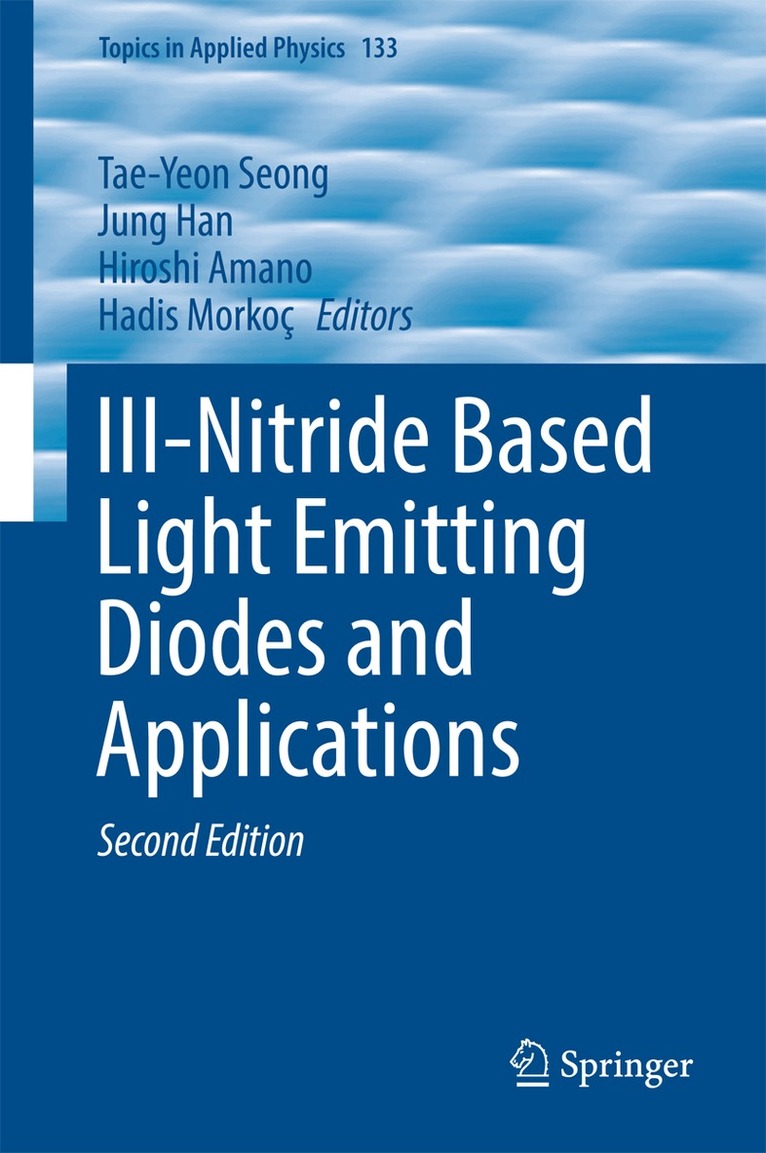
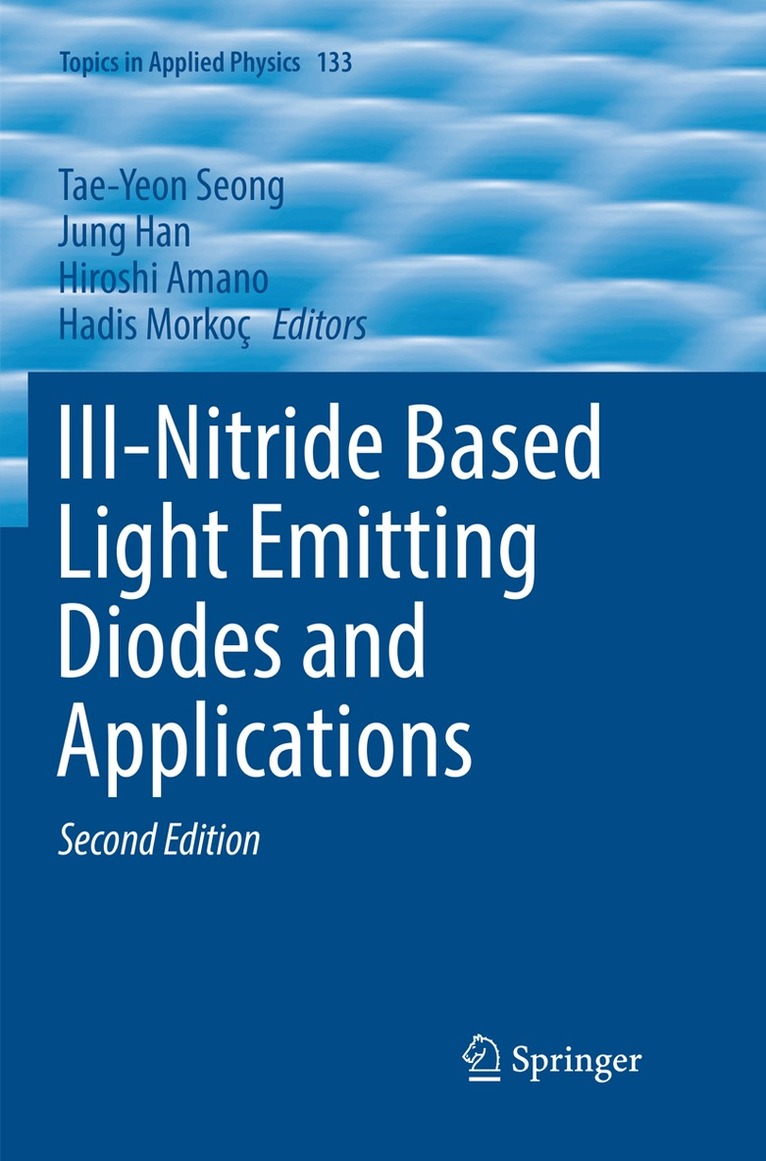
III-Nitride Based Light Emitting Diodes and Applications
Inbunden, Engelska, 2017
2 432 kr
Skickas inom 10-15 vardagar
The revised edition of this important book presents updated and expanded coverage of light emitting diodes (LEDs) based on heteroepitaxial GaN on Si substrates, and includes new chapters on tunnel junction LEDs, green/yellow LEDs, and ultraviolet LEDs.Over the last two decades, significant progress has been made in the growth, doping and processing technologies of III-nitride based semiconductors, leading to considerable expectations for nitride semiconductors across a wide range of applications. LEDs are already used in traffic signals, signage lighting, and automotive applications, with the ultimate goal of the global replacement of traditional incandescent and fluorescent lamps, thus reducing energy consumption and cutting down on carbon-dioxide emission.However, some critical issues must be addressed to allow the further improvements required for the large-scale realization of solid-state lighting, and this book aims to provide the readers with details of somecontemporary issues on which the performance of LEDs is seriously dependent. Most importantly, it describes why there must be a breakthrough in the growth of high-quality nitride semiconductor epitaxial layers with a low density of dislocations, in particular, in the growth of Al-rich and In-rich GaN-based semiconductors. The quality of materials is directly dependent on the substrates used, such as sapphire and Si, and the book discusses these as well as topics such as efficiency droop, growth in different orientations, polarization, and chip processing and packaging technologies.Offering an overview of the state of the art in III-Nitride LED science and technology, the book will be a core reference for researchers and engineers involved with the developments of solid state lighting, and required reading for students entering the field.
Del 133 - Topics in Applied Physics
III-Nitride Based Light Emitting Diodes and Applications
Häftad, Engelska, 2018
2 432 kr
Skickas inom 10-15 vardagar
The revised edition of this important book presents updated and expanded coverage of light emitting diodes (LEDs) based on heteroepitaxial GaN on Si substrates, and includes new chapters on tunnel junction LEDs, green/yellow LEDs, and ultraviolet LEDs.Over the last two decades, significant progress has been made in the growth, doping and processing technologies of III-nitride based semiconductors, leading to considerable expectations for nitride semiconductors across a wide range of applications. LEDs are already used in traffic signals, signage lighting, and automotive applications, with the ultimate goal of the global replacement of traditional incandescent and fluorescent lamps, thus reducing energy consumption and cutting down on carbon-dioxide emission.However, some critical issues must be addressed to allow the further improvements required for the large-scale realization of solid-state lighting, and this book aims to provide the readers with details of somecontemporary issues on which the performance of LEDs is seriously dependent. Most importantly, it describes why there must be a breakthrough in the growth of high-quality nitride semiconductor epitaxial layers with a low density of dislocations, in particular, in the growth of Al-rich and In-rich GaN-based semiconductors. The quality of materials is directly dependent on the substrates used, such as sapphire and Si, and the book discusses these as well as topics such as efficiency droop, growth in different orientations, polarization, and chip processing and packaging technologies.Offering an overview of the state of the art in III-Nitride LED science and technology, the book will be a core reference for researchers and engineers involved with the developments of solid state lighting, and required reading for students entering the field.
3 358 kr
Tillfälligt slut
This book provides a summary of the current state-of-the-art in SiC and GaN and identify future areas of development. The remarkable improvements in material quality and device performance in the last few years show the promise of these technologies for areas that Si cannot operate because of it's smaller bandgap. We feel that this collection of chapters provides an excellent introduction to the field and is an outstanding reference for those performing research on wide bandgap semiconductors.In this book, we bring together numerous experts in the field to review progress in SiC and GaN electronic devices and novel detectors. Professor Morkoc reviews the growth and characterization of nitrides, followed by chapters from Professor Shur, Professor Karmalkar, and Professor Gaska on High Electron Mobility Transistors, Professor Pearton and co-workers on ultra-high breakdown voltage GaN-based rectifiers and the group of Professor Abernathy on emerging MOS devices in the nitride system. Dr Baca from Sandia National Laboratories and Dr Chang from Agilent review the use of mixed group V-nitrides as the base layer in novel Heterojunction Bipolar Transistors. There are 3 chapters on SiC, including Professor Skowronski on growth and characterization, Professor Chow on power Schottky and pin rectifiers and Professor Cooper on power MOSFETs. Professor Dupuis and Professor Campbell give an overview of short wavelength, nitride based detectors. Finally, Jihyun Kim and co-workers describe recent progress in wide bandgap semiconductor spintronics where one can obtain room temperature ferromagnetism and exploit the spin of the electron in addition to its charge.