Hans Lambers - Böcker
Visar alla böcker från författaren Hans Lambers. Handla med fri frakt och snabb leverans.
10 produkter
10 produkter
2 247 kr
Skickas inom 7-10 vardagar
The development of phosphorus (P)-efficient crop varieties is urgently needed to reduce agriculture's current over-reliance on expensive, environmentally destructive, non-renewable and inefficient P-containing fertilizers. The sustainable management of P in agriculture necessitates an exploitation of P-adaptive traits that will enhance the P-acquisition and P-use efficiency of crop plants. Action in this area is crucial to ensure sufficient food production for the world’s ever-expanding population, and the overall economic success of agriculture in the 21st century. This informative and up-to-date volume presents pivotal research directions that will facilitate the development of effective strategies for bioengineering P-efficient crop species. The 14 chapters reflect the expertise of an international team of leading authorities in the field, who review information from current literature, develop novel hypotheses, and outline key areas for future research. By evaluating aspects of vascular plant and green algal P uptake and metabolism, this book provides insights as to how plants sense, acquire, recycle, scavenge and use P, particularly under the naturally occurring condition of soluble inorganic phosphate deficiency that characterises the vast majority of unfertilised soils, worldwide. The reader is provided with a full appreciation of the diverse information concerning plant P-starvation responses, as well as the crucial role that plant–microbe interactions play in plant P acquisition.Annual Plant Reviews, Volume 48: Phosphorus Metabolism in Plants is an important resource for plant geneticists, biochemists and physiologists, as well as horticultural and environmental research workers, advanced students of plant science and university lecturers in related disciplines. It is an essential addition to the shelves of university and research institute libraries and agricultural and ecological institutions teaching and researching plant science.
2 100 kr
Skickas inom 10-15 vardagar
Respiration in plants, as in all living organisms, is essential to provide metabolic energy and carbon skeletons for growth and maintenance. As such, respiration is an essential component of a plant’s carbon budget. Depending on species and environmental conditions, it consumes 25-75% of all the carbohydrates produced in photosynthesis – even more at extremely slow growth rates. Respiration in plants can also proceed in a manner that produces neither metabolic energy nor carbon skeletons, but heat. This type of respiration involves the cyanide-resistant, alternative oxidase; it is unique to plants, and resides in the mitochondria. The activity of this alternative pathway can be measured based on a difference in fractionation of oxygen isotopes between the cytochrome and the alternative oxidase. Heat production is important in some flowers to attract pollinators; however, the alternative oxidase also plays a major role in leaves and roots of most plants. A common thread throughout this volume is to link respiration, including alternative oxidase activity, to plant functioning in different environments.
1 577 kr
Skickas inom 10-15 vardagar
In the last decade, enormous progress has been made on the physiology of plant roots, including on a wide range of molecular aspects. Much of that progress has been captured in the chapters of this book. Breakthroughs have been made possible through integration of molecular and whole-plant aspects. The classical boundaries between physiology, biochemistry and molecular biology have vanished. There has been a strong focus on a limited number of model species, including Arabidopsis thaliana. That focus has allowed greater insight into the significance of specific genes for plant development and functioning. However, many species are very different from A. thaliana, in that they are mycorrhizal, develop a symbiosis with N2-fixing microsymbionts, or have other specialised root structures. Also, some have a much greater capacity to resist extreme environments, such as soil acidity, salinity, flooding or heavy-metal toxicities, due to specific adaptations. Research on species other than A. thaliana is therefore pivotal, to develop new knowledge in plant sciences in a comprehensive manner. This fundamental new knowledge can be the basis for important applications in, e.g., agriculture and plant conservation. Although significant progress has been made, much remains to be learnt. It is envisaged that discoveries made in the recent past will likely lead to major breakthroughs in the next decade.
958 kr
Skickas inom 10-15 vardagar
unfavorable sites for plant growth, and an R- Five traits that are coordinated across species are axis (Ruderal species) reflects adaptation to leaf mass per area (LMA), leaf life-span, leaf N disturbance.
Del 73 - Burleigh Dodds Science: Instant Insights
Instant Insights: Phosphorus Uptake and Use in Crops
Häftad, Engelska, 2023
677 kr
Skickas inom 5-8 vardagar
This collection features four peer-reviewed reviews on phosphorus uptake and use in crops.The first chapter summarises the progress in research on root traits associated with phosphorus acquisition, including root morphology, architecture, biochemistry, colonisation by arbuscular mycorrhizal fungi, and fine root endophytes. The chapter also reviews the recent advances in breeding programmes to improve phosphorus acquisition efficiency.The second chapter discusses interactions between phosphorus management (phosphorus rate, source timing, and placement) and diverse cropping systems and climate and how these interactions are essential to efficient utilization of phosphorus resources.The third chapter assesses the key soil, root and microbial processes that influence phosphorus acquisition with a focus on factors that can be managed to ensure optimal use of fertiliser and development of root systems for improved phosphorus acquisition. A case study from Australia is used to demonstrate how phosphorus efficiency of grasslands can be improved.The final chapter reviews the environmental effects of phosphorus fertilisation in agriculture, primarily its impact on water quality. The chapter considers how future water quality issues can be mitigated and also examines the cycling, fate and transport of phosphorus in agriculture.
1 169 kr
Skickas inom 10-15 vardagar
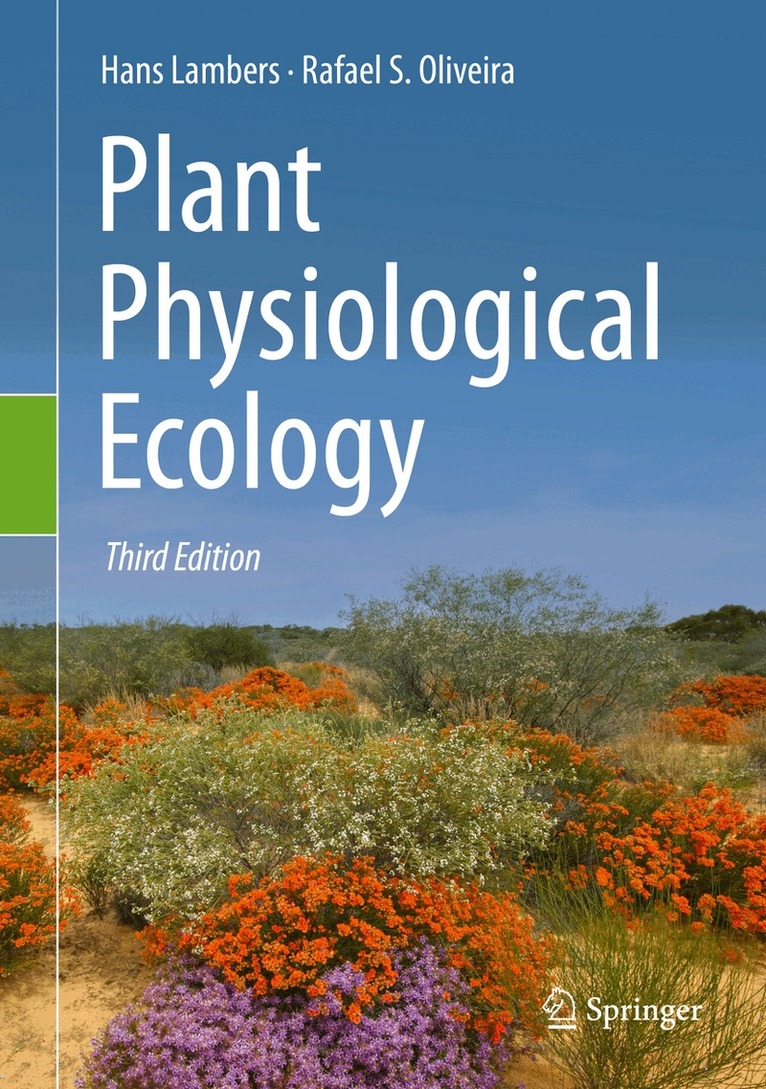
Growth, reproduction, and geographical distribution of plants are profoundly influenced by their physiological ecology: the interaction with the surrounding physical, chemical, and biological environments. This textbook highlights mechanisms that underlie plant physiological ecology at the levels of physiology, biochemistry, biophysics, and molecular biology. At the same time, the integrative power of physiological ecology is well suited to assess the costs, benefits, and consequences of modifying plants for human needs and to evaluate the role of plants in natural and managed ecosystems.Plant Physiological Ecology, Third Edition is significantly updated, with many full color illustrations, and begins with the primary processes of carbon metabolism and transport, plant water relations, and energy balance. After considering individual leaves and whole plants, these physiological processes are then scaled up to the level of the canopy. Subsequent chapters discuss mineral nutrition and the ways in which plants cope with nutrient‑deficient or toxic soils. The book then looks at patterns of growth and allocation, life‑history traits, and interactions between plants and other organisms. Later chapters deal with traits that affect decomposition of plant material and with the consequences of plant physiological ecology at ecosystem and global levels.Plant Physiological Ecology, Third Edition features several boxed entries that extend the discussions of selected issues, a glossary, and numerous references to the primary and review literature. This significant new text is suitable for use in plant ecology courses, as well as classes ranging from plant physiology to plant molecular biology.
747 kr
Skickas inom 10-15 vardagar
Growth, reproduction, and geographical distribution of plants are profoundly influenced by their physiological ecology: the interaction with the surrounding physical, chemical, and biological environments. This textbook highlights mechanisms that underlie plant physiological ecology at the levels of physiology, biochemistry, biophysics, and molecular biology. At the same time, the integrative power of physiological ecology is well suited to assess the costs, benefits, and consequences of modifying plants for human needs and to evaluate the role of plants in natural and managed ecosystems.Plant Physiological Ecology, Third Edition is significantly updated, with many full color illustrations, and begins with the primary processes of carbon metabolism and transport, plant water relations, and energy balance. After considering individual leaves and whole plants, these physiological processes are then scaled up to the level of the canopy. Subsequent chapters discuss mineral nutrition and the ways in which plants cope with nutrient‑deficient or toxic soils. The book then looks at patterns of growth and allocation, life‑history traits, and interactions between plants and other organisms. Later chapters deal with traits that affect decomposition of plant material and with the consequences of plant physiological ecology at ecosystem and global levels.Plant Physiological Ecology, Third Edition features several boxed entries that extend the discussions of selected issues, a glossary, and numerous references to the primary and review literature. This significant new text is suitable for use in plant ecology courses, as well as classes ranging from plant physiology to plant molecular biology.
1 064 kr
Skickas inom 10-15 vardagar
This book will appeal to an international audience as well as be irresistible to local readers. Anyone working or with an interest in Australia’s arid zone should need ready access to this book. There is no equivalent publication out there at the moment, and this book has many authoritative chapters, richly illustrated with colourful material.The challenge of this book was to assemble current knowledge on particular topics and concepts, and principles relating to them. It is also forward-looking by identifying where there are gaps or inadequacies in knowledge, and where future research needs to be directed. Lead authors were encouraged to take such an approach; they had the opportunity to involve any author they considered appropriate. The final product shouldbe a fabulous resource, also for university courses, especially at MSc level.
2 100 kr
Skickas inom 10-15 vardagar
Respiration in plants, as in all living organisms, is essential to provide metabolic energy and carbon skeletons for growth and maintenance. As such, respiration is an essential component of a plant’s carbon budget. Depending on species and environmental conditions, it consumes 25-75% of all the carbohydrates produced in photosynthesis – even more at extremely slow growth rates. Respiration in plants can also proceed in a manner that produces neither metabolic energy nor carbon skeletons, but heat. This type of respiration involves the cyanide-resistant, alternative oxidase; it is unique to plants, and resides in the mitochondria. The activity of this alternative pathway can be measured based on a difference in fractionation of oxygen isotopes between the cytochrome and the alternative oxidase. Heat production is important in some flowers to attract pollinators; however, the alternative oxidase also plays a major role in leaves and roots of most plants. A common thread throughout this volume is to link respiration, including alternative oxidase activity, to plant functioning in different environments.
1 577 kr
Skickas inom 10-15 vardagar
In the last decade, enormous progress has been made on the physiology of plant roots, including on a wide range of molecular aspects. Much of that progress has been captured in the chapters of this book. Breakthroughs have been made possible through integration of molecular and whole-plant aspects. The classical boundaries between physiology, biochemistry and molecular biology have vanished. There has been a strong focus on a limited number of model species, including Arabidopsis thaliana. That focus has allowed greater insight into the significance of specific genes for plant development and functioning. However, many species are very different from A. thaliana, in that they are mycorrhizal, develop a symbiosis with N2-fixing microsymbionts, or have other specialised root structures. Also, some have a much greater capacity to resist extreme environments, such as soil acidity, salinity, flooding or heavy-metal toxicities, due to specific adaptations. Research on species other than A. thaliana is therefore pivotal, to develop new knowledge in plant sciences in a comprehensive manner. This fundamental new knowledge can be the basis for important applications in, e.g., agriculture and plant conservation. Although significant progress has been made, much remains to be learnt. It is envisaged that discoveries made in the recent past will likely lead to major breakthroughs in the next decade.