
Hans Moravec – författare
Visar alla böcker från författaren Hans Moravec. Handla med fri frakt och snabb leverans.
2 produkter
2 produkter
300 kr
Skickas inom 5-8 vardagar
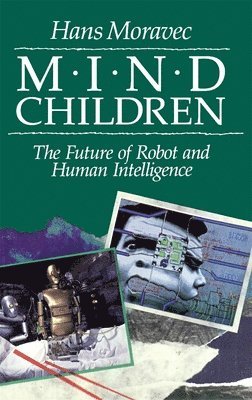
Imagine attending a lecture at the turn of the twentieth century in which Orville Wright speculates about the future of transportation, or one in which Alexander Graham Bell envisages satellite communications and global data banks. Mind Children, written by an internationally renowned roboticist, offers a comparable experience—a mind-boggling glimpse of a world we may soon share with our artificial progeny. Filled with fresh ideas and insights, this book is one of the most engaging and controversial visions of the future ever written by a serious scholar.Hans Moravec convincingly argues that we are approaching a watershed in the history of life—a time when the boundaries between biological and postbiological intelligence will begin to dissolve. Within forty years, Moravec believes, we will achieve human equivalence in our machines, not only in their capacity to reason but also in their ability to perceive, interact with, and change their complex environment. The critical factor is mobility. A computer rooted to one place is doomed to static iterations, whereas a machine on the prowl, like a mobile organism, must evolve a richer fund of knowledge about an ever-changing world upon which to base its actions.In order to achieve anything near human equivalence, robots will need, at the least, the capacity to perform ten trillion calculations per second. Given the trillion-fold increase in computational power since the end of the nineteenth century, and the promise of exotic technologies far surpassing the now-familiar lasers and even superconductors, Moravec concludes that our hardware will have no trouble meeting this forty-year timetable.But human equivalence is just the beginning, not an upper bound. Once the tireless thinking capacity of robots is directed to the problem of their own improvement and reproduction, even the sky will not limit their voracious exploration of the universe. In the concluding chapters Moravec challenges us to imagine with him the possibilities and pitfalls of such a scenario. Rather than warning us of takeover by robots, the author invites us, as we approach the end of this millennium, to speculate about a plausible, wonderful postbiological future and the ways in which our minds might participate in its unfolding.
856 kr
Skickas inom 7-10 vardagar
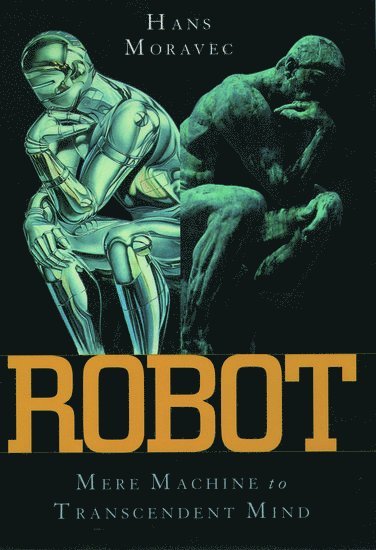
Machines will attain human levels of intelligence by the year 2040, predicts robotics expert Hans Moravec. And by 2050, they will have far surpassed us.In this mind-bending new book, Hans Moravec takes the reader on a roller coaster ride packed with such startling predictions. He tells us, for instance, that in the not-too-distant future, an army of robots will displace workers, causing massive, unprecedented unemployment. But then, says Moravec, a period of very comfortable existence will follow, as humans benefit from a fully automated economy. And eventually, as machines evolve far beyond humanity, robots will supplant us. But if Moravec predicts the end of the domination by human beings, his is not a bleak vision. Far from railing against a future in which machines rule the world, Moravec embraces it, taking the startling view that intelligent robots will actually be our evolutionary heirs. "Intelligent machines, which will grow from us, learn our skills, and share our goals and values, can be viewed as children of our minds." And since they are our children, we will want them to outdistance us. In fact, in a bid for immortality, many of our descendants will choose to transform into "ex humans," as they upload themselves into advanced computers. We will become our children and live forever.In his provocative new book, the highly anticipated follow-up to his bestselling volume Mind Children, Moravec charts the trajectory of robotics in breathtaking detail. A must read for artificial intelligence, technology, and computer enthusiasts, Moravec's freewheeling but informed speculations present a future far different than we ever dared imagine.