Hans-Peter Kohler - Böcker
Visar alla böcker från författaren Hans-Peter Kohler. Handla med fri frakt och snabb leverans.
8 produkter
8 produkter
1 705 kr
Skickas inom 5-8 vardagar
Considerable controversy exists among demographers, economists, and sociologists over the causes of fertility change in developing and developed countries. The neoclassical economic approach to fertility is embraced by its supporters because it facilitates the application of sophisticated consumer and household production theory to one of the most private and intimate questions: a couple's reproductive behavior. Despite the theoretical appeal of the economic approach, it has been eschewed by many critics because of its lack of social and institutional context, its neglect of cultural factors, and its requirement of 'rationality'. The integration of social interaction with economic fertility models in this book emerges as a powerful tool to overcome many of these criticisms. First, the analysis provides a formal integration of economic, sociological, and other approaches to fertility, and shows that there is a useful and promising agenda at the intersection of these schools. The second and more important goal is to sharpen the analytic lens with which theorists from different schools investigate fertility. For economists the work shows the advantages of moving beyond individual decision-making and embedding fertility decisions in a 'local environment' with interpersonal information flows, 'atmospheric' or social externalities, norms, and customs. For sociologists the work shows that theorizing about interactions within social networks can be more sophisticated. The implications of social networks depend substantially on the specific contexts and stages of the demographic transition, and these differences can be used to empirically distinguish between social learning and social influence. Thirdly, the findings have important implications for population policy. The analyses in this book indicate when family planning is likely to diffuse and lead to rapid adoption of birth control, and they derive conditions where Pareto-improving policy measures are likely to exist.
1 092 kr
Skickas inom 10-15 vardagar
This text takes an interdisciplinary look at the subjects of fertility and reproduction. Key topics include: anorexia as a reproductive disease with evolutionary origins; the evolutionary basis of menarche; the familial (genetic) basis of having boys versus girls; twin fertility; and extramarital childbearing. This book is for advanced level students and researchers who study human reproduction and fertility.
1 061 kr
Skickas inom 10-15 vardagar
The counterfactual approach to estimate effects of causes from quasi-experimental data or from observational studies was first proposed by Rubin in 1974 and further developed by James Heckman and others.This book presents both theoretical contributions and empirical applications of the counterfactual approach to causal inference.
1 092 kr
Skickas inom 10-15 vardagar
Miller Published by Kluwer Academic Press, 2000 The Biodemography of Human Reproduction and Fertility Edited by Joseph Lee Rodgers & Hans-Peter Kohler Published by Kluwer Academic Press, 2002 The series has published chapters by researchers who study human fertility, from a particular perspective: Biodemography.
Grundlagen der Bewertung von Optionen und Optionsscheinen
Darstellung und Anwendung der Modelle von Boness, Black-Scholes, Galai-Schneller und Schulz-Trautmann-Fischer
Häftad, Tyska, 2012
565 kr
Skickas inom 10-15 vardagar
Del 23 - Springer Series on Demographic Methods and Population Analysis
Causal Analysis in Population Studies
Concepts, Methods, Applications
Häftad, Engelska, 2010
1 061 kr
Skickas inom 10-15 vardagar
The counterfactual approach to estimate effects of causes from quasi-experimental data or from observational studies was first proposed by Rubin in 1974 and further developed by James Heckman and others.This book presents both theoretical contributions and empirical applications of the counterfactual approach to causal inference.
Del 5 - Understanding Population Trends and Processes
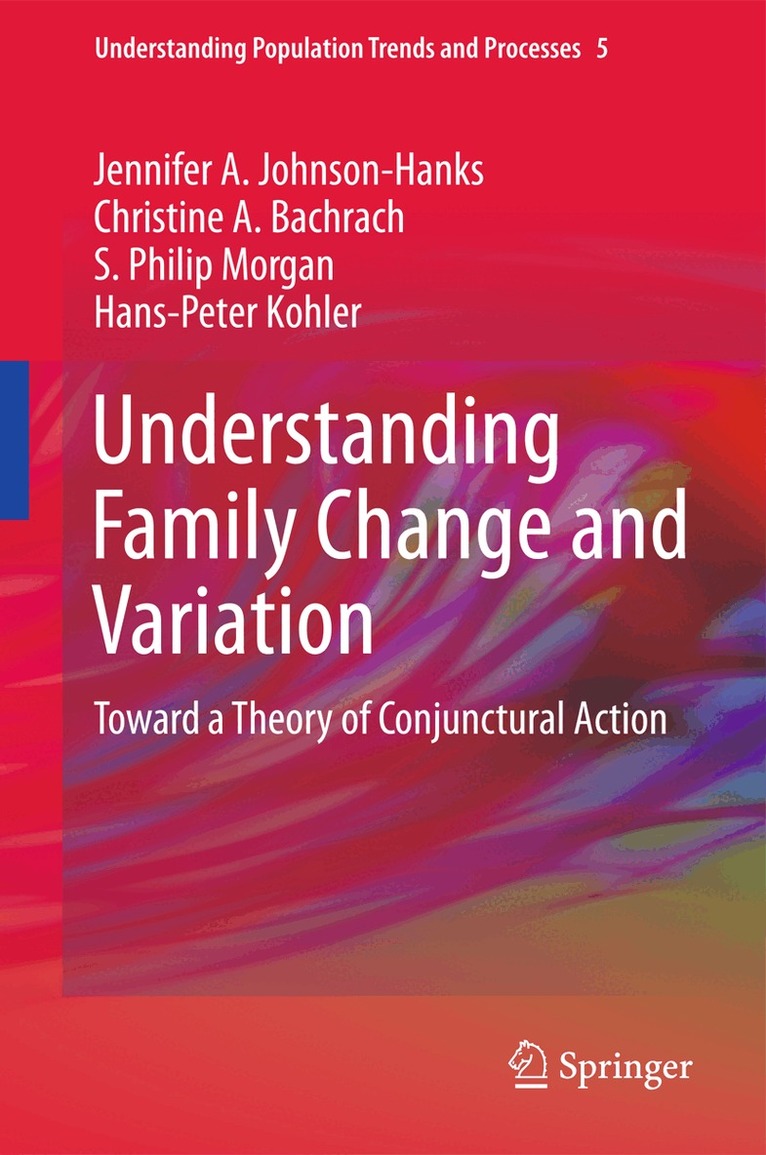
Understanding Family Change and Variation
Toward a Theory of Conjunctural Action
Inbunden, Engelska, 2011
1 061 kr
Skickas inom 10-15 vardagar
Fertility rates vary considerably across and within societies, and over time. Over the last three decades, social demographers have made remarkable progress in documenting these axes of variation, but theoretical models to explain family change and variation have lagged behind. At the same time, our sister disciplines—from cultural anthropology to social psychology to cognitive science and beyond—have made dramatic strides in understanding how social action works, and how bodies, brains, cultural contexts, and structural conditions are coordinated in that process. Understanding Family Change and Variation: Toward a Theory of Conjunctural Action argues that social demography must be reintegrated into the core of theory and research about the processes and mechanisms of social action, and proposes a framework through which that reintegration can occur. This framework posits that material and schematic structures profoundly shape the occurrence, frequency, and context of the vital events that constitute the object of social demography. Fertility and family behaviors are best understood as a function not just of individual traits, but of the structured contexts in which behavior occurs. This approach upends many assumptions in social demography, encouraging demographers to embrace the endogeneity of social life and to move beyond fruitless debates of structure versus culture, of agency versus structure, or of biology versus society.
Del 5 - Understanding Population Trends and Processes
Understanding Family Change and Variation
Toward a Theory of Conjunctural Action
Häftad, Engelska, 2013
1 061 kr
Skickas inom 10-15 vardagar
This approach upends many assumptions in social demography, encouraging demographers to embrace the endogeneity of social life and to move beyond fruitless debates of structure versus culture, of agency versus structure, or of biology versus society.